Lying Air Punch
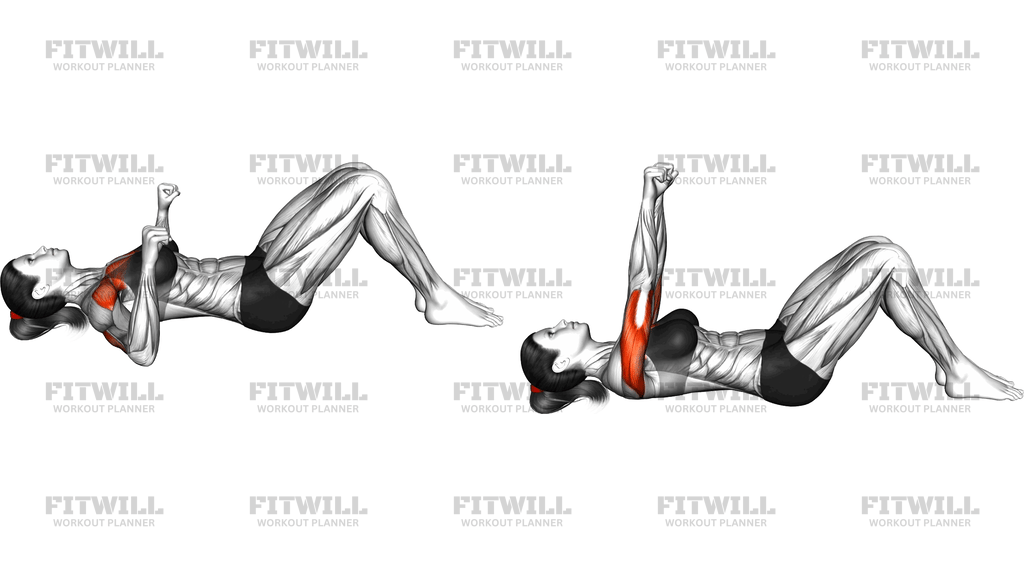
The Lying Air Punch is a bodyweight pressing exercise performed on your back with your knees bent and feet flat on the floor. Instead of pressing a weight, you punch your fists straight up toward the ceiling, alternating arms, so one arm extends fully while the other stays bent near your chest. Because there is no external load, the resistance comes entirely from the speed and control of your own arm movement, making it an easy-entry exercise that still challenges the pressing muscles.
The main work is done by the triceps, which straighten the elbow on every punch, with the chest and front shoulders helping to drive the arm up from the bent position. Your core stays quietly busy the whole time: holding your ribcage down and your lower back close to the floor while one arm reaches and the other recoils takes real trunk control. The bent-knee setup also keeps the hips neutral so the effort stays in the upper body rather than drifting into the lower back.
This movement suits beginners who want to learn the pressing pattern before touching weights, people recovering general training rhythm after time off, and anyone warming up the shoulders and elbows before a bench or push-up session. It is also a low-impact option for home workouts where no equipment is available, and for older or deconditioned trainees who need joint-friendly upper-body work.
Setup matters more than it looks. Lie fully back with your head relaxed, knees bent, and feet flat about hip-width apart. Keep the fists loose rather than clenched tight, and aim both punches at a point directly above the chest, not the face or the knees. Aiming straight up keeps the shoulder in a safe track and stops the elbow from flaring wide.
To execute well, brace your midsection lightly, exhale as one arm punches up to a full but not locked-out extension, and pull that arm back down with control while the other drives up. The rhythm should feel like alternating piston strokes rather than two arms moving together. Start with a moderate tempo you can hold cleanly, then build speed only when the elbows stay steady and the torso stays still.
A few practical points keep this safe and effective. Do not slam the elbow into full lockout at the top, and do not let the lower back arch off the floor as you speed up. If your neck strains to watch your hands, rest your head back and let your arms work in your peripheral vision. Stop the set when your punching rhythm breaks down rather than pushing through sloppy reps.
[ Workout Log & Planner ]
Put your next workout in Fitwill
Keep your plan and training log ready when you are.


Instructions
- Lie on your back on a mat or the floor with your knees bent and your feet flat on the ground about hip-width apart.
- Bend your elbows and bring both fists up beside your chest, knuckles facing forward, with your upper arms resting lightly against your sides.
- Brace your abs gently and press your lower back toward the floor so your ribcage does not flare up.
- Punch one fist straight up toward the ceiling until the arm is extended, keeping the elbow tracking upward rather than flaring out.
- As the first arm reaches the top, immediately begin driving the opposite fist up while pulling the first arm back to your chest.
- Continue alternating at a steady rhythm, aiming every punch at the same point directly above your chest.
- Exhale on each punch upward and inhale naturally as the arms trade positions.
- Keep the movement in your arms and shoulders; resist letting your head lift, your torso twist, or your hips shift side to side.
- Finish your set by bringing both fists back to your chest, lowering your arms, and letting your shoulders settle flat on the floor before standing up.
Tips & Tricks
- Aim every punch at a fixed spot on the ceiling above your chest; if your fists drift toward your face or across your body, reset your shoulder position before continuing.
- Stop each punch just short of a hard elbow lockout. Snapping into full extension with no load behind it is the most common reason elbows get cranky on this drill.
- If your lower back arches as you speed up, shorten the range slightly and slow the tempo; the arch means your abs have stopped controlling your ribcage.
- Keep your fists loose. Clenching hard for a whole set tenses your forearms and neck without adding anything to the training effect.
- Speed is a tool, not the goal. Earn faster rounds by keeping your torso silent first; a twisting torso means the punches are pulling you out of position.
- Your shoulders should stay flat on the floor. If one side lifts as you punch, you are reaching too far across your midline.
- Use this as a warm-up before presses or push-ups with two or three rounds of twenty to thirty seconds, or as a standalone set of 30 to 60 seconds for muscular endurance.
- If lying flat bothers your neck or you feel pressure in your head, place a thin cushion under your head and keep your gaze straight up rather than tracking your hands.
Frequently Asked Questions
What muscles does the Lying Air Punch work?
The triceps do most of the work straightening the elbow on each punch, with the chest and front shoulders assisting the drive. The core works isometrically to keep your ribcage and torso steady while the arms alternate.
Is the Lying Air Punch good for beginners?
Yes. With no external load and the floor supporting your back, it is one of the safest ways to learn the pressing pattern and build elbow and shoulder rhythm before progressing to push-ups or weighted presses.
Why lie on your back to punch instead of standing?
Lying down removes balance demands and support from the legs, so you can focus purely on the arm extension path and keeping the trunk stable. It also makes the drill accessible if standing or impact work is not appropriate for you.
Should my punches go straight up or toward the opposite side?
Punch straight up toward the ceiling above your chest. Crossing toward the opposite shoulder twists your torso and flares the elbow, which reduces control and puts the shoulder in a less stable path.
How fast should I do the Lying Air Punch?
Start at a moderate, controlled pace where your torso stays completely still. Once your form holds, you can increase speed for conditioning, but a fast, sloppy rhythm trains nothing useful.
Can I use the Lying Air Punch as a warm-up?
Absolutely. Two or three short rounds before bench pressing, push-ups, or boxing work raise blood flow in the shoulders and elbows and rehearse the extension pattern without fatiguing the muscles.
My lower back lifts off the floor when I speed up. How do I fix it?
Slow down, brace your abs as if bracing for a light tap to the stomach, and make sure your feet are planted close enough that your knees stay bent. If the arch persists, reduce the range of each punch until control returns.
What can I do instead of the Lying Air Punch?
Standing shadowboxing trains a similar alternating punch pattern with more balance demand, while slow controlled push-ups or light dumbbell floor presses load the same pressing muscles more heavily. Choose based on whether you want speed work or strength work.
How many reps should I do?
Because the resistance is light, count time rather than reps: 20 to 40 seconds per set for warm-ups, or 30 to 60 seconds for two to four sets when training muscular endurance.