Kneeling External Rotation
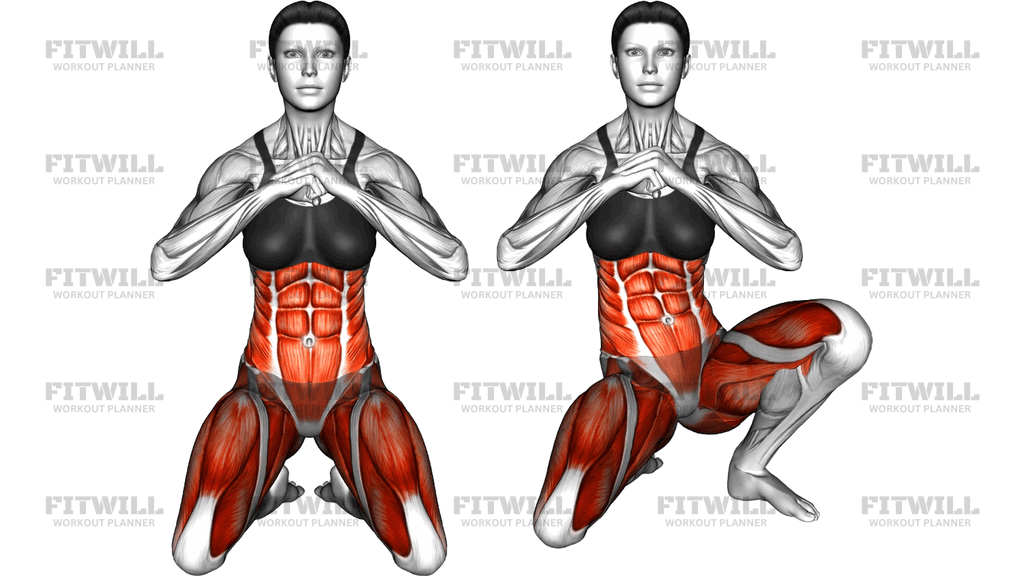
Kneeling External Rotation is a bodyweight mobility drill that takes the hip joint through deliberate outward rotation while you stay anchored in a kneeling position. You begin in a tall kneel with your hands interlaced at chest height, then shift your weight and bring one leg out to the side with the thigh rotated outward and the foot planted, letting the front of the hip open and the outer hip muscles lengthen under control. The clasped hands at the chest are not decoration - they give you a fixed reference point that keeps your torso honest and stops you from cheating the rotation with your spine.
This movement is most useful for anyone whose hips feel tight from long hours of sitting, and for lifters who need usable hip rotation for deep squats, lunges, and single-leg work. It is also a common warm-up choice before lower-body training days and a gentle reintroduction to hip mobility for people recovering general movement quality after a sedentary stretch. Because the knee stays bent and loaded only by your own bodyweight, the drill is easy to scale - you control the depth simply by how far you lean into the position.
The primary work happens at the hip: the external rotators and glute region on the working leg control the rotation, while the outer hip tissue on that same side gets a controlled stretch as the thigh turns out. Meanwhile the kneeling leg and your trunk do quiet but real work - your core braces to keep the ribcage stacked over the pelvis, and the quadriceps and hip area of the kneeling leg stabilize you throughout. That combination of mobility in one hip and stability in the rest of the body is exactly what makes the drill transfer to squatting and lunging patterns.
Setup matters more than range here. A tall, upright torso with hands clasped at the sternum forces the rotation to come from the hip socket rather than from twisting your lower back or letting the pelvis collapse. If you allow the spine to rotate instead, the hip barely moves and you lose the point of the exercise. Keep the kneeling knee tracking straight ahead and let the moving leg do the traveling.
To execute it well, move slowly into the rotated position, pause briefly when you feel a moderate stretch through the outer hip, and return with the same control you used going out. Two or three rounds per side before training, or as a standalone mobility break, is usually enough. Never force the knee or bounce at end range - the hip responds far better to patient, repeated exposure than to aggressive pushing, and any sharp pinching at the front of the hip is a signal to reduce depth rather than grind through it.
[ Workout Log & Planner ]
Put your next workout in Fitwill
Keep your plan and training log ready when you are.


Instructions
- Kneel on the floor or an exercise mat with your knees about hip-width apart and your shins resting on the ground behind you.
- Sit up tall so your shoulders stack over your hips, then interlace your fingers and hold both hands together at chest height with your elbows pointing out to the sides.
- Brace your abdominal muscles lightly to lock your ribcage over your pelvis before you start moving.
- Shift your weight toward one side and lift that knee off the floor, rotating the thigh outward so the knee travels out and away from your midline.
- Plant that foot on the floor out to the side with the knee bent, letting the hip open into external rotation while your hands stay clasped at your chest.
- Lean your torso gently toward the planted foot until you feel a moderate stretch through the outer hip and glute area, keeping your back knee and shin in contact with the floor.
- Hold the rotated position for a slow breath or two, keeping the torso upright and avoiding any twist through the lower back.
- Exhale as you press back to the tall kneeling position, drawing the leg back under your hips with control rather than letting it snap back.
- Complete your repetitions on one side, then switch legs and repeat the same rotation and return on the other side.
Tips & Tricks
- If you feel a pinch at the front of the moving hip instead of a stretch at the outer hip, reduce how far you lean in - the pinching usually means you have driven past your current rotation range.
- Watch that your hands stay anchored at the sternum. When people reach or drift forward with the arms, the torso rounds and the rotation leaks out of the hip.
- Do not let the kneeling knee roll inward as you shift your weight; keep its kneecap pointing straight ahead so the stabilizing leg does the supporting job properly.
- The rotation should feel like it comes from the hip socket. If your belt line or shoulders are turning instead, you are substituting spine motion for hip motion - square the chest forward and accept a smaller range.
- Keep your glutes and core gently engaged rather than hanging into your joints. An active brace lets you control the end range instead of collapsing into it.
- Slow the return phase down deliberately. Most people rush back to the start, which skips the controlled loading of the external rotators on the way out of the stretch.
- If the floor is hard on your kneeling knee or shin, place a folded mat or pad under it - discomfort there will make you tilt and twist to escape the pressure.
- Aim for a stretch you could breathe through for a full breath. If you are holding your breath or grimacing, back off the depth; forcing external rotation rarely speeds up progress.
Frequently Asked Questions
What does the Kneeling External Rotation primarily work?
It targets the hip external rotators and glute area of the moving leg while the outer hip tissues lengthen. The kneeling side and your core work isometrically to keep you stable and upright.
Why are the hands clasped at the chest during this exercise?
The clasped hands give your torso a fixed reference point so the rotation comes from the hip instead of the spine. They also help with balance as you shift your weight onto one knee.
Is the Kneeling External Rotation suitable for beginners?
Yes, as long as you limit the depth to a comfortable stretch and move slowly. Beginners often have limited rotation, so a smaller range performed with an upright torso is more productive than forcing the leg far out to the side.
Should I feel this in my lower back?
No, the sensation should stay around the outer hip and glute of the rotating leg. If your lower back is twisting or working, square your chest to the front and shorten the range until the movement comes purely from the hip.
Can the Kneeling External Rotation help my squat depth?
It can support better squat positioning because external rotation is part of what lets the hips sit down between the feet in a deep squat. Use it as a warm-up before lower-body sessions rather than expecting one session to change your mobility.
What is the most common mistake in this exercise?
Letting the pelvis and lower back rotate instead of the hip, usually paired with leaning the chest forward. Keeping the hands at the sternum and the torso tall corrects both at once.
What can I use instead if kneeling hurts my knees?
A padded mat or folded towel under the kneeling knee usually solves it. If kneeling still bothers you, a seated hip external rotation stretch with one ankle across the opposite knee trains a similar range without floor pressure on the shins.
How long should I hold the rotated position?
One to two slow breaths per repetition works well, for roughly two to three rounds per side. Longer static holds are fine as a standalone stretch, but for a warm-up keep the transitions moving.
Is it safe to push deeper into the stretch for faster progress?
No, forcing end range, especially with bouncing, tends to make the hip guard and tighten rather than open. Progress comes from repeating a moderate, breathable range consistently over weeks.