Sitting Knee Raise On A Stability Ball
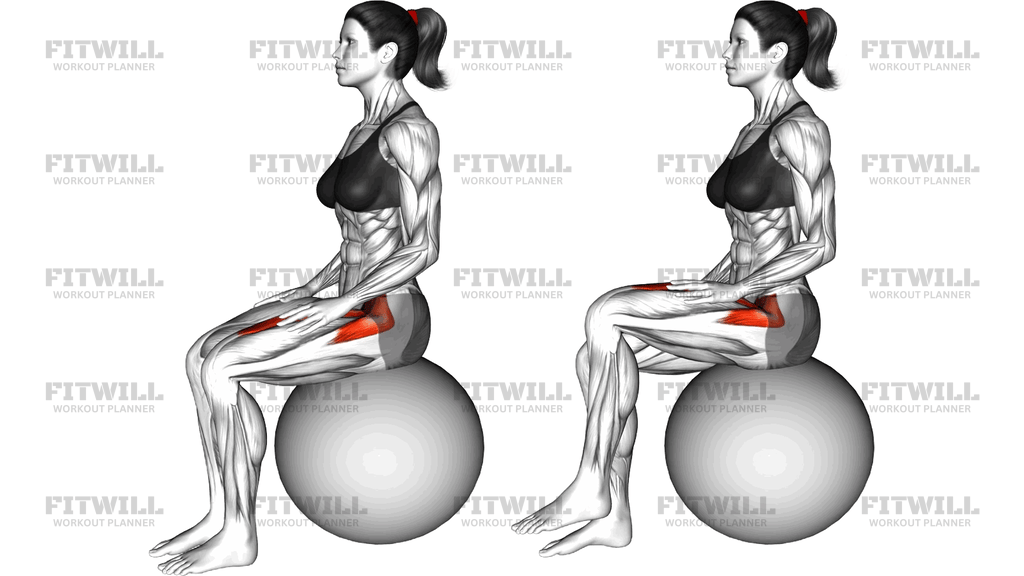
The Sitting Knee Raise On A Stability Ball is a seated core and hip flexor drill where you perch upright on an exercise ball and lift one knee toward your chest at a time. Because the ball gives under you with every movement, your trunk has to work the entire time just to keep you centered, which makes a simple knee lift considerably more demanding than it looks. The muscles highlighted in this movement sit at the front of the hip, mainly the iliopsoas group, with the quadriceps on the front of the thigh assisting as the knee travels upward.
This exercise suits people who want a gentle but genuine hip flexor and core challenge without loading the spine with weight. It is a good fit for beginners learning to sit tall on a ball, for desk workers whose hip flexors feel sluggish from long sitting, and for anyone using a stability ball in rehab-style or low-impact training where controlled, supported movement is preferred. More experienced lifters can also use it as a warm-up drill before squats or hanging leg work to wake up the hip flexors.
Setup matters more here than in most seated movements. Sit on the ball with your feet flat on the floor roughly hip-width apart, knees bent close to ninety degrees, and your torso tall. If the ball is too small your knees ride above your hips and the lift loses range; if it is too large you sink and round your lower back. Choose a size that lets you sit with your thighs roughly parallel to the floor, and place your hands lightly on your thighs so they can sense the movement without doing the work for you.
To perform the raise, brace your trunk, then lift one knee up toward your chest while keeping your foot relaxed and your torso upright. The ball will want to roll backward under you as the leg rises, so a small counter-pressure through the planted foot keeps it steady. Pause briefly at the top, lower the foot back to the floor with control, and repeat on the other side, alternating legs for repetitions or completing all reps on one side before switching.
Keep the movement deliberate rather than bouncy. A common error is leaning the chest back and turning the lift into a torso crunch, or letting the ball drift forward as the knee comes up. Think of your head and shoulders staying stacked over your hips while only the thigh moves. Slow tempo and a honest pause at the top do more for this exercise than speed ever will.
In practice, use two to three sets of ten to fifteen lifts per side, either as a standalone core session on the ball or as part of a longer stability circuit. Because you are seated and supported, the exercise is easy to scale: lift the knee a few inches for an easier version, or raise it fully toward the chest and hold for two to three seconds for a harder one. Stop the set if you start rolling noticeably on the ball or feel strain in the lower back rather than the front of the hip.
[ Workout Log & Planner ]
Put your next workout in Fitwill
Keep your plan and training log ready when you are.


Instructions
- Sit centered on a stability ball with your feet flat on the floor, hip-width apart, and your knees bent to roughly ninety degrees so your thighs are near parallel to the floor.
- Reach your spine up tall, stack your shoulders over your hips, and rest your hands lightly on your thighs near the knees.
- Draw your lower belly in gently and press both feet into the floor to steady the ball before you move.
- Shift a small amount of weight into one foot so it anchors the ball on that side.
- Lift your opposite knee up toward your chest, letting the thigh rise while your torso stays upright and your head stays level.
- Stop when the knee is as high as you can bring it without leaning your chest back or rounding your lower back, and hold the top for one to two seconds.
- Lower the foot back to the floor under control, feeling the front of the hip lengthen rather than dropping the leg.
- Exhale as you lift the knee and inhale as you lower it back to the floor.
- Repeat on the same leg for your target reps, or alternate legs rep by rep, re-centering yourself on the ball between sides if it has rolled.
- After your set, place both feet down, breathe normally, and reset your tall seated posture before starting the next set.
Tips & Tricks
- If the ball keeps rolling backward as the knee lifts, push slightly harder through the heel of the planted foot — that foot is your brake.
- Avoid turning the lift into a torso crunch; if your chest is falling back toward the ball, reduce the lift height and rebuild with a shorter range.
- Hands belong on the thighs for light guidance only. If you find yourself pressing hard on your leg to hoist it up, the hip flexors are not doing the work, so lighten the effort and lift slower.
- Keep the lifted foot loose. Clenching the foot and pointing the toes usually means you are tensing the whole leg instead of moving cleanly from the hip.
- A ball that is slightly under-inflated is easier to control; a firm ball rolls more and raises the balance demand, so adjust inflation to match your ability.
- Watch your lower back at the top of the lift — if it tucks under or rounds, you have gone past your available hip range and should stop a little earlier.
- Exhaling on the lift is not cosmetic; the breath helps brace the trunk so the ball does not push you around as the leg rises.
- Alternate sides only when you can keep the ball still between reps. If the ball wanders, finish all reps on one side, reset, then do the other.
- If your hip crease pinches at the top, lower the knee a few degrees instead of forcing the range, and let flexibility improve over sessions.
Frequently Asked Questions
What muscles does the Sitting Knee Raise On A Stability Ball work?
The primary work is done by the hip flexors at the front of the hip, especially the iliopsoas, with the quadriceps assisting as the knee rises. Your abdominals and deep trunk muscles work continuously to keep you balanced on the ball.
Is the Sitting Knee Raise On A Stability Ball suitable for beginners?
Yes, it is one of the friendlier ball exercises to start with because you are seated and close to the floor. Beginners can lift the knee only a few inches at first and increase the height as balance improves.
How high should I lift my knee during this exercise?
Lift as high as you can while keeping your chest tall and the ball still. If your lower back rounds or your torso leans back at the top, you have lifted past your current range.
Why do I keep rolling backward on the ball when I lift my knee?
The rising leg shifts your center of gravity, so the ball rolls away from it. Anchor the movement by pressing your opposite foot firmly into the floor and keeping a slight forward lean at the start of each lift.
What size stability ball should I use for the Sitting Knee Raise?
Pick a ball that lets you sit with your thighs roughly parallel to the floor and knees near ninety degrees. For most people that is a 55 to 65 centimeter ball, adjusted for height.
Should I alternate legs or do all reps on one side?
Both work. Alternating keeps the ball easier to control and feels rhythmical, while finishing one side first gives a more focused challenge to each hip flexor — choose based on how stable you feel.
Can I substitute the Sitting Knee Raise On A Stability Ball with a regular seated knee lift on a bench?
You can, but a fixed bench removes the balance demand that makes the ball version valuable. If you do not have a ball, a sturdy chair works as a stepping stone until your trunk control is ready.
Is it normal to feel this more in the hip crease than in the abs?
Yes, because the moving action is hip flexion, the front of the hip is the main mover. The abdominal work is a stabilizing effort, so it feels more like constant bracing than a burn.
Are there any safety concerns with this exercise?
Make sure the ball is properly inflated and placed on a non-slip surface, and stay within a range where you keep contact and control. If you feel lower back strain instead of work at the front of the hip, reduce the lift height and slow the tempo.