Bodyweight Standing Pec Dec
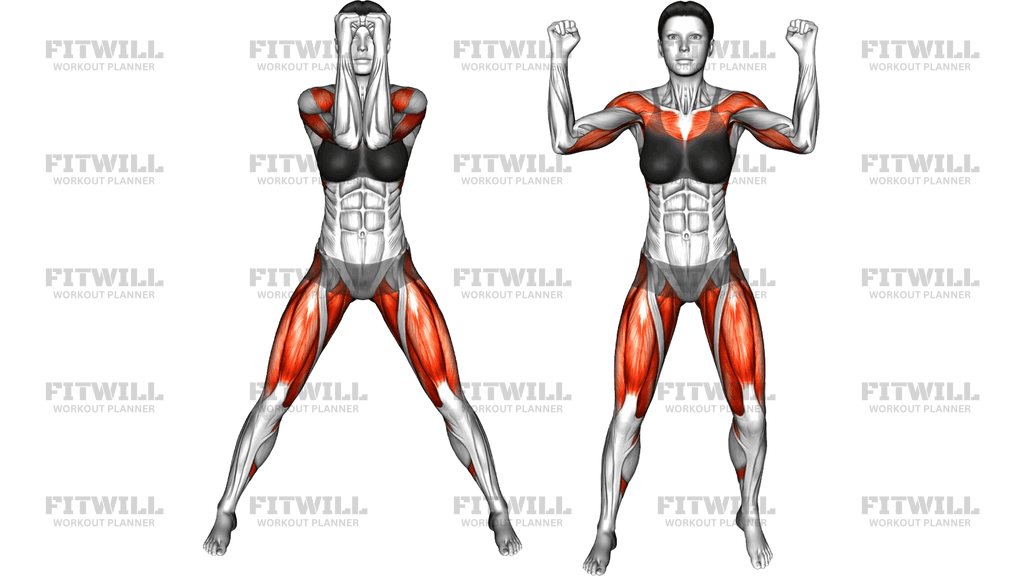
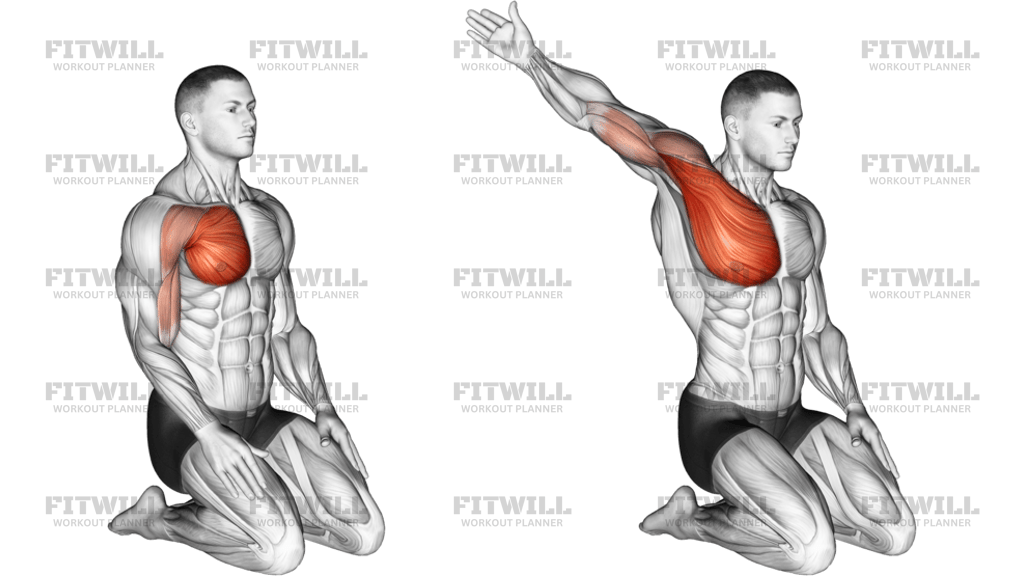
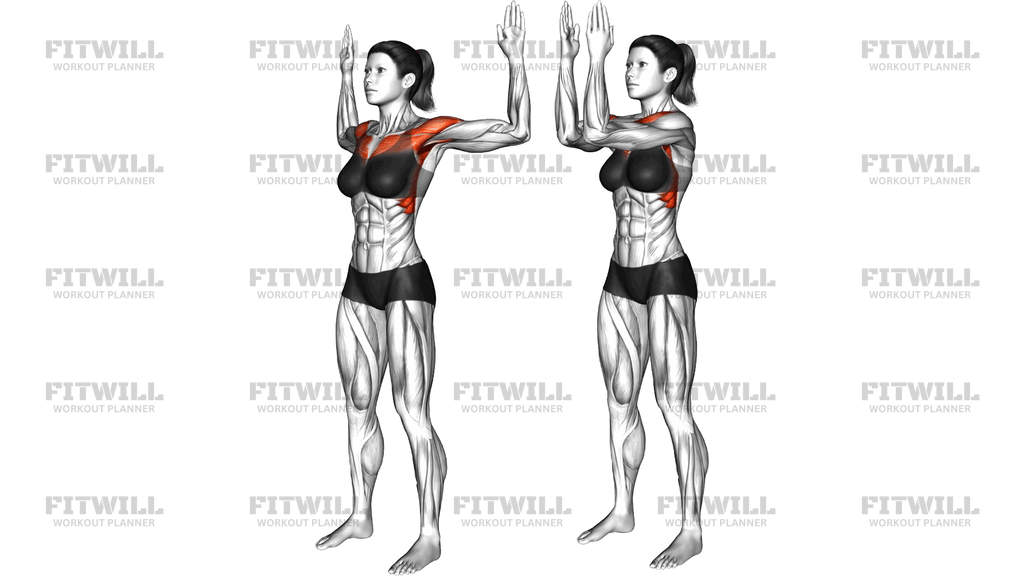
The Bodyweight Standing Pec Dec is a chest isolation movement that mimics the arm path of a machine pec deck fly, using nothing but your own muscular effort to create the squeezing action. You stand tall, raise your upper arms out to the sides, bend your elbows to roughly right angles, and then bring your forearms and hands together in front of your chest before opening back out. Because there is no external load, the resistance comes from actively pressing your arms toward each other and controlling the opening phase.
This exercise suits anyone who trains at home, travels often, or wants a chest-focused movement that requires no equipment and spares the shoulder joint from heavy pressing. It is also a useful teaching tool: the fixed elbow position and horizontal arm path make it easier to feel the chest contracting across the midline, which many lifters struggle to sense during presses and push-ups. Beginners can use it to learn what a chest squeeze should feel like, while more experienced lifters can use it as a high-repetition finisher or a warm-up activation drill.
The primary muscles worked are the pectorals, especially the sternal portion of the chest that drives horizontal adduction of the arms. The front delts assist as the arms travel forward and inward, and the muscles of the upper back and shoulder blade region work to hold the arms out wide and control the return. Because you are standing, your core and legs also contribute quietly by keeping your torso upright and stable while your arms move.
Setup matters more than it might seem. Keep your elbows at a consistent height and angle throughout, close to shoulder level, and keep your palms facing forward in the open position. If your elbows drift up, down, or backward, the work shifts away from the chest and toward the shoulders and neck. A stable, upright torso with the chest lifted gives the pecs the best line of pull across the front of the shoulder.
To perform it well, imagine your hands are pressing against two invisible pads that you are squeezing together. Bring the forearms and hands fully together in front of your face or upper chest, hold the squeeze for a beat, then open your arms back out to the start position with deliberate control rather than letting gravity and momentum swing them wide.
Common use cases include home workouts with zero equipment, chest activation before pressing, post-rehab routines where load needs to stay minimal, and adding extra chest volume at the end of a session without fatiguing the elbows or lower back. Move slowly, prioritize the squeeze over speed, and treat the return phase as its own repetition.
[ Workout Log & Planner ]
Put your next workout in Fitwill
Keep your plan and training log ready when you are.


Instructions
- Stand with your feet roughly hip-width apart, weight balanced over the whole foot, and your torso upright with the chest lifted and shoulders relaxed away from the ears.
- Raise both arms out to the sides until your upper arms are at about shoulder height, then bend your elbows to roughly 90 degrees so your forearms point forward and upward, palms facing forward.
- Brace your core lightly and pull your shoulder blades gently down and together so your torso stays stable and does not sway as the arms move.
- Exhale and press your forearms and hands toward each other in a smooth arc, as if squeezing two invisible pads together in front of your chest.
- Continue until your forearms and hands meet in front of your face or upper chest, and actively squeeze your chest at the closed position for one to two seconds.
- Inhale as you slowly open your arms back out along the same curved path, resisting the urge to let them snap back to the wide position.
- Stop when your upper arms are back at shoulder level and your elbows remain bent at about 90 degrees, palms facing forward again.
- Keep your head neutral and eyes forward throughout; avoid jutting the chin forward as the hands come together.
- Repeat for your target repetitions, keeping the elbow height and arc identical on every rep, and reset your posture between sets.
Tips & Tricks
- Think of the movement as a hug closing inward, not as pushing your hands straight ahead; the arc should curve around the torso like the arms of a pec deck machine.
- If you cannot feel your chest working, press harder into the closing phase as if squeezing a ball between your forearms — the effort of the squeeze is what replaces the missing weight.
- Do not let your elbows drop toward your ribs as you close; keep the elbows at or slightly below shoulder height so the pecs, not the front delts alone, do the work.
- Avoid arching your lower back or leaning your torso backward as the arms come together; if you notice this, tighten your core and imagine growing slightly taller through the crown of your head.
- The most common mistake is rushing the opening phase — the wide position is where the chest is under the most tension, so take two to three counts to open your arms each rep.
- Shrugging the shoulders toward the ears is a sign the arms are too heavy to control or the range is too wide; shrink the arc slightly and keep the upper traps relaxed.
- Keep the wrists firm and palms facing forward in the open position; floppy or turned-in wrists often cause the elbows to collapse inward and change the arm path.
- Because there is no load, higher repetitions work better than low reps — aim for slow, quality reps in the 12 to 20 range, adding a pause at the squeeze once the movement feels easy.
- If one side tends to reach across faster than the other, slow the rep down and watch your hands in a mirror to keep both elbows traveling on matching arcs.
Frequently Asked Questions
What muscles does the Bodyweight Standing Pec Dec work?
It primarily targets the pectorals through horizontal adduction of the arms, with the front delts assisting on the closing phase. The upper back and shoulder stabilizers also work to hold the wide position and control the return.
How is the Bodyweight Standing Pec Dec different from a machine pec deck?
Both use a similar elbow-bent, horizontal arm arc, but the machine provides external resistance while this version relies on your own muscular effort to create the squeeze. It is lower in load but easy to do anywhere and gentle on the shoulder joint.
Is this exercise good for beginners?
Yes. It is one of the simplest ways to learn how a chest contraction feels, and because there is no external weight, the risk of overloading the shoulders or elbows is low. Beginners should focus on slow tempo and a full squeeze at the front.
Why should my elbows stay bent at 90 degrees during the Bodyweight Standing Pec Dec?
The bent-elbow position shortens the lever arm, which lets the chest do the work without heavy strain on the shoulder. If the elbows straighten or change angle mid-rep, the movement turns into a different exercise and the chest focus is lost.
How many repetitions should I do since there is no added weight?
Higher repetitions usually work better than low reps for a bodyweight movement like this. Twelve to twenty slow reps with a deliberate squeeze at the closed position is a good starting point, and you can add a pause as it gets easier.
My shoulders feel this more than my chest — what am I doing wrong?
This usually means the elbows are drifting too high or the hands are being pushed straight forward instead of following a curved arc. Lower the elbows to about shoulder height and focus on squeezing your forearms together as if wrapping around a barrel.
Can I use the Bodyweight Standing Pec Dec as a warm-up before pressing?
Yes, it works well as an activation drill before bench presses, push-ups, or dumbbell presses because it pre-fires the chest without causing fatigue. One or two sets of ten to fifteen easy reps with a light squeeze is enough.
What can I substitute if I want more resistance than bodyweight provides?
You can press a medicine ball or your palms firmly against each other while performing the same arc, or use a cable or band fly with the same elbow-bent path. Wall pushes with the forearms are another low-equipment option.
Is it safe to do this exercise every day?
For most people, yes — the movement is low-load and low-impact. If you experience any pinching or sharp discomfort at the front of the shoulder, reduce the width of the arc or the frequency of training rather than pushing through pain.