Isometric Mid Thighs Pull
The Isometric Mid Thighs Pull is a maximum-effort static pull performed against an immovable barbell, usually set at mid-thigh height inside a power rack. Instead of lifting the bar through a full range of motion, you get into your strongest pulling position and drive upward against the fixed bar for a set period of time, typically three to six seconds. Nothing visibly moves, but nearly every muscle from your calves to your upper traps is working hard underneath the surface.
This movement is a staple in strength and conditioning because it lets you train the exact position where a deadlift, clean, or Olympic lift pull is most decisive, without the recovery cost of heavy dynamic lifting. Sprinters, jumpers, weightlifters, and powerlifters use it to build rate of force development and measure strength in the power position. It is also useful for lifters who want heavy posterior chain loading while keeping spinal shear more manageable than with a heavy deadlift from the floor.
The setup matters more than most people expect. Because the bar cannot move, every bad habit in your position gets exposed immediately: if your hips are too high, your shoulders drift ahead of the bar, or your torso rounds, you will feel the effort leak away. The bar should sit at mid-thigh with arms straight, shoulders slightly over or in line with the bar, knees bent to roughly a quarter-squat, and shins close to vertical.
Execution is about intent, not travel. After a big breath and a braced trunk, you push the floor away and attempt to pull the bar upward through the ceiling with total commitment, holding that effort for the prescribed time. The strain should spread through the glutes, thighs, and entire back, with the bar pressed hard against the thighs. Exhale partly during the hold, reset your breath and posture completely between repetitions, and never ease into the pull halfway.
Because there is no eccentric phase and no bar movement, the Isometric Mid Thighs Pull is easy to program as a peak-performance tool before a heavy lifting block, a testing measure of whole-body force, or a low-fatigue strength session. Start conservatively on duration and effort, keep your torso rigid throughout, and treat every rep as a crisp, all-out effort rather than a long grind.
[ Workout Log & Planner ]
Put your next workout in Fitwill
Keep your plan and training log ready when you are.


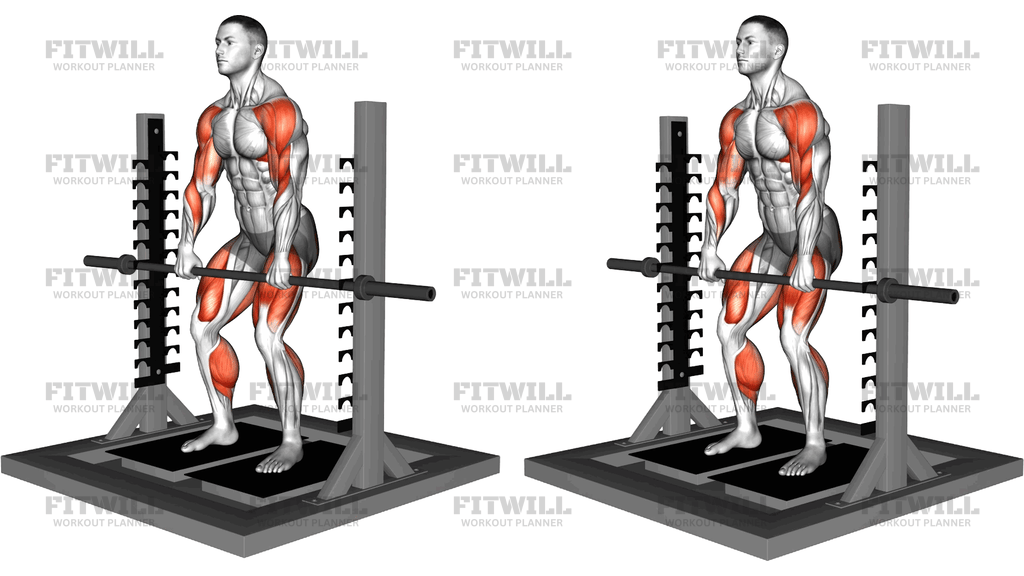
Instructions
- Set a barbell on the safety pins of a power rack at mid-thigh height, high enough that your arms hang straight down to the bar when you stand tall with a slight knee bend.
- Stand with your feet about hip-width apart, shins close to vertical, so the bar sits directly against the middle of your thighs.
- Hinge at the hips and bend the knees into a quarter-squat position, chest up, shoulders slightly over the bar, and take a firm overhand or mixed grip just outside your thighs.
- Pull the slack out of your arms, squeeze your lats to lock the bar against your legs, and set your spine in a neutral position.
- Take a deep breath into your belly and brace your core hard, as if preparing to absorb a punch.
- Drive your feet down into the floor and simultaneously attempt to pull the bar straight up through the rack, pressing the bar hard against your thighs.
- Hold that maximum effort for three to six seconds without letting your hips rise, your chest drop, or your torso round.
- Exhale in short, controlled breaths during the hold rather than releasing all your air at once.
- Stop the effort cleanly, step back from the bar, and stand up fully to release tension.
- Reset your stance, grip, and brace completely before starting the next repetition.
Tips & Tricks
- A common mistake is standing too upright with straight legs, which turns the effort into an arm and upper-back tug. Keep a quarter-squat so the glutes and thighs stay loaded.
- If the bar sits at your knees instead of mid-thigh, the pull angle shifts and your lower back takes more of the strain. Adjust the pins so the bar contacts the middle of the thighs with arms straight.
- Ease into the first rep of the session at about eighty percent effort to confirm your position, then go to full intensity. A cold, all-out yank at the bar can strain your back before you are braced.
- Watch for the hips creeping upward during the hold, which shortens the pull and shifts work away from the legs. Film a set from the side and hold your hip angle steady.
- Grip often fails before the legs do in this exercise. Use chalk or a mixed grip and focus on squeezing the bar rather than passively hanging from it.
- Keep the effort punchy and short. Once the hold stretches past six or seven seconds, peak force drops and the rep becomes a grinding strain on the lower back rather than a power stimulus.
- Do not fully exhale during the hold. Losing your brace mid-pull is the fastest way to lose your rigid torso position under maximal tension.
- Breathe and move between reps. Walking away from the bar and resetting your stance takes ten seconds and makes every rep a fresh, high-quality effort.
Frequently Asked Questions
What muscles does the Isometric Mid Thighs Pull work?
It is a whole-body pull, but the main drivers are the glutes, quads, and hamstrings, supported heavily by the lower back, upper back, traps, and forearms. Because the bar is fixed, nearly every muscle in the pulling chain is under tension at once.
Why is the bar set at mid-thigh height instead of on the floor?
Mid-thigh is the power position used in deadlifts, cleans, and snatches, where the strongest upward force is produced. Setting the bar there with straight arms lets you train that exact joint angle with maximum intent.
How long should I hold each Isometric Mid Thighs Pull?
Three to six seconds of all-out effort is the standard range. Longer holds reduce peak force output and turn the set into a grinding endurance effort rather than a power drill.
Is the Isometric Mid Thighs Pull safe for beginners?
Beginners can use it, but it works best once they have learned a solid hinge and deadlift position, since the setup mirrors those shapes. Start at moderate effort with shorter holds and have a coach check your hip and spine position before going all-out.
Can I do the Isometric Mid Thighs Pull without a power rack?
A rack with adjustable pins is the practical setup because the bar must be truly immovable at thigh height. Strapping a bar to a rack or using very heavy pins set high can work in a pinch, but anything that lets the bar move turns it into a partial deadlift.
What is the most common mistake in this exercise?
Letting the hips shoot up and the chest fall during the hold, which turns the pull into an upper-back strain. Keep your hip angle constant, bar pressed against the thighs, and torso rigid for the whole hold.
How hard should I pull if the bar cannot move?
Pull with the intent to rip the bar through the ceiling, gradually building to one hundred percent effort over the first second of the hold. The lack of movement is the point; the nervous system still receives a strong force-training stimulus.
How do I breathe during the hold?
Take a big breath and brace before the pull, then exhale in short, controlled bursts through pursed lips during the hold. Do not dump all your air at once, or your trunk will soften under maximal tension.
What can I use instead of the Isometric Mid Thighs Pull?
Rack pulls from mid-thigh, trap bar deadlifts, and heavy kettlebell swings all train a similar pulling chain through movement. Isometric wall or partner-resisted pulls can substitute when no rack is available, though they are harder to load precisely.
How does this exercise test strength?
When the bar is attached to a force plate or load cell, the Isometric Mid Thighs Pull measures peak force and rate of force development, which is why it is popular in athletic testing. Even without measuring equipment, it reliably exposes weak positions and grip limits under maximal effort.