Sitting Floor Floating Heels Together Abductor
The Sitting Floor Floating Heels Together Abductor is a bodyweight hip exercise performed from a reclined seated position on the floor. You support yourself on your hands behind your hips, bend your knees, lift your heels so they hover just off the floor, and press them together. From there, you open your knees out to the sides and bring them back in while keeping the heels glued to each other and suspended. The floating heels are what make this version unique: they remove the floor as a lever and force the hip muscles to control everything.
This movement primarily trains the hip abductors, the muscles on the outside of the hips that pull the knees apart and stabilize the pelvis with every step you take. Because the heels stay lifted and together, the inner thighs also work hard to hold the feet pressed to one another, and the deep core works to keep your ribs and pelvis from wobbling as the legs move. The result is a small-looking exercise with a surprisingly demanding burn through the outer hips.
The setup matters a lot here. Sitting tall with straight arms behind you lets you stay light on your hands instead of sinking into your shoulders, and the reclined angle shortens the hip flexors slightly, which makes it easier to feel the knees opening from the hips rather than from the lower back. If you let the heels drop or separate, the exercise turns into a passive butterfly stretch instead of active abductor work, so the heel contact point is the detail to protect.
This is a useful drill for runners and lifters who want to wake up the outer hips before squats or lunges, for people who sit long hours and feel their hips locked up, and for beginners building foundational hip control without any equipment. It also works well in home workouts or physical-therapy-style routines because it loads the hips gently while still producing clear muscle feedback.
Keep the movement small and deliberate. A narrow range where you feel the outer hips doing the work beats forcing the knees wide by arching the lower back or rolling the pelvis. Move at a slow tempo, exhale as the knees open, and stop each rep with the heels still pressed together and hovering. If your shoulders or wrists tire before your hips, lean back less and shift more weight toward your sit bones.
[ Workout Log & Planner ]
Put your next workout in Fitwill
Keep your plan and training log ready when you are.


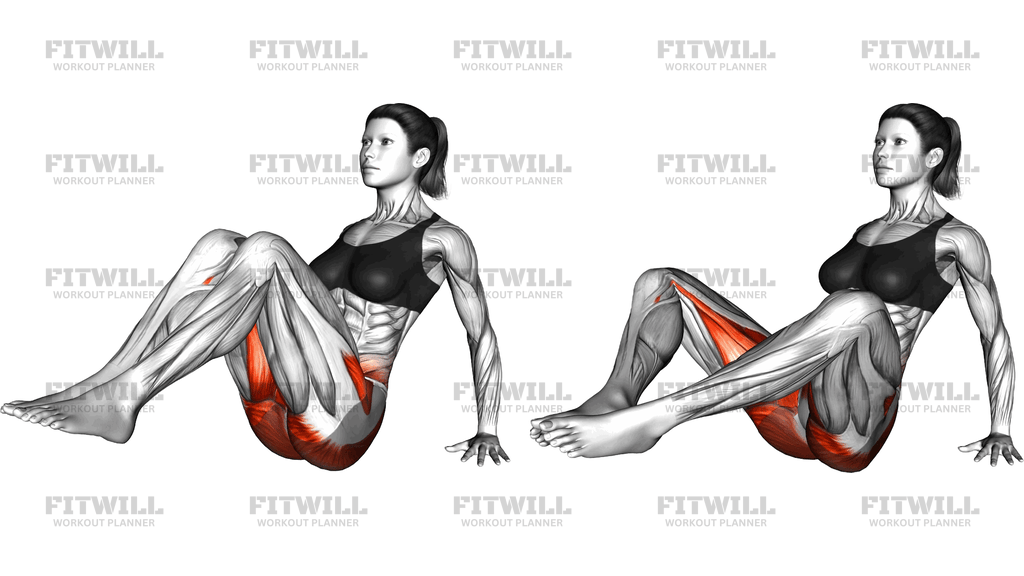
Instructions
- Sit on the floor or a mat with your legs bent in front of you and your hands planted on the floor behind your hips, fingers pointing away from you or slightly outward.
- Recline your torso to a comfortable angle, rest your weight between your sit bones and hands, and draw your shoulder blades down so you are not shrugging into your ears.
- Press your heels together and lift both feet a few centimeters off the floor so the heels hover, with knees bent and pointing up toward the ceiling and touching or nearly touching.
- Brace your midsection lightly and keep your ribs stacked over your pelvis so your lower back stays neutral.
- Exhale and open both knees out to the sides at the same time, letting the knees travel away from each other while the heels stay pressed together and floating.
- Pause briefly at your widest controlled point, feeling the work on the outside of the hips and a stretch through the inner thighs.
- Inhale and draw the knees back together until they touch, resisting on the way in instead of letting gravity collapse them.
- Keep the heels lifted for the entire set; if they drop or separate, pause, reset the heel contact, and continue.
- Complete your repetitions, then lower the feet to the floor and shake out the hips before the next set.
Tips & Tricks
- If your knees refuse to open very far, the issue is usually tension, not weakness. Narrow the range and focus on squeezing the outer hips at the open position rather than chasing width.
- Watch for the pelvis tipping backward as the knees open. If your lower back rounds, lift your chest slightly and reduce how far you abduct until the torso stays still.
- The most common cheat is letting the heels sink toward the floor as the set gets hard. That silently shifts work away from the hips, so check heel height every few reps.
- Keep pressure in the heels rather than the toes when they are pressed together. Pushing through the toes rolls the ankles inward and muddies the abductor signal.
- If your wrists ache from supporting your torso, make fists or use light dumbbells as handles, or sit a little more upright so less weight sits on your arms.
- Tempo is the main intensity dial here. Since there is no external load, slowing the opening phase to two or three seconds does more than adding extra sloppy reps.
- Do not let the shoulders creep up toward the ears as fatigue builds. Reset the shoulder blades down between reps if needed.
- Aim to feel the work on the side of each hip, not in the front of the hip or the low back. If the hip flexors cramp, bend the knees slightly more and lift the heels a little higher.
Frequently Asked Questions
What muscles does the Sitting Floor Floating Heels Together Abductor work?
The main workers are the hip abductors on the outside of the hips, including the glutes. The inner thighs work isometrically to keep the heels pressed together, and the core stabilizes the torso throughout.
Why do the heels need to float off the floor in this exercise?
Lifting the heels takes the floor away as a support point, so your hip muscles have to actively hold and move the legs instead of resting them on the ground. It also makes the heel-to-heel contact a clear reference for clean form.
Is the Sitting Floor Floating Heels Together Abductor suitable for beginners?
Yes, it needs no equipment and the range can be kept small. Beginners should focus on keeping the heels together and floating rather than opening the knees wide.
How is this different from a seated butterfly stretch?
In a butterfly stretch the soles of the feet touch and the heels rest on the floor while you passively hold the stretch. Here the heels stay pressed together and lifted, and the knees actively open and close, making it a strength and control exercise rather than a static stretch.
Why do I feel this in my inner thighs instead of my outer hips?
The inner thighs work hard to hold the heels together, so some feedback there is normal. If they dominate completely, you are likely squeezing the feet too aggressively; lighten the heel pressure and shift your attention to driving the knees apart.
What should I do if my wrists or shoulders fatigue before my hips?
Sit more upright so less body weight rests on your arms, or support yourself with soft fists or a light handle. You can also do shorter sets and reset your shoulder position between reps.
How many reps and sets should I do?
Because the resistance is your own leg weight, higher reps work well. Aim for 2 to 3 sets of 12 to 20 slow repetitions, stopping when the heel position or torso control breaks down.
Can I use this as a warm-up before squats or running?
Yes, it is a good low-load way to activate the outer hips before lower-body training. One or two moderate sets before squats, lunges, or a run is enough.
Is it safe for my knees and lower back?
The knee joints are not loaded externally in this drill, and keeping the torso still protects the lower back. If knee discomfort occurs, reduce how far the knees open, and if any movement causes pain rather than muscle effort, stop and consult a qualified professional.