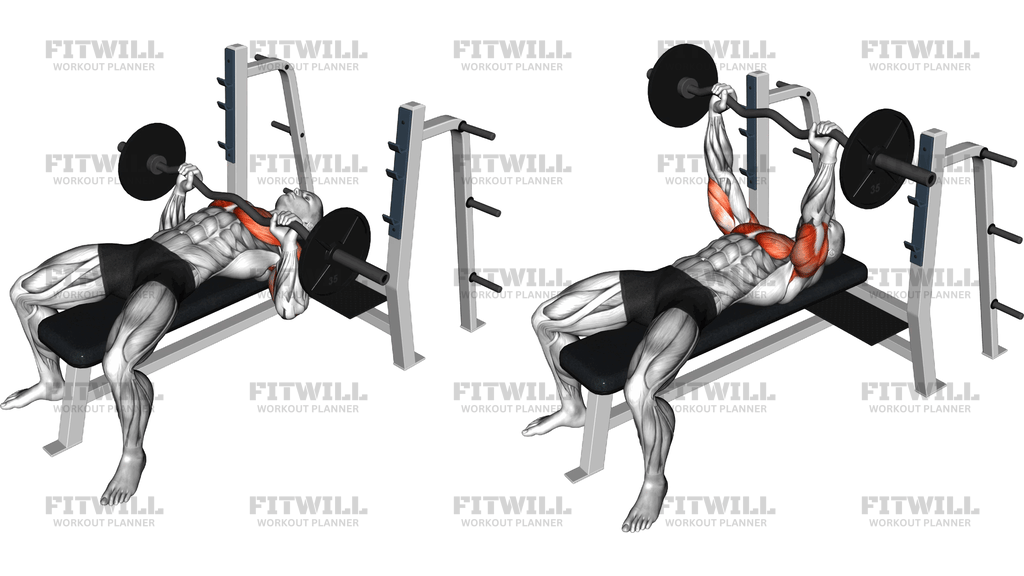
Ez Bar Lying Straight Arms Pullover
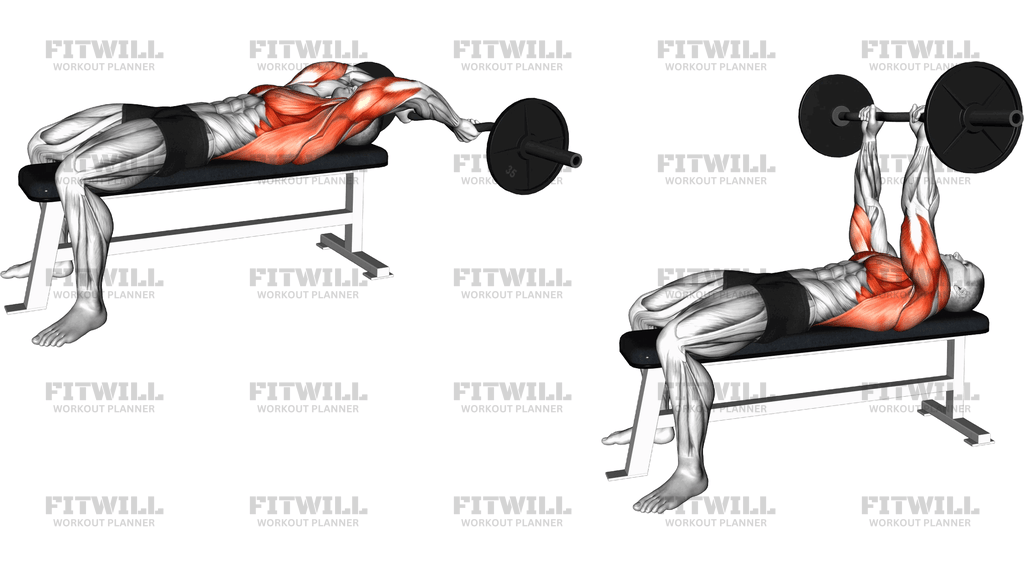
The Ez Bar Lying Straight Arms Pullover is a classic upper-body movement performed lying across a flat bench with an EZ barbell held overhead at roughly shoulder width. With your arms kept almost completely straight, the bar travels in an arc from behind your head up to a point above your chest, then lowers back along the same path. Because the elbows stay extended, the shoulders and rib cage do most of the moving rather than the arms doing a press or extension.
This exercise works two large muscle groups at once: the pectorals and the lats. As the bar arcs overhead, the pecs stretch under load through a range no press can reach, and the lats help pull the bar back up toward vertical. The triceps, serratus anterior, and stabilizers around the shoulder joint also contribute, which is why the pullover has remained a staple in both chest-focused and back-focused programs for decades.
The straight-arm setup matters more than it might seem. Keeping the arms nearly locked turns the movement into a shoulder extension and flexion pattern driven by the chest and lats. The moment you bend the elbows, triceps take over and the exercise quietly becomes a skull crusher. The EZ bar's angled grip sits more comfortably in the wrists than a straight bar, letting most lifters hold the weight securely without wrist strain while their arms are loaded overhead.
To execute it well, lie lengthwise or slightly across the bench with your head supported, feet planted on the floor, and the bar held over your chest. Lower it in a controlled arc back past your head until you feel a deep but comfortable stretch, then pull it back over your face and chest using your lats and pecs rather than momentum. Your lower back should stay in contact with the bench; if it arches sharply, the weight is too heavy or your range is too deep.
This movement suits intermediate and advanced lifters looking to expand their pressing strength, add tissue to the chest and back through a long range, or finish an upper-body session with a stretch-focused exercise. Beginners can use it too, but should start with a very light load to learn the arc before adding plates.
From a safety standpoint, respect the position: a loaded bar passing over your face and throat demands control. Never use a weight you cannot stop mid-rep, always collared the plates, and if you train alone, set the bar down from overhead rather than trying to re-rack it behind your head when fatigued.
[ Workout Log & Planner ]
Put your next workout in Fitwill
Keep your plan and training log ready when you are.


Instructions
- Set a flat bench so you can lie on it with your head and upper back fully supported and your feet flat on the floor on either side.
- Load the EZ barbell lightly, secure collars on both sleeves, and position it within easy reach beside or behind the head of the bench.
- Grip the angled inner section of the EZ bar with an overhand grip at about shoulder width, and extend the bar straight up over your chest with your arms nearly locked.
- Brace your core and press your lower back gently into the bench so your rib cage does not flare up as the weight travels overhead.
- Keeping your elbows almost straight, lower the bar in a smooth arc back over your face and past the top of your head until you feel a solid stretch across your chest and lats.
- Pause briefly at the deepest point without bouncing, letting the stretch happen at the shoulders rather than letting your spine arch.
- Pull the bar back along the same arc by driving your elbows down and slightly in, as if dragging it over your head toward your chest.
- Finish each rep with the bar directly above your chest, arms extended, before starting the next repetition.
- Exhale as you pull the bar up and over, inhale slowly as you lower it back behind your head.
- After your final rep, bring the bar back over your chest, sit up carefully with it, and set it on the floor or a rack instead of dropping it behind you.
Tips & Tricks
- A slight elbow bend of 5 to 10 degrees is fine, but if the angle visibly changes during the set, the triceps are stealing the work, usually a sign the load is too heavy.
- Stop the descent at the point where your lower back starts to peel off the bench; going deeper only adds spinal stress, not extra stretch.
- Keep the bar's path low and close to your head and face. Letting it drift wide turns the arc into a shoulder-dangling position and stresses the joint capsule.
- Think about pulling with your elbows rather than your hands. This cue keeps the lats and pecs driving the concentric instead of the forearms and triceps.
- Slow the lowering phase to two or three seconds. The stretch under tension is where most of the benefit of this exercise lives, and rushing it wastes that.
- Grip the EZ bar so your wrists stack over your elbows; the angled grip should let your hands sit naturally without bending sideways under load.
- If your shoulders click or pinch at the bottom, shorten the range rather than forcing depth. The pullover should feel like a stretch, never like a jab.
- Squeeze your glutes and plant your feet hard to anchor your torso, especially on the last few reps when the temptation to arch is strongest.
- Start with a very light bar or even an unloaded EZ bar for your first session. The leverage in this position makes even modest weights feel much heavier than a bench press with the same load.
Frequently Asked Questions
Which muscles does the Ez Bar Lying Straight Arms Pullover work?
The primary movers are the pectorals and the lats, which control the bar through the overhead arc. The triceps, serratus anterior, and shoulder stabilizers assist, and the core works to keep your rib cage anchored to the bench.
Why use an EZ bar instead of a straight bar for pullovers?
The angled grip lets your wrists sit in a slightly rotated, more neutral position, which most people find more comfortable when the arms are extended overhead under load. It also makes the bar easier to control if your grip tires.
How straight should my arms really be during the Ez Bar Lying Straight Arms Pullover?
Almost straight, with only a small fixed bend of about 5 to 10 degrees to protect the elbows. That bend should stay identical from the bottom of the rep to the top; if it grows as the bar comes up, the triceps are taking over.
Is this a chest exercise or a back exercise?
It is genuinely both, which is unusual. The deep stretch loads the pecs, while the pull back over your head is driven largely by the lats, so you can bias either depending on where you focus and how deep you lower.
Can beginners do the Ez Bar Lying Straight Arms Pullover?
Yes, but only after learning the arc with a very light or unloaded bar. Because the weight travels over the face and the leverage is unfavorable, beginners should master control before adding meaningful plates.
Why does my lower back arch during pullovers?
The overhead position naturally pulls the rib cage up, and a heavy load or excessive depth amplifies this. Brace your core, press your lower back into the bench, and shorten the range until you can keep contact throughout the set.
What can I substitute if I don't have an EZ barbell?
A dumbbell held in both hands, a straight barbell with a light load, or a cable pullover standing at a high pulley all train the same overhead arc. The barbell or dumbbell versions most closely match this movement pattern.
How deep should I lower the bar behind my head?
Lower until you feel a clear stretch across the chest and lats without your lower back lifting off the bench or your shoulders feeling pinched. For most lifters that means the bar ends just above or behind head level, not all the way to the floor.
How should I breathe during the Ez Bar Lying Straight Arms Pullover?
Inhale as you lower the bar overhead and exhale as you pull it back over your chest. Holding your breath while extended overhead tends to spike internal pressure and makes it harder to keep your torso stable.
Is it safe to do this exercise alone without a spotter?
It can be, provided you use a conservative load and keep the plates collared. The main risk is fatigue near the end of a set, so finish reps only while you can still bring the bar fully back over your chest, then sit up with it and set it down rather than dropping it behind your head.