Smith Incline Close Grip Bench Press
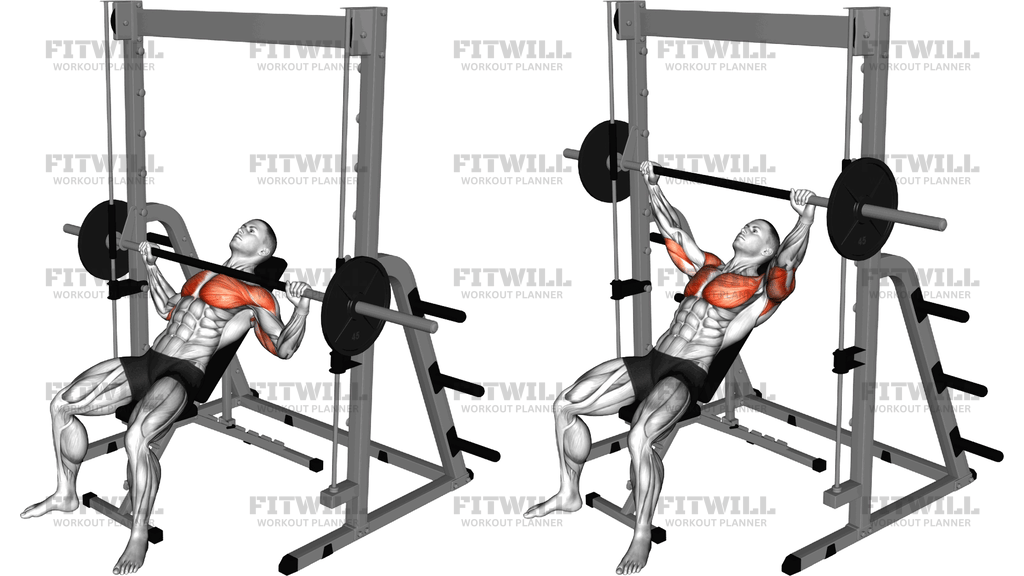
The Smith Incline Close Grip Bench Press is a machine-based press performed on an incline bench positioned inside a Smith machine, using a grip noticeably narrower than shoulder width. The fixed vertical bar path of the Smith machine combined with the incline angle shifts the emphasis toward the upper chest, while the close hand placement places heavy demand on the triceps through the locking portion of each rep. It is essentially a hybrid of an incline press and a close-grip press, and the machine removes the need to stabilize a free barbell side to side.
This movement suits lifters who want to load the upper chest and triceps without a spotter, since the Smith machine's rotating safety hooks let you secure the bar at any point by twisting your wrists. It is also useful for people returning from time away from training, beginners learning the pressing groove, or experienced lifters who want to fatigue the triceps and upper chest with a controlled, guided bar path after free-weight work.
Setup matters more here than it might seem. Because the bar travels in a straight vertical line, the incline bench must be positioned so the bar lowers to the right spot on your upper chest without drifting forward or backward. Set the bench at roughly 30 to 45 degrees, slide it under the bar, and check that the bar lines up over your collarbone area at lockout before you load any plates. Your feet stay flat on the floor and your upper back and hips stay in contact with the bench throughout.
To perform it, take an overhand grip about shoulder-width apart or slightly inside that, unlock the bar, and lower it under control to the top portion of your chest. Keep your elbows relatively close to your torso rather than flared wide, which protects the shoulders and keeps the triceps involved. Press back up to full extension without letting the hips lift off the bench, exhaling as you drive up.
The most common use cases are upper-chest focused hypertrophy days, triceps accessory work, and pressing volume for lifters who train alone. Because the machine stabilizes the weight for you, you can focus entirely on the feel of the chest and triceps working rather than on balancing the bar.
A few practical points keep this exercise safe and effective. Always set the mechanical safety stops below your chest level before your first set, keep the wrists stacked over the elbows at the bottom, and avoid bouncing the bar off the chest. If the bar path feels like it is drifting toward your neck or stomach, reposition the bench rather than adjusting your body to chase the bar.
[ Workout Log & Planner ]
Put your next workout in Fitwill
Keep your plan and training log ready when you are.


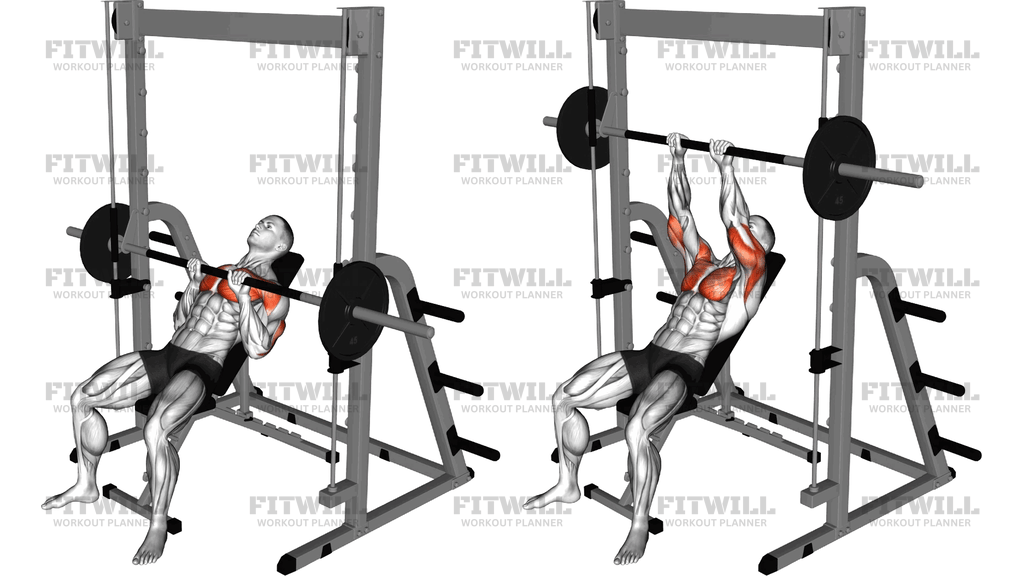
Instructions
- Set the incline bench to roughly 30 to 45 degrees and position it inside the Smith machine so the bar sits directly above your upper chest when you lie back.
- Grip the bar with an overhand grip about shoulder-width apart or slightly narrower, and adjust the bench forward or back until the bar lines up over your collarbone area at lockout.
- Set the Smith machine safety stops just below the level of your chest so the bar cannot sink past a safe depth if you fail a rep.
- Plant your feet flat on the floor, squeeze your shoulder blades down and back, and keep your upper back and glutes firmly on the bench.
- Twist the bar to release the hooks and take a breath, bracing your core before the first rep.
- Lower the bar in a straight, controlled line to the top of your chest, keeping your elbows tucked close to your ribs rather than flared wide.
- Pause briefly at the bottom with your wrists stacked over your elbows, without bouncing the bar off your chest.
- Press the bar back up along the same vertical path until your arms are fully extended, exhaling as you drive up.
- Complete all reps, then twist the bar to re-rack it in the hooks before letting your grip relax.
- Sit up slowly from the bench only after the bar is fully secured in the hooks and the plates are still on the sleeves.
Tips & Tricks
- If the bar grazes your chin or neck on the way down, the bench is set too far back under the bar; slide it slightly forward so the bar tracks over the upper chest instead.
- Narrower than shoulder-width is the target, but gripping with your hands almost touching shifts stress to the wrists; keep at least a hand-width between them.
- Elbows that flare out to the sides turn this into a regular incline press and irritate the shoulders; cue your elbows to brush your ribs as the bar descends.
- Because the Smith bar weighs on a fixed path, do not arch your lower back to shorten the range; if your hips lift off the bench, the weight is too heavy.
- Let the machine's fixed path work for you by pausing a full second at the bottom, which exposes any weakness in the triceps at the sticking point.
- The upper chest responds well to moderate loads here, so favor 8 to 12 controlled reps over maximal singles, especially since the close grip limits how much you can press.
- Warm up your wrists and elbows first, since the close grip places more flexion load on them than a standard-width press.
- If you feel the work mostly in the front of your shoulders, lower the bench angle a notch so the press angle targets the clavicular portion of the chest more directly.
Frequently Asked Questions
Which muscles does the Smith Incline Close Grip Bench Press work?
The primary muscle is the upper chest, specifically the clavicular head of the pectoralis major. The triceps work hard through the lockout because of the narrow grip, and the front shoulders assist on every press.
How narrow should my grip be on the Smith Incline Close Grip Bench Press?
Aim for about shoulder-width or slightly inside it, usually 12 to 18 inches between your hands. Going extremely narrow adds wrist strain without much extra triceps benefit.
Is the Smith Incline Close Grip Bench Press good for beginners?
Yes, it is one of the safer ways to learn close-grip pressing because the fixed bar path removes balance demands and the hooks act as a built-in spotter. Beginners should start with a light load to learn the groove first.
Why does the bench position matter so much in this exercise?
The Smith machine bar only moves vertically, so the bench must be placed exactly where the bar will meet your upper chest. If the bench is too far forward or back, the bar will drift toward your neck or lower chest and the movement feels wrong.
How do I set the safety stops for the Smith Incline Close Grip Bench Press?
Place the stops just below the height of your chest when you are lying on the bench, so a failed rep can rest on them rather than on your ribcage. Check the stop height before every session, since bench positions can vary.
What is the most common mistake with this press?
Flaring the elbows wide and turning it into a standard incline press, which defeats the close-grip purpose. Keep the elbows tucked near your ribs so the triceps stay loaded.
Can I substitute the Smith Incline Close Grip Bench Press with a dumbbell version?
Yes, a close-grip incline dumbbell press on an incline bench trains the same muscles, though you must stabilize the weights yourself. An EZ-bar or barbell close-grip incline press on a rack also works if you have a spotter.
Should I touch my chest at the bottom of each rep?
Lower the bar to gently contact the top of your chest without bouncing. A brief pause at the bottom keeps the tension on the chest and protects the sternum and shoulder joints.
Is it safe to train alone on the Smith Incline Close Grip Bench Press?
Generally yes, as long as the safety stops are set correctly and the bar is fully twisted into the hooks before you release your grip. Never slide out from under the bar while it is still unracked.
Where should I place the Smith Incline Close Grip Bench Press in my workout?
It works well as a main or second pressing movement on an upper-chest day, or as a triceps-focused accessory after heavier free-weight pressing. Since the close grip limits load, treat it as a moderate-weight, higher-rep movement.