Heel Tap Arm Curl
The Heel Tap Arm Curl is a standing bodyweight movement that pairs a no-equipment arm curl with a rhythmic heel tap, so your upper body and lower body work together in one coordinated rep. You stand tall, bend your elbows to curl your fists up toward your shoulders, and lift one heel off the floor behind you as you curl, alternating sides with each rep. Because there is no dumbbell or cable involved, the resistance comes entirely from controlling your own arm and maintaining tension through the working muscles.
This exercise is a good fit for beginners who are learning what a proper curl feels like without load, for people training at home with no equipment, and for anyone using it as a warm-up or activation drill before weighted arm work. It also works well as a low-impact finisher, since the heel taps add a light calf and balance component while the repeated curls build local muscular endurance in the upper arms.
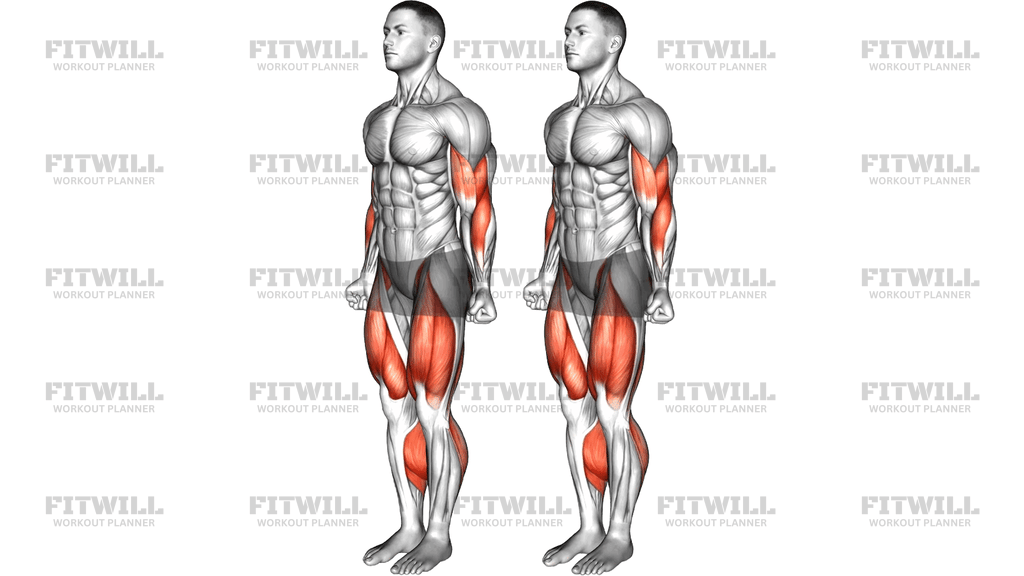
The primary muscles trained are the biceps on the front of the upper arm, assisted by the forearms as you keep your fists firm throughout each rep. The heel tap brings the calves into play, particularly as you rise onto the ball of one foot and lower the heel back down under control, and your stabilizers work quietly to keep you upright on a narrowing base of support.
Setup matters more than it looks. Because the arm curl is bodyweight only, the only real tension you can create comes from deliberate muscle engagement — squeezing the biceps at the top and resisting on the way down rather than letting the arms drop. Standing tall with ribs stacked over the hips keeps the movement in the elbows instead of turning it into a torso swing. The heel tap should be a controlled lift, not a stomp, so you stay balanced and the calf does the work.
To execute well, curl with intent: drive your fists up as if moving against resistance, pause briefly at the top, and take a slow two-to-three count on the way down while the opposite heel lifts. Keep your elbows pinned lightly against your sides so the path stays consistent. Common use cases include home workouts, hotel-room sessions, active recovery days, and teaching newcomers the elbow-only hinge of a curl before they ever pick up a weight.
From a safety standpoint, the movement is gentle on the joints, but avoid locking the knees hard, snapping the heels down onto the floor, or shrugging the shoulders toward the ears as fatigue builds. If balance becomes the limiting factor, stand near a wall or reduce the height of the heel lift rather than rushing the reps.
[ Workout Log & Planner ]
Put your next workout in Fitwill
Keep your plan and training log ready when you are.


Instructions
- Stand upright with your feet hip-width apart, arms relaxed at your sides, and your gaze straight ahead.
- Close your hands into loose fists with palms facing forward, and lightly brace your core so your torso stays tall.
- Shift a small amount of weight onto one foot, keeping that knee soft rather than locked.
- Curl both fists up toward your shoulders by bending only at the elbows, keeping your upper arms pressed lightly against your ribs.
- As you curl, lift the heel of your opposite foot off the floor behind you in a smooth tap, rising onto the ball of that foot.
- Pause briefly at the top of the curl and squeeze your biceps and the calf of the lifted foot.
- Lower your fists slowly back to your sides over a two-to-three count while setting the heel back down with control.
- Repeat the curl and heel tap on the other side, alternating heels with each rep.
- Exhale as you curl up, inhale as you lower your arms and the heel back down.
- Reset your stance and posture between reps if you feel yourself swaying or leaning forward.
Tips & Tricks
- The most common mistake is turning this into a torso swing — if your chest starts rocking forward with each curl, slow the tempo and brace your abs before the next rep.
- Keep your elbows fixed at your sides; if they drift forward or flare out, the shoulders take over and the biceps stop doing the work.
- Tap the heel softly behind you rather than snapping it down — a loud landing usually means the calf is not controlling the descent.
- Squeeze your fists firmly for the whole set; a limp grip lets the forearms disengage and makes the curl feel empty.
- If you wobble on the tapping side, shorten the lift so the heel only rises an inch or two, then build height as your balance improves.
- Match the heel tap to the curl rather than doing them on separate rhythms — the coordination is part of the exercise.
- Do not rush the lowering phase; since there is no external weight, the slow negative is where most of the useful tension comes from.
- Stand near a wall for the first few sessions if balance is a challenge, but avoid leaning on it once you can control the movement.
- Stop the set when your elbows start drifting or your shoulders shrug — those are signs the biceps are fatigued and form is slipping.
Frequently Asked Questions
What muscles does the Heel Tap Arm Curl work?
The biceps are the primary movers, with the forearms supporting the grip and the calf of the tapping leg working each time the heel lifts and lowers. Core stabilizers also contribute to keeping you upright.
Can the Heel Tap Arm Curl build muscle without any equipment?
It builds endurance and muscle control rather than significant size, since the resistance is limited to your own limbs. Squeezing hard at the top and lowering slowly increases the tension, but for serious hypertrophy you will eventually want weighted curls.
Why does the heel tap happen on the opposite side of the curl?
The cross-body pattern challenges coordination and balance, forcing your stabilizers to work while your arms move. It also keeps the drill rhythmic and makes it harder to rush through reps.
Is the Heel Tap Arm Curl good for beginners?
Yes — it is one of the safest ways to learn the elbow-only movement pattern of a curl before adding dumbbells or cables. The heel tap also gently introduces single-leg balance without any impact.
My shoulders creep up toward my ears during the curl — how do I fix that?
Pull your shoulder blades down and back before starting, and keep your upper arms touching your ribs throughout. If the shrug still happens, the set has gone too long, so rest and reset.
What can I substitute if the balance component is too hard?
Perform the same bodyweight arm curl while standing on both feet flat, or hold a light wall contact with one hand. Add the heel tap back in once you can complete the curls without swaying.
How many reps of the Heel Tap Arm Curl should I do?
Because the load is light, higher volumes work well — start with 10 to 15 alternating reps per side for two to three sets, and focus on slow lowering rather than adding speed.
Should my heels make contact with the floor loudly on each tap?
No — a quiet, controlled tap means your calf is lowering the heel deliberately. Loud landings indicate you are dropping the heel and losing the lower-leg benefit of the movement.
Is this exercise safe for the elbows and knees?
The movement is low-load and generally easy on the joints when performed with control. Keep the knees slightly bent rather than locked, and avoid snapping the elbows straight at the bottom of each curl.