Resistance Band Side Plank Clamshell
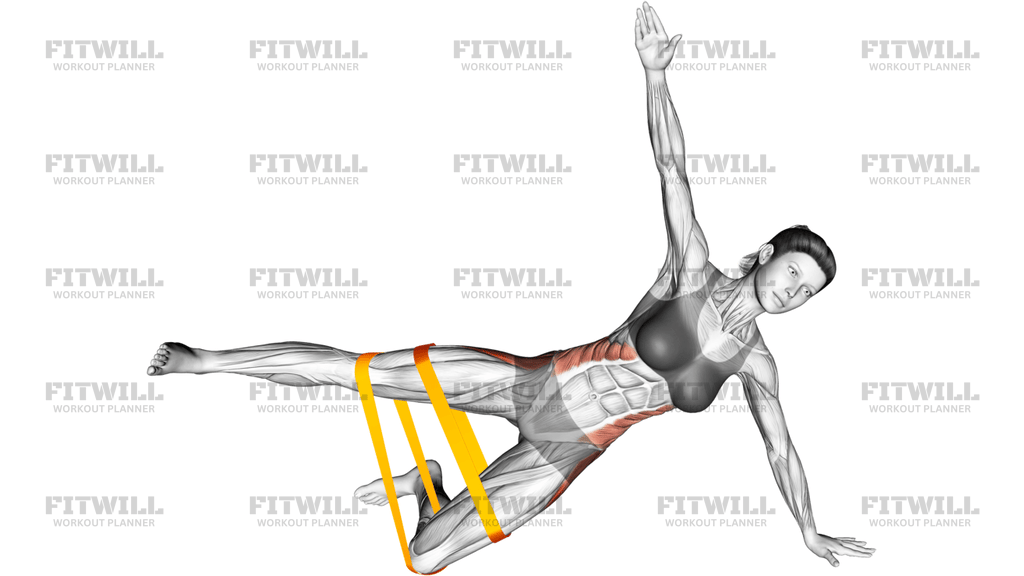
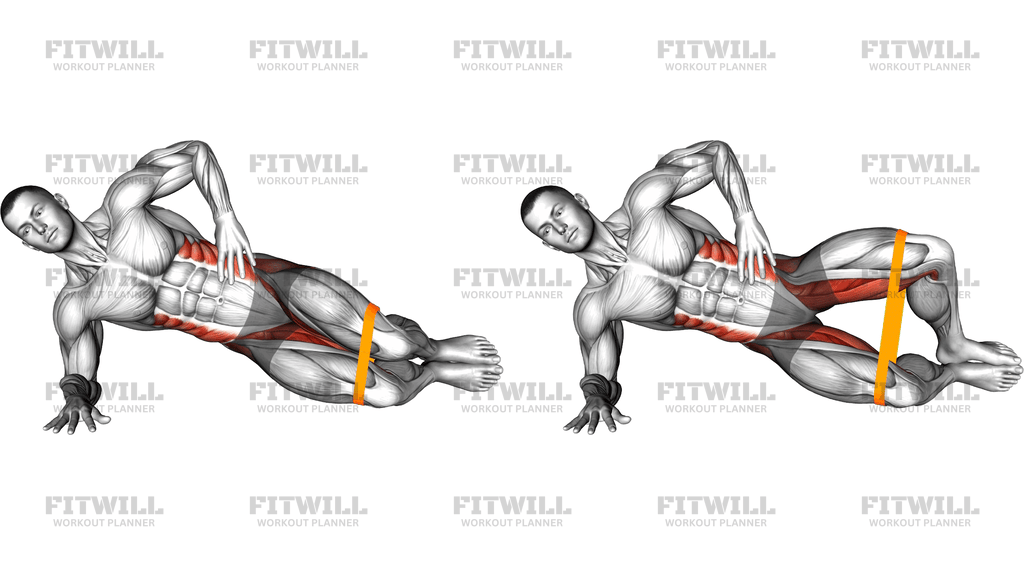
Resistance Band Side Plank Clamshell combines two demanding jobs into one movement: holding a stable side plank while the top leg opens against band tension. You support yourself on one straight arm with your body in a long line, a loop band wrapped around your thighs just above the knees, and you lift the top knee away from the bottom leg without letting your trunk twist or your hips sag. It looks simple from the outside, but the moment the band stretches, everything from your shoulder to your ankle has to work together to keep you still.
The main target is the gluteus medius and the outer hip muscles of the top leg, which drive the knee opening against the band. At the same time, the bottom-side obliques, deep core, and quadratus lumborum work hard to hold the plank position, and the supporting shoulder and arm stabilize the upper body. This dual demand is what makes the exercise valuable: hip strength built in isolation often falls apart the moment you have to stabilize at the same time, and this drill trains exactly that combination.
This movement is especially useful for runners and field-sport athletes, since weak or poorly controlled hip abductors are a common contributor to knees that cave inward and hips that drop with each stride. It is also a solid addition for anyone spending long hours sitting, because the side-lying position lets the hip work through abduction without bearing weight through the leg. Because the band adds resistance and the plank adds a stability requirement, it suits intermediate trainees; beginners can start by doing each half separately before combining them.
Setup details matter more here than in most band exercises. The band must sit above both knees so it pulls the legs together, and the elbow or hand should be stacked directly under the shoulder so the plank is supported by structure rather than strain. If your hips drift backward or forward, or if your bottom hip drops toward the floor, the glutes stop doing the work and the lower back starts picking up the slack.
Execute it with a deliberate tempo: press the floor away to keep your ribcage lifted, brace your waist, and open the top knee by rotating at the hip rather than rolling the whole torso back. Pause briefly at the widest point, then lower the knee with control so the band pulls it back instead of letting it collapse. Expect to feel a deep burn along the side of the top hip and along the waist of the bottom side within a modest number of repetitions.
Common use cases include hip-stability blocks in strength programs, warm-up or activation work before lower-body training, and rehabilitation-style programming for lateral hip and knee control. Keep the range honest rather than large: a controlled knee lift of a modest distance with a still trunk beats a big sweeping motion that rolls your whole body. If the band forces your hips to twist, drop to a lighter loop or perform the movement without the band first.
[ Workout Log & Planner ]
Put your next workout in Fitwill
Keep your plan and training log ready when you are.


Instructions
- Loop a resistance band around both thighs just above the knees, then lie on your right side with your legs fully extended and stacked, left leg on top.
- Place your left hand flat on the floor and press up into a straight-arm side plank, positioning the hand directly under the shoulder so the wrist, elbow, and shoulder line up vertically.
- Stack your hips and feet so your body forms one long line from head to heels; rest your right hand on your waist or place it on your hip for balance.
- Brace your abdominal wall and press the floor away with the supporting arm to lift the ribcage and keep your bottom side from collapsing toward the floor.
- Exhale and lift the top (left) knee upward against the band, rotating from the hip while keeping your feet in contact and your trunk facing forward, not rolling backward.
- Pause for a beat at the widest point where your hips stay square and your torso has not twisted.
- Inhale and lower the top knee slowly, resisting the band as it draws the legs back together, and touch the knees lightly without fully releasing tension.
- Complete all repetitions on one side, then reset the plank on the other side and repeat with the right leg on top.
- Between sets, stand up and shake out the supporting shoulder and wrist; if your hips sag mid-set, end the set rather than grinding through a broken position.
Tips & Tricks
- The most common failure is the whole body rolling backward as the knee opens. Fix it by imagining your pelvis is a bucket of water you cannot spill—rotate only at the top hip joint.
- If your supporting shoulder aches before your hips fatigue, you are sinking into it. Actively push the floor away so the shoulder blade stays packed against the ribcage instead of letting the torso hang on the joint.
- Choose a band tension you can hold for a full side plank plus 8–10 knee openings. Too heavy a band turns the drill into a trunk-twisting contest and removes the work from the outer hip.
- Keep your neck neutral by looking straight ahead rather than craning down at the floor or up at the ceiling; this helps the whole spine hold one line.
- A dropped bottom hip is a sign the quadratus lumborum and obliques are losing the fight. Either shorten the set, widen your base by adjusting foot position within a straight-line plank, or practice the plank without the band until you own that position.
- Moving the knees fast lets momentum do the lifting. Slow the opening phase to about two seconds so the gluteus medius actually earns its contraction.
- If the band slips down toward the knees' joint line mid-set, it is positioned too low or too loose; reposition it above both knees where it stays anchored by thigh tension.
- Because the top leg works unilaterally, always match sides exactly—same number of reps and same hold time—so you can compare left-to-right hip strength and address any imbalance.
Frequently Asked Questions
Which muscles does the Resistance Band Side Plank Clamshell work?
The top leg's gluteus medius and outer hip muscles perform the knee opening against the band, while the bottom-side obliques, deep core, and quadratus lumborum hold the side plank. The supporting shoulder and arm also work statically to keep the upper body stable.
Is this exercise suitable for beginners?
It can be, but it helps to build the two pieces first: practice a straight-arm side plank on its own, then a band clamshell lying flat on your side. Once both feel solid, combine them, starting with a light band and fewer repetitions.
Why is the band placed above the knees rather than at the ankles?
Above the knees gives the band a shorter, more manageable lever arm and places resistance where the hip abductors act most directly. At the ankles the band would be far heavier and would pull the plank itself out of line, making the trunk twist much harder to prevent.
My hips twist every time I open my knee. How do I fix that?
The band is probably too strong or you are lifting the knee past your controllable range. Use a lighter loop, limit the opening to a smaller range, and cue yourself to keep both hips facing the same direction throughout the rep.
Can I do this movement on my elbow instead of a straight arm?
Yes, an elbow-supported version shortens the leverage demands on the shoulder and can help if the straight-arm version fatigues your wrist or shoulder first. Expect the core contribution to stay similar, though the plank feels slightly easier overall.
How many repetitions and sets should I do?
Two to three sets of 8–12 controlled openings per side works well, prioritizing a still trunk over a big knee range. Because the plank component is fatiguing, quality drops quickly—end a set as soon as your hips sag or your torso starts rotating.
What can I substitute if I don't have a resistance band?
You can perform the side plank with a bodyweight clamshell-style knee lift, though the resistance will be limited. Alternatively, do a standard side plank and a separate side-lying band or cable hip abduction to cover both components.
Is it safe for my lower back and shoulder?
It is generally well tolerated when the hand stays stacked under the shoulder and the trunk holds one line, since those positions share load appropriately. If you have a current shoulder, wrist, or back complaint, use the easier elbow-supported version or get clearance from a qualified professional first.