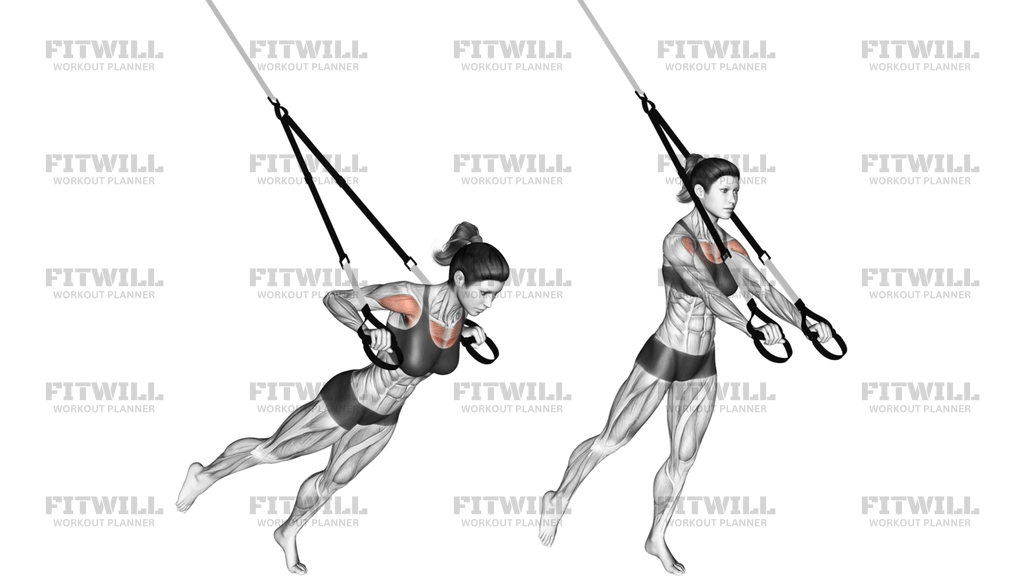
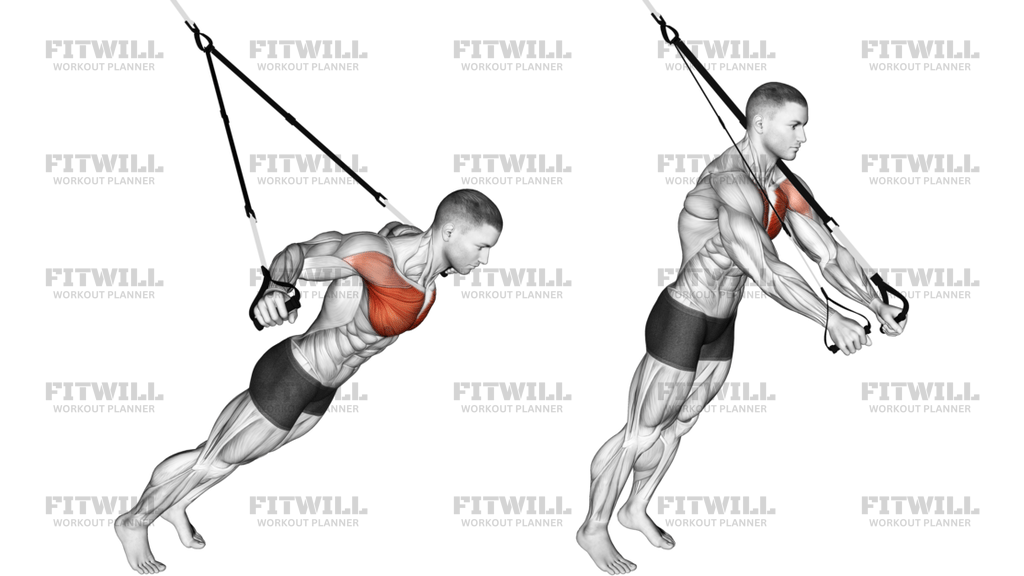
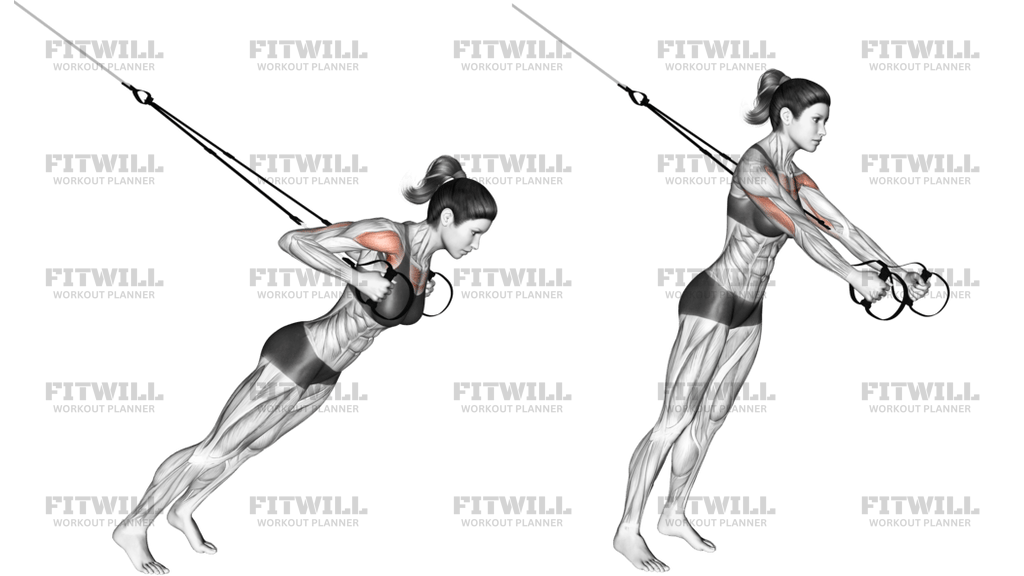
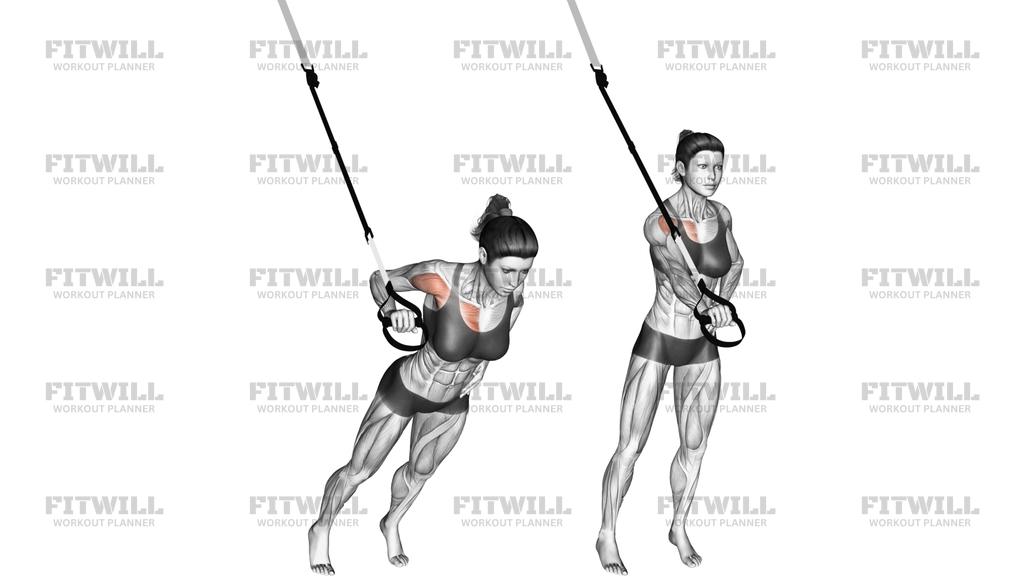
Suspended Push-up With Knee Tucks
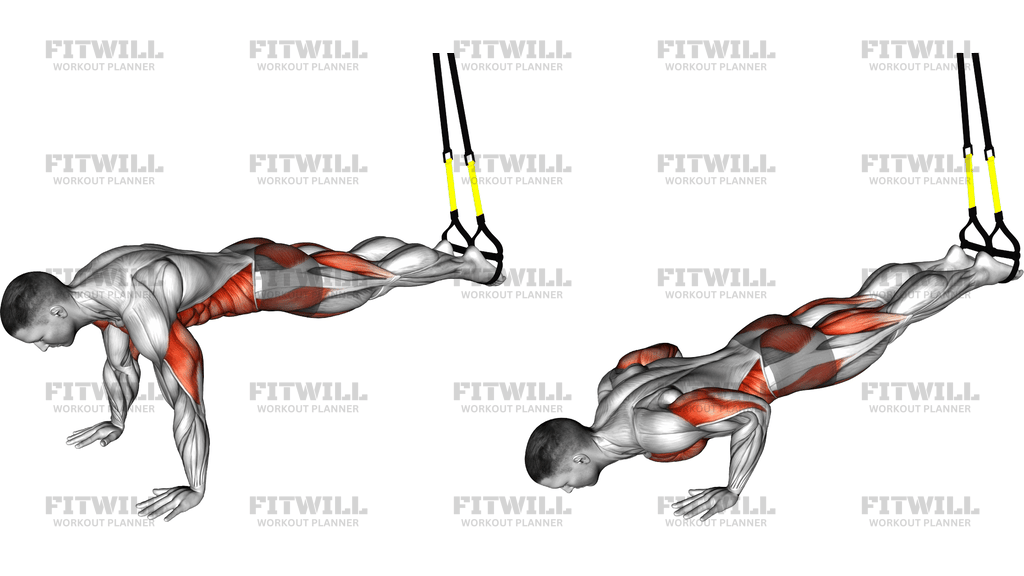
Suspended push-up with knee tucks combines two demanding bodyweight exercises into one fluid repetition: a push-up done with the feet in the straps of a suspension trainer, followed by a knee pull that draws the thighs toward the chest. Because the feet rest in unstable hanging straps rather than on the floor, every push-up requires extra work from the chest, triceps, front delts, and the deep stabilizing muscles around the shoulders and torso. The knee pull then shifts the load to the lower abs and hip flexors, making this a genuine upper body and core combination, not just a simple pressing exercise.
This movement suits intermediate and advanced trainees who can already perform solid floor push-ups and at least a few controlled knee tucks or planks on the straps. It appears frequently in suspension training circuits, metabolic conditioning, and home programs where a single pair of straps has to provide a full-body stimulus. If you train alone with minimal equipment, this one exercise covers pressing strength, anti-rotation core control, and hip flexion all in one workout slot.
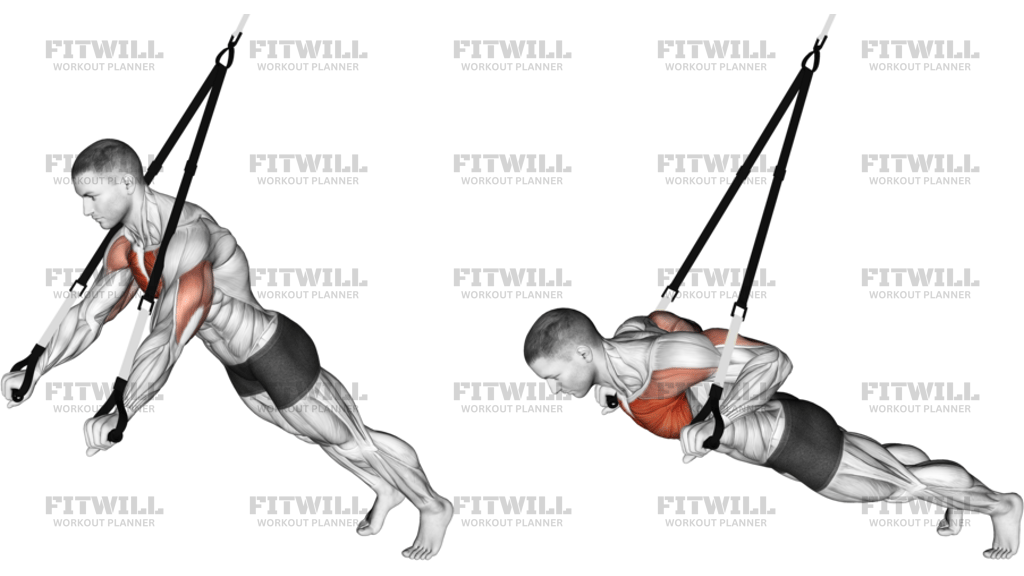
Setup matters even more here than in a regular push-up. Adjust the straps so they hang roughly shin-height, slip your feet into the handles so the cradle sits on your instep or ankle, and walk your hands out until your body forms a straight line from head to heels. If the straps hang too high, your feet sway and your lower back arches; if your hands are too far forward or too close, the press goes through your shoulders at an awkward angle. Take ten seconds to lock in a straight, rigid starting position, and every subsequent repetition will be cleaner.
To execute well, lower your chest toward the floor with your elbows at roughly a 45-degree angle to your torso, keeping the straps from swinging side to side. Press back up to the straight-body position, then immediately pull both knees toward your chest, letting your hips rise while your shoulders stay stacked over your wrists. Extend your legs back to the straight plank without letting your hips sag, and repeat. Breathe in as you lower, breathe out as you press and pull your knees in.
The most common mistakes are letting the hips drop during the push-up, turning the knee pull into a pike by lifting the hips too high with straight legs, and rushing the reps so the straps start to swing. Slow the tempo down and treat the straight-body plank between the two actions as the anchor of the movement. If your form breaks down, shorten the set rather than compensating, and progress by increasing reps or slowing the lowering phase before adding pauses at the bottom of the push-up or the top of the knee pull.
[ Treeningupäevik ja kavade koostamine ]
Planeeri järgmine treening Fitwillis
Treeningkava ja päevik on käepärast, kui oled valmis alustama.


Juhised
- Anchor the suspension trainer to a secure overhead attachment point and adjust both straps to the same length, roughly shin height, with the handles hanging free.
- Sit with your back to the anchor, slip both feet into the handles so the cradles support your instep or ankles, then walk your hands forward until your arms are straight under your shoulders and your body forms one line from head to heels.
- Place your hands slightly wider than shoulder-width, fingers spread, and squeeze your glutes and thighs so your hips do not sag toward the floor.
- Brace your core as if bracing for a light punch, and gently pull your shoulder blades down and together so your shoulders stay stable before you start moving.
- Inhale and lower your chest toward the floor, bending your elbows to about 45 degrees from your ribs until your chest is a few centimeters off the ground.
- Breathe out and press the floor away to return to the straight plank, keeping both straps under even tension so your feet do not drift side to side.
- Without pausing, breathe out and pull both knees toward your chest, rounding your lower back slightly and letting your hips rise as your thighs approach your torso.
- Slowly extend your legs back until your body is straight again, controlling the straps so your feet do not swing behind you.
- Complete your target number of reps, then rest your knees on the floor and pull your feet out of the handles one at a time to exit safely.
Nõuanded
- If your hips sag during the push-up portion, shorten the range slightly and focus on squeezing your glutes before descending; a sagging midsection is the first sign that your core has handed the work over to your lower back.
- Keep your shoulders stacked directly over your wrists during the knee pull. If your shoulders drift behind your hands, the pull becomes harder to control and your wrists take extra load.
- The straps should stay quiet. Swaying or crossing straps usually means one leg is pushing harder than the other, so check that your weight is evenly distributed in both cradles.
- Separate the two actions mentally: press first, then pull the knees in. Trying to combine them into one blended motion robs the chest of a full press and the abs of a full knee pull.
- For a harder push-up, pause for one second with your chest just off the floor; for a harder knee pull, draw your knees toward your elbows instead of toward your chest.
- If the knee pull is too difficult at first, perform the suspended push-up alone for a few weeks, or replace the pull with a shorter-range knee lift where your thighs only reach perpendicular to the floor.
- Wear flat, grippy shoes or use the foot cradles barefoot with care; slippery feet sliding inside the handles are a common cause of losing the plank position mid-set.
- Lower the straps closer to the floor to make the setup more stable while you learn the movement, then raise them gradually as your control improves.
- End the set when your plank position breaks, not when your arms fail; in this exercise, a collapsing torso is the real limit, and pushing past it trains bad habits.
Korduma kippuvad küsimused
Which muscles does the suspended push-up with knee tucks work?
The push-up portion primarily trains the chest, with strong support from the triceps and front delts. The knee pull shifts the emphasis to the lower abs and hip flexors, while the entire trunk works isometrically to keep the suspended body stable.
Is the suspended push-up with knee tucks suitable for beginners?
It is demanding because the feet are unstable and the exercise combines two movements. Beginners should first build a solid floor push-up and a stable plank or knee pull on the straps, then either shorten the range of the knee pull or perform the push-up alone before combining both.
How high should I set the suspension straps for this exercise?
Set the handles around shin-height so your body can reach a straight plank with your arms directly under your shoulders. Lower straps are more stable and easier; higher straps increase instability and the demand on the core.
Why do my hips sag when I press back up from the push-up?
Your core has fatigued before your pressing muscles. Squeeze your glutes, breathe out forcefully as you press, and end the set earlier; sagging hips shift the stress to your lower back without improving the development of the chest or abs.
Should the knee movement be a pull or a pike?
In this exercise the knees bend and draw toward the chest, so the hips rise only moderately. A pike, where the legs stay straight and the hips lift high, is a different movement that targets the shoulders and upper abs more heavily.
What can I use if I don't have a suspension trainer?
You can approximate the knee pull with a stability ball under your shins, or do a push-up followed by mountain climbers on the floor. The unstable foot position won't be identical, but the combined pressing and core demand remains.
How do I keep the straps from swinging side to side?
Distribute your weight evenly between both feet, press and pull symmetrically, and slow the tempo. Swinging straps almost always come from uneven force from one leg or rushing the transition between the push-up and the knee pull.
How many reps should I aim for with the suspended push-up with knee tucks?
Start with sets of 5 to 8 clean reps where your plank line holds throughout. Build toward 10 to 15, then add difficulty through slower lowering, pauses, or pulling the knees toward the elbows instead of endlessly increasing the volume.
Are there any safety concerns with this movement?
Check before every workout that the anchor point and straps are rated for bodyweight and securely attached. Keep your wrists and shoulders stacked, avoid letting your lower back arch at the bottom of the push-up, and exit the straps with your knees on the floor rather than trying to step out of a full plank.