Push-Up Medicine Ball
Push-Up Medicine Ball is an offset push-up variation that places one hand on a medicine ball and the other hand on the floor. The uneven base creates a more demanding press than a standard floor push-up because the chest, triceps, front deltoid, and serratus have to produce force while the core resists rotation and the shoulder girdle stays organized.
The medicine ball changes the support point on one side of the body, which makes stability part of the exercise. You are not just lowering and pressing; you are keeping the torso square, the hips level, and the loaded shoulder controlled while one arm works from a less stable surface. That is why the setup matters. If the ball is too far forward, the stance is too narrow, or the hand position is awkward, the set quickly turns into a twisting balance drill instead of a clean push.
Set the ball under one shoulder, place the other hand flat on the floor slightly wider than shoulder width, and walk the feet back into a strong plank. Keep the feet apart enough to control sway, squeeze the glutes, and hold the ribs down before you lower. On the way down, let the elbows bend smoothly while the chest travels toward the floor and the shoulder line stays as level as possible.
At the bottom, the chest should be close to the floor without dumping the head forward or collapsing the low back. Press back up by driving through both palms and keeping pressure even through the shoulder blades. The rep should look controlled from start to finish, with no bounce off the ball and no sharp rotation through the pelvis.
Use Push-Up Medicine Ball when you want a push-up that also trains anti-rotation control, unilateral stability, and upper-body pressing strength. It works well in accessory work, home training, athletic prep, and core-integrated chest sessions. Keep the movement crisp and repeatable, and stop the set if the ball slides, the hips twist hard, or the shoulder on the ball side starts to feel jammed rather than loaded.
[ Workout Log & Planner ]
Put your next workout in Fitwill
Keep your plan and training log ready when you are.


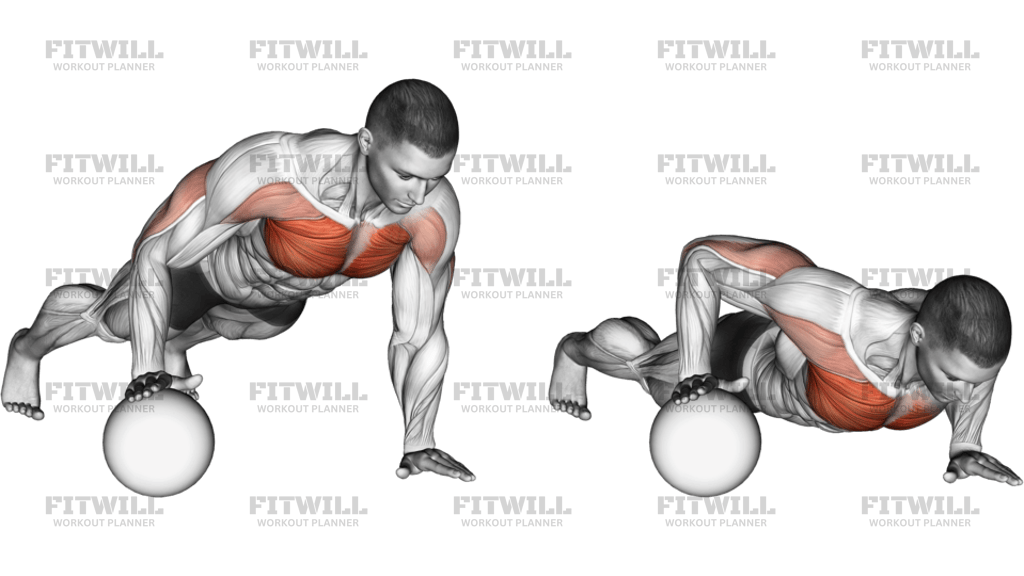
Instructions
- Place one hand on the medicine ball and the opposite hand flat on the floor slightly wider than shoulder width.
- Walk both feet back until your body forms a straight line from head to heels.
- Spread the feet just enough to keep the torso from rolling toward the ball.
- Squeeze your glutes and brace your abs before the first rep.
- Inhale and lower your chest toward the floor with the elbows tracking at a comfortable angle.
- Keep the shoulder on the ball side stable instead of letting it shrug forward.
- Stop just above the floor or as low as you can go without twisting the hips.
- Exhale and press through both hands to return to the plank position.
- Reset your plank after each rep and switch the ball to the other side when the set is complete.
Tips & Tricks
- Use a medicine ball with enough grip and stability that it does not roll as soon as pressure shifts.
- Keep the feet a little wider than a normal push-up stance so the torso does not rotate toward the unsupported side.
- If the ball is too close to your chest, the shoulder will crowd forward; keep it under the pressing shoulder instead.
- Let the elbows travel back at roughly a 30 to 45 degree angle rather than flaring straight out.
- Hold the ribs down at the bottom so the low back does not sag as the body searches for balance.
- Press smoothly without bouncing off the ball, which can make the shoulder position collapse on the way up.
- A shorter range is better than forcing the chest to the floor and twisting through the pelvis.
- If the wrist on the floor side feels irritated, turn the hand slightly out or move the support hand a bit farther forward.
- Switch sides evenly so both shoulders get the same amount of offset loading.
Frequently Asked Questions
What muscles does Push-Up Medicine Ball work most?
The chest does the main pressing work, with the triceps, front shoulders, and core helping to keep the body steady.
Is one hand supposed to stay on the medicine ball?
Yes. One hand stays on the ball while the other hand stays on the floor, which creates the offset push-up position shown in the image.
Which hand should go on the ball?
Either side can be used, but the ball should stay under the shoulder you want to challenge more and you should switch sides evenly.
Why do my hips twist during the rep?
The stance is probably too narrow or the ball is too unstable. Widen your feet and slow the lowering phase so the torso stays square.
Can beginners do this version of a push-up?
Yes, if they can already hold a strong plank and control a basic push-up. Start with a stable ball and a short range of motion.
How do I know the ball is in the right spot?
It should sit under the pressing shoulder, not out in front of the chest, so the rep feels balanced rather than cramped.
What is the biggest form mistake to avoid?
Do not let the torso twist or the ball-side shoulder collapse forward. That turns the movement into a sloppy balance drill.
What if the medicine ball keeps sliding?
Use a firmer, less slippery ball and place it on a dry surface. If it still moves, reduce the load by shortening the range or switching to a more stable variation.