Vertical Leg Raise On Parallel Bars
Vertical Leg Raise On Parallel Bars is a bodyweight core exercise performed from a captain's-chair style station with your forearms supported on the pads and your torso held tall between the bars. It is used to train the abs hard while also demanding hip-flexor strength, pelvic control, and the ability to resist swinging through the lower body. The supported setup makes it a practical option for direct trunk work when you want more stability than a hanging raise and less spinal loading than many floor-based abdominal movements.
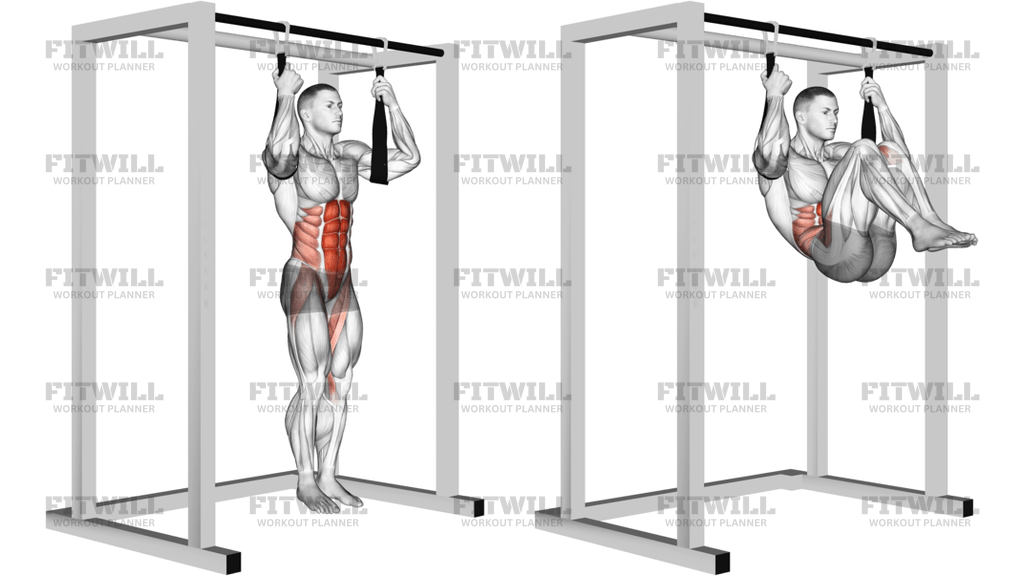
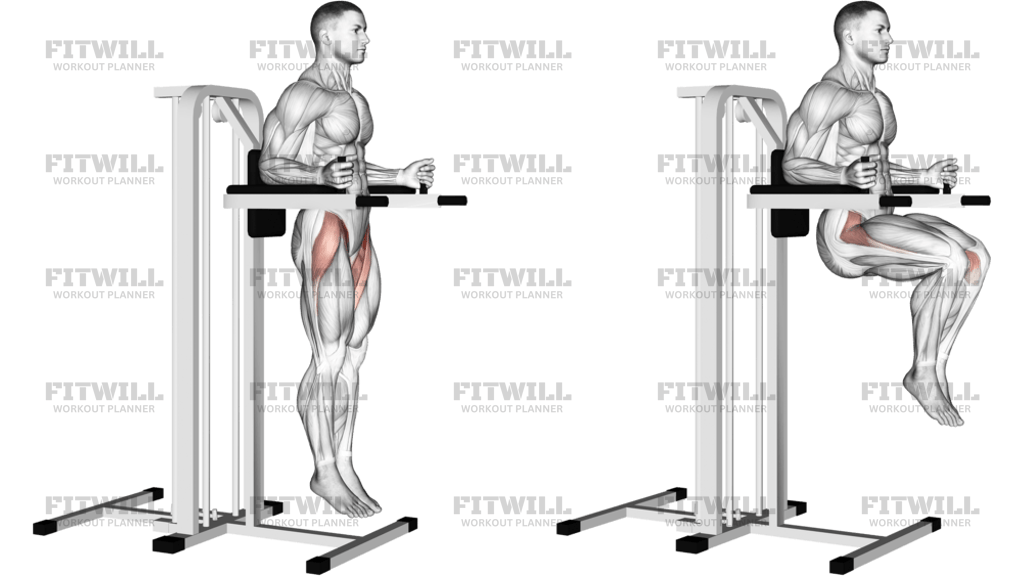
The image for this exercise shows the common bent-knee version, which is usually the most controllable place to start. You keep your shoulders packed down, grip the handles, and lift the knees by curling the pelvis upward rather than just kicking the thighs forward. That small posterior pelvic tilt at the top is what turns the rep into a true abdominal crunch pattern instead of a loose leg lift. When the pelvis tips and the ribs stay down, the rectus abdominis has to shorten under tension and the obliques help keep the torso from twisting.
Because the body is suspended, the setup matters as much as the motion. If the elbows are not firmly planted, the shoulders creep toward the ears, or the lower back arches to start the rep, momentum will take over quickly. A good rep begins from a dead still hang with the chest open, the neck neutral, and the hips stacked under the torso. From there, the knees travel up in a smooth arc, the trunk stays quiet, and the top position is controlled instead of snapped into.
This exercise fits well in core-focused sessions, athletic accessory work, or finishers where you want a strict abdominal movement without needing external load. It is especially useful for people who want to build lower-abdominal strength, improve control in hip-flexion patterns, or progress toward harder hanging leg raises. It can also be scaled by shortening the range, bending the knees more, or slowing the lowering phase so the set stays clean.
The main safety priorities are avoiding swing, keeping the shoulders supported, and lowering only as far as you can control without losing the pelvis. If the hips start drifting backward or the spine starts to arch, the set is too hard or the tempo is too fast. Done correctly, this movement gives a strong abdominal contraction, a clear hip-flexor challenge, and repeatable reps that are easy to judge by form rather than by speed.
[ Workout Log & Planner ]
Put your next workout in Fitwill
Keep your plan and training log ready when you are.


Instructions
- Step onto the parallel bars and place your forearms on the pads with your elbows supported and your hands gripping the handles.
- Let your body hang straight between the pads, keep your shoulders down, and hold your chest tall without shrugging.
- Bring your knees together and set your pelvis under you so your lower back is not arched at the start.
- Brace your abs, then begin the rep by lifting your knees upward in a smooth arc toward your torso.
- Keep the motion controlled so the pelvis rolls slightly upward instead of swinging the legs forward.
- Raise until your thighs are close to your chest or until you reach the highest position you can hold without rocking.
- Pause briefly at the top while keeping the torso still and the shoulders pressed into the pads.
- Lower your legs slowly until your hips are open again and you are back in a controlled hanging position.
- Exhale as you lift, inhale as you lower, and stop the set if you lose control of the swing or the pelvis.
Tips & Tricks
- Keep pressure through the forearms and handles so the shoulders do not drift upward as the knees rise.
- Think about curling the pelvis toward your ribs at the top, not just lifting the thighs.
- If your body starts to swing, shorten the range and slow the lowering phase before adding more reps.
- A slight knee bend usually makes the rep more controlled than trying to keep the legs straight.
- Do not let your lower back arch at the bottom; reset the brace before each rep if needed.
- Move in a clean rhythm and avoid kicking the legs up with hip momentum.
- Use the highest position you can control for a full pause rather than chasing a bigger-looking rep.
- If grip or shoulder support limits the set first, stop before the abs turn into a passive swing.
- For harder sets, slow the descent to make the abs resist the pull back to the start.
Frequently Asked Questions
What does the Vertical Leg Raise On Parallel Bars train most?
It primarily trains the rectus abdominis, with the hip flexors and obliques helping control the lift.
Why are the elbows and forearms so important on the pads?
They keep your torso supported so you can focus on the abdominal curl instead of hanging loose and swinging.
Should I raise straight legs or bent knees?
The bent-knee version is easier to control and matches the image here, while straighter legs make the movement harder.
What is the most common mistake on parallel bars?
Swinging the legs up with momentum instead of curling the pelvis and keeping the torso stable.
How high should the knees come up?
Bring them up as high as you can without rocking or arching, usually toward the chest or just below it.
Can this replace hanging leg raises?
It can be a great alternative if you want more support through the shoulders and less grip demand.
What should I do if my lower back starts arching?
Shorten the range, bend the knees more, and reset the pelvic tuck before the next rep.
Is this more of an ab exercise or a hip-flexor exercise?
It is both, but the abs should drive the pelvic curl while the hip flexors help bring the legs up.