Band Lunges
Band Lunges is a split-stance lower-body exercise that uses a resistance band to challenge the quads, glutes, and hip stabilizers while you move through a lunge pattern. The band adds a constant pull on the body, so the exercise rewards clean alignment, steady balance, and a controlled tempo more than raw load. It is a useful choice when you want unilateral leg work, a warm-up that actually trains the movement pattern, or accessory volume without needing a barbell or machine.
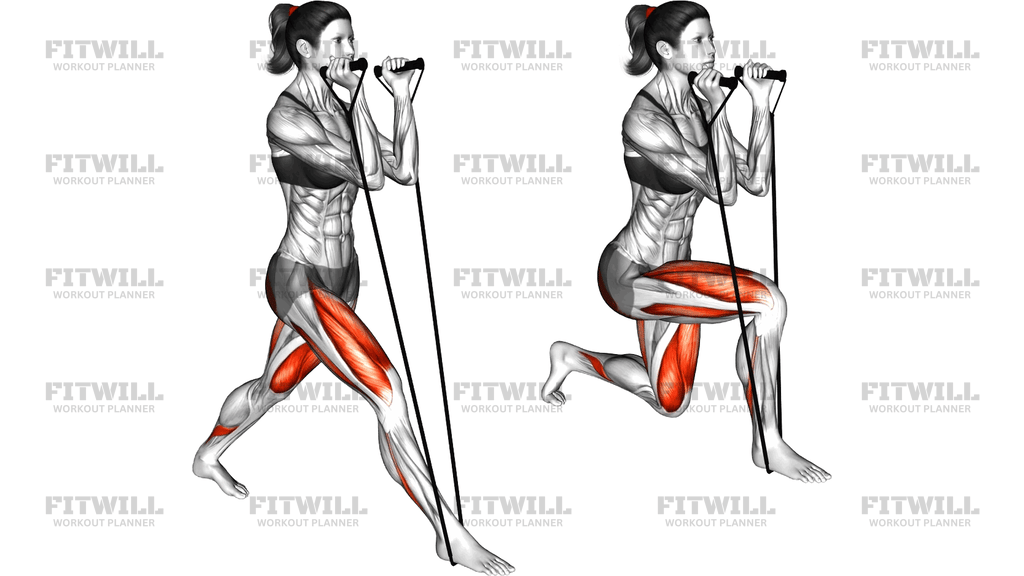
The setup matters because the band changes the feel of the rep from the very start. Step one foot onto the center of the band, hold a handle in each hand, and rack the handles at shoulder height so the band stays organized instead of swinging around your body. Set your feet in a split stance with the front foot flat, the back heel lifted, and your torso tall. That position gives you a stable base and keeps the tension where you want it: on the working leg and not on your shoulders or lower back.
As you lower, bend both knees and let the back knee travel toward the floor while the front shin tracks over the toes. Keep your front heel down, keep pressure through the whole front foot, and keep the handles close to the shoulders so the band does not yank your upper body forward. At the bottom, the back knee should hover just above the floor before you drive back up through the front heel and midfoot. The rep should feel smooth from top to bottom, with the torso staying stacked rather than folding at the waist.
Band Lunges work especially well when you want a controlled lunge that still gives you meaningful leg tension without heavy external weights. Because the band can pull you upward at the top and make you rush the return, the best reps are usually the ones that stay quiet, balanced, and repeatable. Beginners can use a lighter band and a shorter stance, while more experienced lifters can increase the challenge by using a stronger band, slowing the lowering phase, or taking a slightly deeper split stance. If the front knee collapses inward, the heel pops up, or the handles drift away from the shoulders, shorten the stance and reduce the resistance before you add more load.
[ Workout Log & Planner ]
Put your next workout in Fitwill
Keep your plan and training log ready when you are.


Instructions
- Step one foot onto the center of the band and take a split stance with the other foot behind you and the back heel lifted.
- Hold a handle in each hand and rack the handles at shoulder height with your wrists stacked over your elbows.
- Set your torso tall, square your hips toward the front, and plant the front foot flat on the floor.
- Brace your midsection and shift most of your weight into the front leg before you start the descent.
- Lower straight down by bending both knees until the back knee hovers just above the floor.
- Keep the front knee tracking over the second or third toe and keep the front heel planted.
- Exhale and drive through the front heel and midfoot to stand back up without snapping the knee shut at the top.
- Keep the handles close to your shoulders on the way up so the band stays under steady tension.
- Reset your split stance carefully after the last rep before you release the band.
Tips & Tricks
- Choose a band that lets you reach the bottom position without the handles being pulled out of your shoulders at the top.
- A shorter split stance usually keeps the work more on the quads; a longer stance shifts more stress toward the glutes and hips.
- Keep the front foot in a tripod: big toe, little toe, and heel all stay in contact with the floor.
- If the front knee caves inward, slow the descent and think about driving the knee over the second toe.
- Let the back knee travel down and slightly back, not straight forward into the front shin.
- Keep your ribcage stacked over your pelvis instead of arching your lower back to stay upright.
- Pause only long enough for control; bouncing out of the bottom usually makes the band and knee path sloppy.
- If your shoulders shrug while holding the handles, lighten the band and keep your elbows pointed slightly down.
- Use a slower lowering phase when you want more leg tension without adding more band resistance.
Frequently Asked Questions
What muscle does Band Lunges target most?
The quads are the primary movers, with the glutes, adductors, and core helping you stay stable through the split stance.
Can beginners perform this exercise?
Yes. Start with a light band and a shorter stance so you can keep the handles steady at shoulder height and control the bottom position.
Where should the band sit during Band Lunges?
The middle of the band should be under the front foot, with one handle in each hand and the handles racked near the shoulders.
Should my back knee touch the floor?
No. Let it hover just above the floor so you keep tension on the front leg and avoid losing the bottom position.
How do I make Band Lunges more quad-focused?
Use a slightly shorter stance, keep the torso tall, and let the front knee travel forward while the heel stays planted.
Why do the handles feel awkward at the top of the rep?
If the band is too light or your stance is too short, the handles can pull upward quickly. Step farther onto the band or use a stronger band so the tension stays smooth.
What if my front heel comes off the floor?
Shorten the stance and reduce the band tension. The front foot should stay flat so the leg can drive through the whole foot instead of the toes alone.
Can I use Band Lunges as a warm-up?
Yes. Use a lighter band and crisp reps to rehearse the lunge pattern before heavier lower-body work.