Band Standing Leg Extension
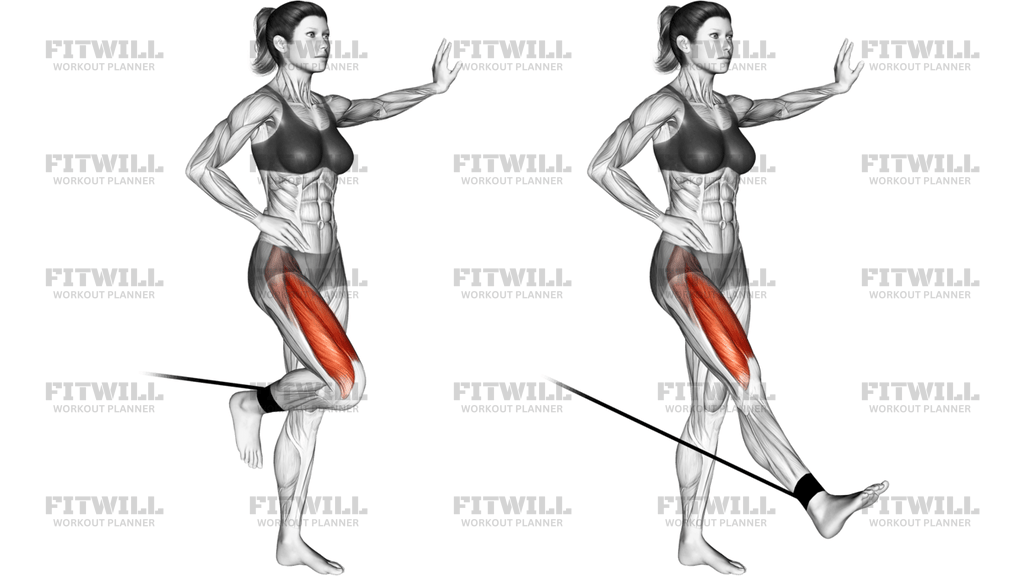
Band Standing Leg Extension is a standing single-leg quad exercise that uses a low anchored band to challenge knee extension without a machine. The band pulls from behind the body while you straighten the working knee, so the quads have to do the main work and the standing leg has to keep you balanced. It is useful when you want direct thigh work with a simple setup, especially if you need a lighter alternative to machine extensions or want to add quad-focused work at home.
The setup matters more here than on many other band moves. The anchor should stay low and behind the working leg so the band loads the leg as the knee bends and straightens. Your torso should stay tall, the support foot should be rooted, and the pelvis should stay square instead of twisting to help the rep along. If the stance gets loose, the band will start pulling the body around instead of loading the quads.
Each repetition should feel like a controlled knee extension, not a swing. Start with the working knee bent, then extend the lower leg forward until the leg is nearly straight and the quad is fully contracted. Hold briefly at the top if you can keep tension, then let the knee bend back slowly as the band returns the leg to the start. The standing leg, hips, and trunk should stay steady while the working thigh does the job.
This movement is often used for quad isolation, warmups before lower-body training, or accessory work when you want more knee-dominant volume without heavy spinal loading. It can also help lifters learn to feel the quads contract through the full range of knee extension. Because the band tension increases near the top, the finish of the rep should stay smooth rather than snapping into lockout.
Keep the resistance light enough that you can control the return and avoid twisting through the hips or leaning back. A small amount of balance work is normal, but the exercise should not turn into a standing core drill. If the knee feels pinchy or the band path is awkward, shorten the range and reduce the load until the rep feels clean and pain-free.
[ Workout Log & Planner ]
Put your next workout in Fitwill
Keep your plan and training log ready when you are.


Instructions
- Anchor a band low behind you and loop it around the ankle of the working leg.
- Stand tall on the support leg, keep the working knee bent, and let the band start with the lower leg tucked back.
- Square your hips and brace lightly so your torso stays upright instead of leaning forward or twisting.
- Hold one hand on your hip or extend it slightly for balance without pulling your body off center.
- Exhale and straighten the working knee, driving the lower leg forward against the band.
- Finish with the leg nearly straight and the quad squeezed, but do not snap the knee into a hard lockout.
- Pause briefly at the top while keeping the support foot planted and the pelvis level.
- Inhale and let the knee bend back slowly until you return to the bent starting position under control.
- Repeat for the planned reps, then step out of the band tension carefully.
Tips & Tricks
- Choose a band that lets you control the last third of the extension, where the tension is highest.
- Keep the support knee soft and planted so the working leg, not the standing leg, does the lifting.
- If your hips rotate toward the band, shorten the range and re-square before the next rep.
- A short pause near full extension makes the quad work harder than chasing speed or extra reps.
- Lower the leg slowly on the way back; letting the band yank the ankle back usually means the resistance is too heavy.
- Keep the toes of the working foot pointed forward so the knee extends in a straight line.
- Do not arch the low back to fake a bigger finish position.
- If the band rubs behind the ankle or slips, reposition it lower and check the anchor height before continuing.
Frequently Asked Questions
What muscle does Band Standing Leg Extension target most?
The quads do most of the work because the exercise is driven by knee extension.
Can beginners perform this exercise?
Yes. Beginners usually do best with a light band, a small range at first, and a steady support stance.
Where should the band be anchored?
Use a low anchor behind the working leg so the band loads the lower leg as the knee bends and straightens.
Should my standing leg stay bent or locked out?
Keep a soft, stable knee on the support leg. Locking it out makes balance harder and can encourage hip sway.
Do I need to lock out the working knee at the top?
No. Finish the rep close to straight, squeeze the quad, and stop before the knee snaps into a hard lockout.
Why does the band feel hardest near the end of the rep?
Because the band lengthens as you extend the knee, so tension rises as the lower leg comes forward.
What should I do if I feel my hips twisting?
Reduce the band tension, narrow the range, and keep both hip points facing forward throughout the rep.
Is this a good warm-up before leg training?
Yes. It can wake up the quads before squats, lunges, or other knee-dominant lower-body work.