Cable Sitting Calf Raise
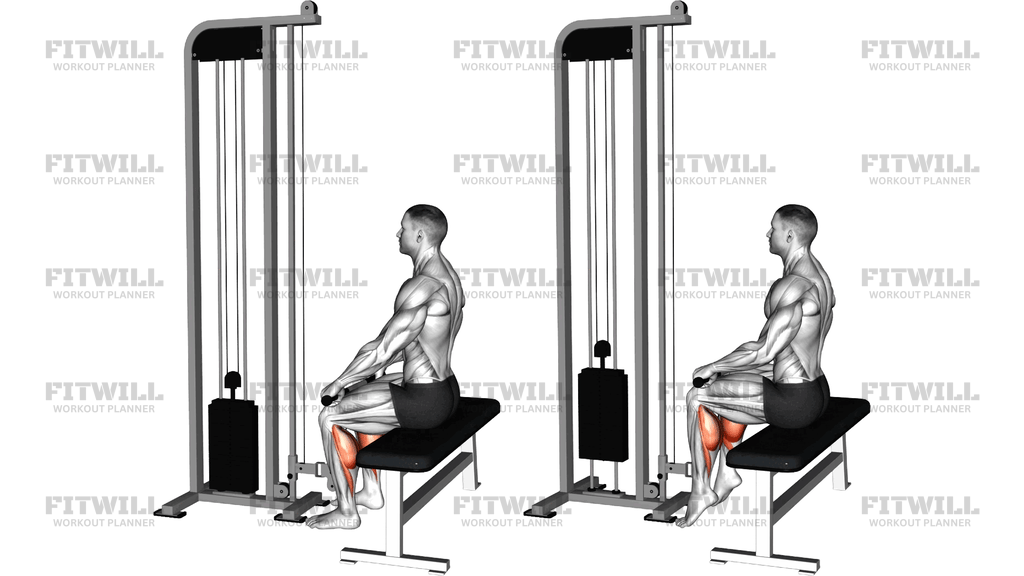
The Cable Sitting Calf Raise is a seated calf exercise that uses a low cable pulley for resistance instead of a machine or dumbbells. You sit sideways on a flat bench with the cable attachment braced across your knees, then drive up onto the balls of your feet and lower your heels back down under control. Because the knee is bent to roughly ninety degrees, the gastrocnemius is placed in a shortened position at the knee, which shifts most of the work to the soleus, the deep, flat muscle that sits underneath it and makes up the bulk of the lower calf.
This setup is a good option when the seated calf raise machine at your gym is taken or poorly sized for your legs, and it is also easy to adjust. Changing the pin on the stack in small increments gives you finer control over load than most plate-loaded machines, which makes the movement useful for beginners learning the pattern as well as for more experienced lifters chasing higher rep volumes. Because the resistance comes from a cable, the tension stays smooth and constant through the entire range, including the stretch at the bottom, where many people rush or lose contact with the weight.
Setup matters more here than it might seem. The bench height and your distance from the pulley determine both the angle of pull on your knees and whether you can reach a full stretch without the weight stack bottoming out or the cable pulling your knees upward. Your feet need enough room in front of the bench so your heels can drop below the level of your toes at the bottom, and your knees should stay bent and stable so the quads and hip flexors do not turn the set into a leg press.
To execute it well, keep the movement slow and deliberate. Pause briefly with a full stretch in the calf at the bottom, then press the balls of your feet down to raise your heels as high as they will go, and squeeze the top for a beat before lowering. The calf muscles respond well to controlled tempo and long pauses, and most people who fail to progress on calf work are simply bouncing through the stretch. Expect a strong burning sensation in the lower calf rather than the upper calf bulge, which is exactly what you want from a seated variation.
[ Workout Log & Planner ]
Put your next workout in Fitwill
Keep your plan and training log ready when you are.


Instructions
- Set a flat bench sideways to a cable machine so the low pulley is directly in front of your knees, and attach a handle or strap to the low cable.
- Sit upright on the bench with your feet flat on the floor and your knees bent about ninety degrees, feet roughly hip-width apart.
- Lay the cable handle across both knees, just above the kneecaps, and hold it firmly in place with one or both hands so it cannot slide off.
- Sit tall and brace your trunk lightly, keeping your back neutral rather than rounded forward over your thighs.
- Allow your heels to lower toward the floor until you feel a stretch along the back of the lower leg, keeping the balls of your feet in firm contact with the ground.
- Exhale and press down through the balls of your feet to lift your heels as high as possible, keeping your knees bent and pointing the same direction the whole time.
- Pause for one to two seconds at the top with the calves fully contracted.
- Inhale and lower your heels in a slow, controlled motion back to the stretched position without letting the weight stack slam down.
- Complete your repetitions, then release the handle from your knees before standing up or adjusting the weight.
Tips & Tricks
- If the handle tends to slip off your knees, cross your hands over it so each hand holds the opposite side, which pins it down far more securely.
- Keep your knees bent at the same angle for every rep. Straightening the knees as you press up quietly turns the set into a standing calf raise and reduces the soleus emphasis.
- Do not let the weight stack touch down between reps if you want continuous tension. Stop your descent just before the plates settle.
- Bouncing out of the bottom stretch is the most common fault on this movement. The cable makes the bounce feel easy, so deliberately pause in the stretch for a full second.
- Adjust your distance from the machine so the cable pulls roughly straight down over your knees. Sitting too far away drags your torso forward and rounds your lower back.
- Your toes may turn slightly outward or inward to shift emphasis within the calf, but keep the change small. Excessive foot rotation usually just strains the ankle.
- If your heels cannot drop below your toes because of floor contact or tight calves, place the balls of your feet on a small plate or step platform to create room for a fuller range.
- Keep the working foot's knee from wobbling inward or outward by squeezing the thigh lightly; the knee should act as a fixed hinge, not a moving joint.
- Higher reps, in the fifteen to twenty-five range, tend to work better here than very heavy sets, since the small handle-on-knees setup is less stable than a dedicated machine.
Frequently Asked Questions
Which muscles does the Cable Sitting Calf Raise work?
The primary muscle is the soleus, with the gastrocnemius assisting. The bent-knee position shortens the gastrocnemius across the knee joint, which is why the soleus takes on most of the load in this seated variation.
How is the Cable Sitting Calf Raise different from a standing calf raise?
Standing calf raises are done with straight knees, which puts the gastrocnemius under a strong stretch and makes it the main mover. The seated version bends the knee to about ninety degrees, so it targets the soleus more directly and lets you train the calf without the lower back or whole body bearing the load.
Is the Cable Sitting Calf Raise suitable for beginners?
Yes. The seated position is stable, the cable stack allows small weight jumps, and there is no balance demand like there is in a single-leg standing raise. Beginners should start light and focus on a full stretch and pause at the top before adding load.
Why does the cable handle go on my knees instead of being pulled with my hands?
Resting the attachment across the knees transfers the cable's resistance directly into the shin and ankle, so your heels have to push against it to lift. Your hands only hold the handle in position, which is why you keep your arms relaxed rather than pressing with them.
What should I do if the handle slides off my knees during the set?
Hold the handle with crossed hands so each hand anchors the opposite side against your thigh, and make sure your knees stay bent at a consistent angle. Sliding usually happens when the knees rise or straighten during the rep.
Can I use a bench instead of the dedicated seated calf machine?
Yes, that is the main appeal of this setup. A flat bench plus a low pulley replicates the machine's function, and adjusting the stack gives you finer load increments than most plate-loaded seated calf machines.
How deep should I lower my heels at the bottom?
Lower until you feel a clear stretch along the back of the lower leg, ideally with the heel slightly below the level of your toes. If the floor blocks your heel, elevate the balls of your feet on a plate or step to create the extra range.
How many reps should I do on this exercise?
The soleus is fatigue-resistant and dominated by slow-twitch fibers, so sets of fifteen to twenty-five reps with a controlled tempo generally work better than very heavy sets of five to eight. Even at heavier loads, keep the form strict.
Is it safe for my knees to have a cable pressing on them?
The load rests on the strong part of the thigh just above the kneecap, and the knee stays bent and static throughout, so the joint itself is not moving under load. If you have a current knee complaint or the pressure causes discomfort, choose a strap attachment that spreads the load or use a seated calf machine instead.
What is a good substitute if my gym has no low cable pulley?
A seated calf raise machine is the closest match, followed by a dumbbell held on the knees while seated on a bench. Both preserve the bent-knee, soleus-focused position that defines this movement.