Boxing Full Uppercut (With Bag And Gloves)
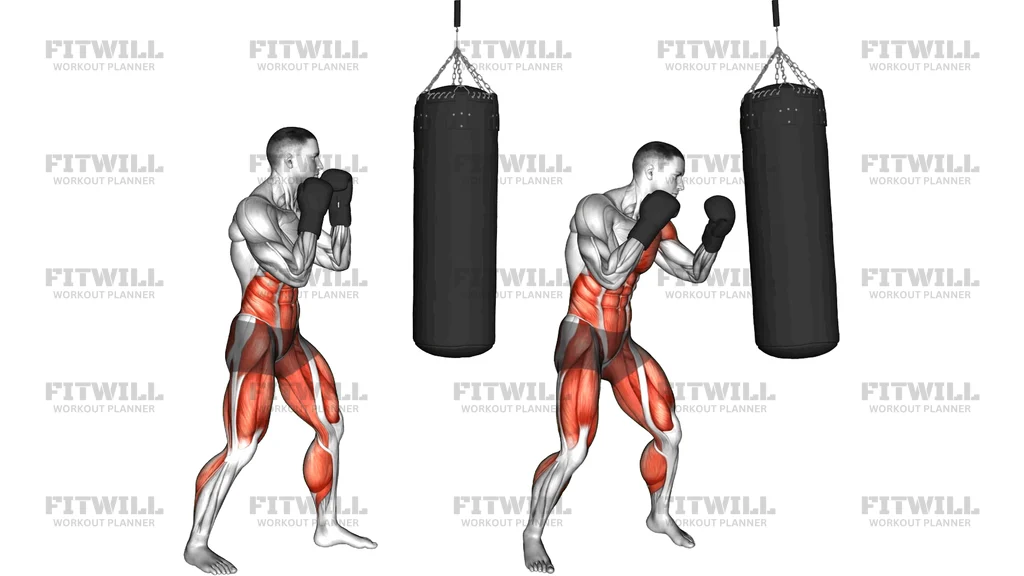
The Boxing Full Uppercut (With Bag And Gloves) is a heavy bag drill that trains the full-body mechanics of the uppercut punch, from the ground up. Unlike an isolated arm movement, a proper uppercut starts with a slight knee bend and hip dip, then drives upward through the legs and hips as the torso rotates, sending the fist in a vertical arc into the underside of the bag. Wearing boxing gloves on a suspended heavy bag gives you a realistic target with enough resistance and rebound to practice the punch with genuine intent.
This drill is useful for boxers and martial artists sharpening their short-range power, and equally for general lifters who want a demanding conditioning movement that ties the legs, trunk, and arms into one coordinated action. The highlighted muscle work sits in the obliques and abdominal wall, which transmit rotational force, along with the shoulders and chest that finish the punch, and the thighs and calves that initiate the drive off the floor.
The setup matters because the uppercut is a short lever with a steep angle of travel. Standing at the correct distance from the bag, with the lead foot staggered and knees softly bent, determines whether the punch travels cleanly upward through the target or drifts and loses power. Your hands stay high in guard between punches, chin tucked, so the non-punching arm never drops as the working hand fires.
To execute well, dip slightly by bending the knees, rotate the hips and torso inward for the side you are punching with, and let the elbow stay bent as the fist rises in a tight vertical path. Contact happens with the knuckles of the glove on the lower half of the bag, ideally as the bag swings back toward you rather than away. Exhale sharply on each punch and reset your guard immediately after contact.
Common use cases include technical boxing practice, heavy bag conditioning rounds, and warm-up or finisher work in a general fitness program. Keep your wrists aligned under the fists, avoid leaning back or overreaching for the bag, and build volume gradually. Because the punch loads the lower back and knees with rotational force, control the dip depth and keep the movement crisp rather than sloppy when fatigue sets in.
[ Workout Log & Planner ]
Put your next workout in Fitwill
Keep your plan and training log ready when you are.


Instructions
- Put on your boxing gloves and stand facing a suspended heavy bag at roughly arm's length, close enough that your fist reaches the lower half of the bag with a slightly bent elbow.
- Take a staggered stance with your lead foot forward and rear heel slightly raised, knees softly bent, and bring both gloves up to your chin in guard.
- Brace your abdominal wall as if expecting light contact, tuck your chin, and keep your weight balanced across both feet.
- For a rear-hand uppercut, dip by bending the knees a few inches and loading the rear hip while your guard stays high.
- Drive upward through the rear leg, rotating the hip and torso inward as your elbow stays bent and the fist travels in a tight vertical arc toward the underside of the bag.
- Strike the lower portion of the bag with the lead knuckles of the glove, palm facing you at contact, and exhale sharply as you land the punch.
- Allow the glove to rebound off the bag and bring the hand straight back to your chin, re-establishing guard without letting the other hand drop.
- Breathe rhythmically between punches, inhaling during the reset and exhaling on every strike.
- Alternate sides for a two-hand version, dipping with each knee bend and rotating through the corresponding hip so both sides of the trunk share the work.
- Finish the round by stopping the bag's swing with your gloves, stepping back, and loosening your shoulders before the next set.
Tips & Tricks
- The most common mistake is arm-punching: if the fist rises while your feet stay flat, you lose most of the force. Feel the rear heel lift and the knee straighten a fraction before the glove arrives.
- Keep the elbow under the fist throughout the arc. When the elbow flares out to the side, the punch becomes a wide hook and stresses the shoulder joint.
- Do not lean your head and chest over your front foot to reach the bag. If you cannot touch the lower half of the bag comfortably, step slightly closer instead of overreaching.
- Time the punch to the bag's swing. Hitting a bag that is swinging away deadens the impact and jolts the elbow; striking as it returns lets the glove rebound cleanly.
- Keep the non-punching glove glued to your cheek. Many people drop the opposite hand during the dip, which is exactly when a real opponent would counter.
- A deep squat-like dip is not better. Two to four inches of knee bend is enough to load the hips; anything deeper slows the punch and rounds the lower back.
- Keep your wrist firm and aligned so the glove lands square. A collapsed wrist on bag contact is a fast route to a sore forearm.
- If the bag swings wildly between punches, you are pushing rather than snapping. Aim for a quick, penetrating hit and immediate return to guard to keep the bag moving predictably.
- Fresh gloves and wrapped wrists make longer rounds far more comfortable on the knuckles and wrists, especially as punch volume climbs.
Frequently Asked Questions
What muscles does the Boxing Full Uppercut (With Bag And Gloves) work?
The punch is driven by the obliques and core, which rotate the trunk, with strong contributions from the shoulders and chest at contact. The quads, glutes, and calves generate the upward leg drive, and the forearms work to keep the fists closed and wrists firm.
Is the Boxing Full Uppercut (With Bag And Gloves) suitable for beginners?
Yes, as long as you start slowly with single punches rather than fast combinations. Practice the knee dip and hip rotation without power first, then add speed once the vertical path feels natural.
Where exactly should I hit the bag during an uppercut?
Aim for the lower half of the bag, roughly at your sternum-to-chin height depending on your stance. Hitting too high turns the punch into a push and extends your arm into a weak position.
Why does my shoulder ache after practicing the Boxing Full Uppercut (With Bag And Gloves)?
This usually means the elbow is flaring away from your body or the punch is being generated from the arm instead of the legs and hips. Keep the elbow tucked under the fist and lead the movement with the hip rotation to unload the shoulder.
Should I throw one uppercut at a time or alternate hands?
Start with single rear-hand uppercuts to groove the mechanics, then progress to alternating left and right for conditioning rounds. Alternating doubles the trunk rotation demand and keeps the bag swinging more consistently.
Can I do the Boxing Full Uppercut (With Bag And Gloves) without gloves?
Gloves are strongly recommended for bag work because they protect the knuckles and wrists at realistic impact force. Without them, use very light contact or a softer target until your hands are conditioned.
How close should I stand to the heavy bag?
Stand close enough that your fist reaches the lower half of the bag with your elbow still bent. If you have to straighten your arm or step in to land the punch, you are too far away for this movement.
Is the uppercut a strength exercise or a cardio exercise?
It functions as both: the mechanics are explosive and strength-oriented, while continuous rounds on the bag push your heart rate high. Short, sharp sets emphasize power, and longer timed rounds shift it toward conditioning.
How do I protect my lower back during this drill?
Keep the knee dip shallow, stay upright through the chest, and let the rotation come from the hips rather than bending at the waist. If your lower back takes over, reduce punch power and rebuild the hip drive.