90 To 90 Side Bend Stretch
The 90 To 90 Side Bend Stretch combines a seated 90/90 hip position with a lateral flexion of the spine, so you work on two areas at once. You sit on the floor with one leg bent to roughly 90 degrees in front of you and the other leg bent to roughly 90 degrees out to the side behind you, then lean sideways over the front leg while the opposite arm reaches up and over your head. The result is a stretch through the obliques and the muscles along the side of your lower back on the far side, along with the outer hip of the front leg.
This setup is especially useful for anyone whose hips feel locked up from long hours of sitting. The 90/90 base positions your hips in both internal and external rotation, which is a range most desk-bound people quietly lose, and adding the side bend layers a lateral stretch over the trunk that a standard hip stretch never touches. It is a common sight in warm-ups for squats and golf, in martial arts and BJJ mobility work, and in cool-downs after lower body training days.
The muscles doing the stretching here are the near-side obliques on the side you bend toward, plus the far-side obliques and quadratus lumborum, which are lengthened as the torso curves over. Because the pelvis is pinned by your legs, the lateral bend travels through the waist rather than being absorbed by the hips, which is exactly what makes the stretch feel so targeted along the ribs to the hip crest.
Setup quality decides everything in this stretch. If your front knee lifts off the floor or your back leg drifts, the pelvis tilts and the side bend turns into a twist, and you lose the clean lateral line through the waist. Sit tall first, square your chest forward, and only then start the lean. The reach of the top arm should feel like it is lengthening your ribs away from your hip, not like you are simply flopping toward the floor.
Because this is a floor-based stretch with no load, it is very beginner friendly, but it demands honest mobility. If you cannot sit upright in the 90/90 base without rounding, place a yoga block or folded towel under the hip of the front-leg side to level your pelvis. Move into the bend slowly, breathe steadily, and let the range improve over weeks rather than forcing depth in a single session. Mild stretch discomfort is expected; sharp pain in the hip, knee, or spine is your signal to back off and reduce the lean.
[ Workout Log & Planner ]
Put your next workout in Fitwill
Keep your plan and training log ready when you are.


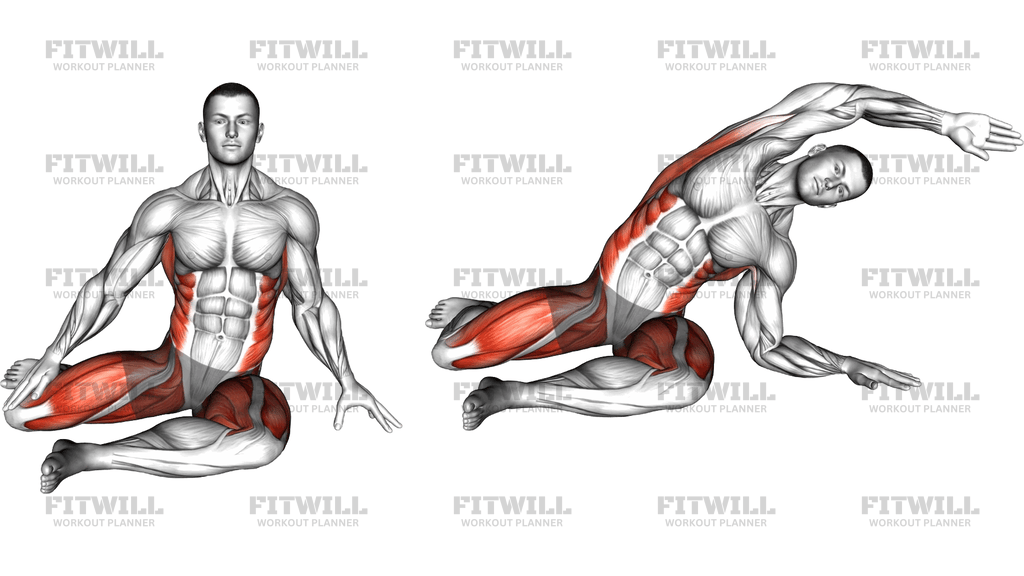
Instructions
- Sit on the floor or an exercise mat with both legs bent. Place your right leg in front of you with the knee at about 90 degrees and the shin lying across your body, foot resting near your left hip.
- Position your left leg out to the side behind you, knee bent about 90 degrees so the shin runs parallel to the back wall and the thigh points forward. Both sit bones should stay as even as possible on the floor.
- Sit up tall, stack your ribs over your pelvis, and rest your right hand lightly on the floor beside your right hip or on your front thigh for support.
- Brace your core lightly to keep your chest facing forward, then begin leaning your torso sideways toward your front leg without letting your chest rotate toward the floor.
- Reach your left arm up and over your head in the same direction as the lean, lengthening the left side of your body from ribs to hip as you go.
- Follow the arm with your eyes and let your head stay in line with your spine rather than dropping it forward.
- Hold the end position where you feel a clear stretch along the left side of your waist and the outer edge of your right hip, breathing slowly and deeply for 20 to 45 seconds.
- Exhale and slowly pull yourself back upright using your supporting hand, reversing the arm path so the overhead arm returns to your side.
- Straighten up fully, reset your posture, and repeat on the other side with the legs switched so the left leg is in front and you bend toward the left.
- Complete 2 to 3 rounds per side, resting briefly between rounds and keeping the range consistent rather than chasing extra depth each rep.
Tips & Tricks
- If your front knee hovers off the floor, do not push it down hard; instead, elevate the opposite hip on a block or folded towel so the pelvis levels out and the knee can settle naturally.
- A common mistake is letting the chest rotate down toward the floor as you lean, which turns the side bend into a forward twist. Keep your sternum pointing at the wall in front of you throughout.
- Do not round through the lower back to reach further sideways. Bend from the waist by pushing the hip of the stretched side down and away, keeping the spine long.
- Keep the weight light on your supporting hand. If you push hard into the floor you will dump tension out of the stretch and simply lean instead of lengthen.
- The overhead arm should reach diagonally, in line with the curve of your body, not straight up. Reaching too vertically removes tension from the far-side obliques.
- Watch the back leg: if the knee of the rear leg lifts or the foot swings, your pelvis is rotating. Shift your weight slightly toward the front-leg sit bone to stay square.
- Breathe into the stretched side of your ribcage. Each exhale usually lets you ease a little deeper without forcing anything.
- If your knees or hips complain in the 90/90 base before the side bend even starts, spend a few weeks on the plain 90/90 sit first and add the lateral bend only when the base feels comfortable.
- Avoid bouncing at the end range. A slow, steady hold with quiet breathing gives the waist and outer hip far more usable range than pulsing.
Frequently Asked Questions
Which muscles does the 90 To 90 Side Bend Stretch target?
The main targets are the obliques and the quadratus lumborum along the side of your lower back on the side away from the bend, while the outer hip muscles of the front leg, such as the gluteus medius and deep rotators, are stretched by the 90/90 base position.
Why is the stretch done with both knees bent at 90 degrees?
The two 90-degree legs put one hip in external rotation and the other in internal rotation at the same time, covering two common restriction patterns in one position. That stable base also pins the pelvis so the side bend travels through the waist instead of the hips.
Should I bend toward the front leg or away from it?
In this version you lean toward the front leg while the opposite arm reaches overhead. That lengthens the far side of your waist and adds a lateral opening to the outer hip of the front leg.
Is the 90 To 90 Side Bend Stretch suitable for beginners?
Yes, it is body weight and easy to scale. Beginners should elevate the hip on the front-leg side with a block or cushion and reduce the lean until they can hold the base position comfortably.
My front knee will not stay down in the 90/90 position. What should I do?
Lift the opposite hip onto a yoga block or folded towel to level your pelvis, and reduce how far you lean. Forcing the knee down usually rotates the pelvis and removes the stretch from the waist.
How long should I hold each side?
Hold for 20 to 45 seconds per side and repeat 2 to 3 rounds. Longer, relaxed holds with steady breathing work better for range than short, forced pulls.
Can I use this stretch before training?
It works well as part of a lower body warm-up for squats, golf, tennis, or grappling, since it opens the hips and lateral trunk together. Keep pre-workout holds shorter, around 15 to 20 seconds, and save longer holds for after training.
What can I substitute if the seated position is uncomfortable?
A standing side bend with a wide stance stretches the obliques similarly, and a separate seated 90/90 hip stretch covers the hip portion. Combine the two until the floor position feels accessible.
Is it normal to feel this more in the hip than in the waist?
Yes, especially if your hips are tighter than your trunk. Keep your chest facing forward and focus on pushing the hip of the stretched side down into the floor to shift the sensation into the waist.
Are there any safety concerns with this stretch?
Move slowly and stop at mild stretch discomfort, never sharp pain. If you have a recent hip, knee, or lower back injury, get clearance from a qualified professional before loading the 90/90 position.