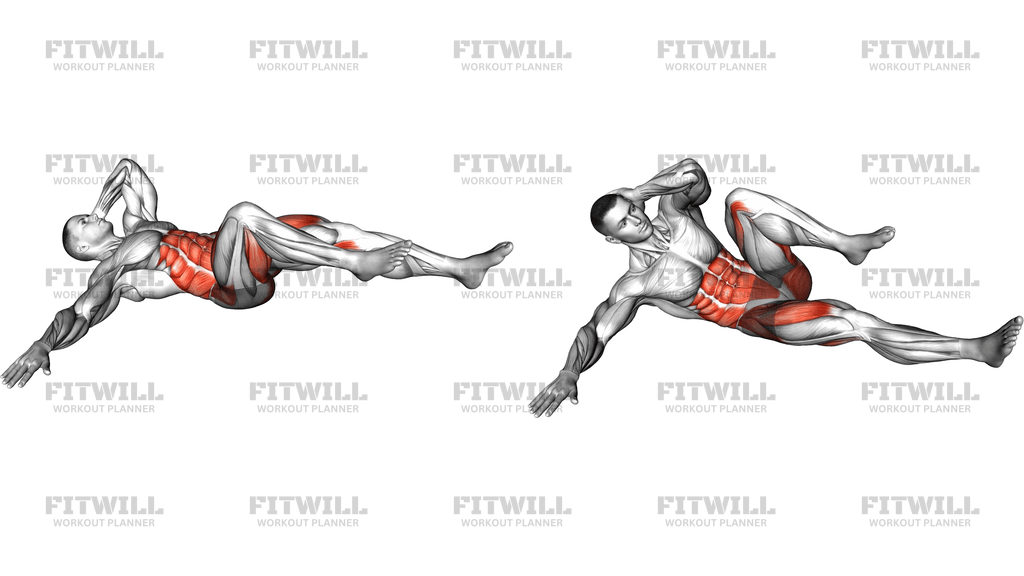
Oblique Crunch Opposite Elbow To Knee
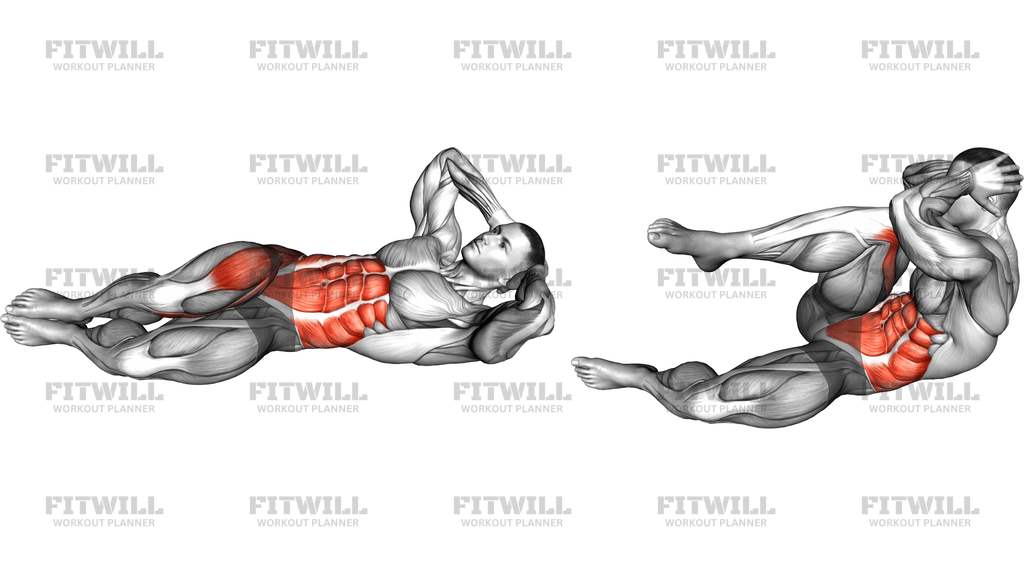
The Oblique Crunch Opposite Elbow To Knee is a bodyweight floor exercise that targets the side muscles of your trunk by folding the body diagonally. You lie on your back with your hands lightly placed behind your head, then lift your shoulder blade off the floor while rotating your ribcage so one elbow travels across your body toward the opposite knee. Because the crunch and the rotation happen together, the obliques on the working side have to shorten through both of their jobs at once: flexing the spine and pulling it into rotation.
This movement is a step up from a standard crunch. A regular crunch works the rectus abdominis in a straight up-and-down plane, but the moment you add the cross-body reach, the demand shifts to the external and internal obliques, which run diagonally around your waist. Those muscles are what let you twist, resist unwanted rotation, and transfer force between your upper and lower body, so training them directly pays off in throwing, swinging, and carrying tasks as well as in how your waist looks and feels.
Setup matters more than most people realize. Your lower back should stay in contact with the floor, your knees should be bent, and your hands should support the weight of your head without pulling on your neck. The most common way this exercise goes wrong is yanking the head forward with the arms, which turns an oblique exercise into a neck exercise. Keeping the elbows wide and letting the abdominal muscles do the lifting is what makes the difference between a productive set and twenty wasted, uncomfortable reps.
To execute it well, think about rotating from the ribs rather than reaching with the elbow. The elbow is just the far end of the moving segment; the actual work is a diagonal crunch where your shoulder blade lifts and your torso twists toward the opposite hip. Exhale as you pull up and across, pause briefly at the top where the obliques are fully contracted, then lower back down under control instead of letting gravity drop you.
This exercise fits well in a home core routine, a warm-up before heavier lifting, or as a finishing movement after squats and deadlifts. Because it needs nothing more than a mat and a few feet of floor, it is easy to program anywhere, and alternating sides lets you work both obliques evenly in the same set. Start with modest reps and prioritize the twisting quality of each rep over the height you reach; a short, tight contraction beats a long, loose one every time.
If you have any history of neck or lower back discomfort, keep the range small, avoid pulling on your head, and stop if you feel pain rather than muscle effort. Done with control, the Oblique Crunch Opposite Elbow To Knee is one of the most direct ways to challenge the diagonal strength of your waist using only your body weight.
[ Workout Log & Planner ]
Put your next workout in Fitwill
Keep your plan and training log ready when you are.


Instructions
- Lie on your back on an exercise mat with your knees bent and your feet flat on the floor, about hip-width apart.
- Place your hands lightly behind your head with your fingers near your ears and your elbows flared out to the sides; do not interlace your fingers and pull.
- Gently brace your abdominal muscles and press your lower back toward the floor so your spine starts in a neutral, supported position.
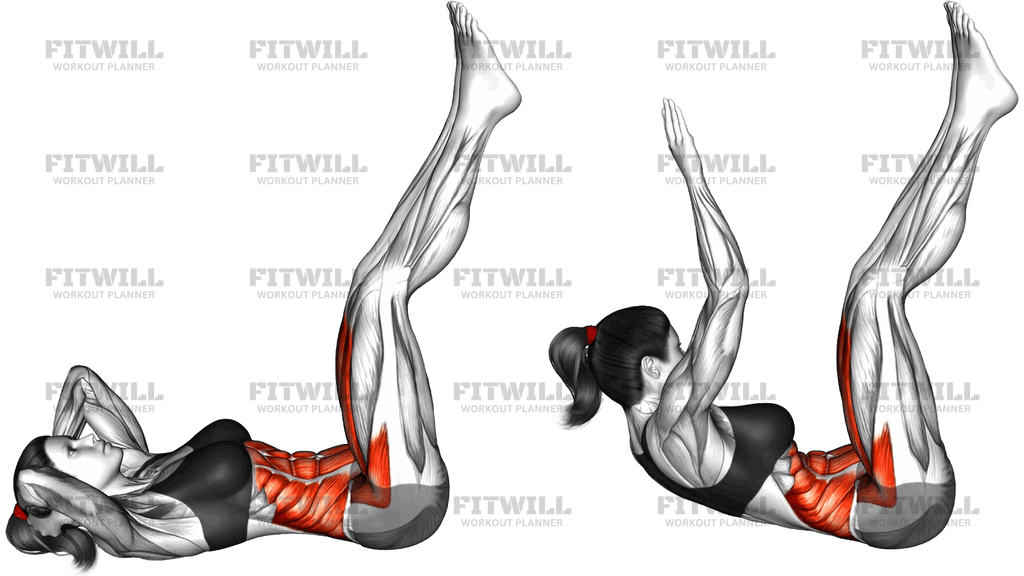
- Exhale as you lift your shoulder blade off the mat and rotate your ribcage, driving one elbow diagonally across your body toward the opposite knee.
- At the top, your torso should be twisted so the elbow points toward the far knee while the opposite shoulder stays heavy on the floor; squeeze the oblique on the working side for a moment.
- Keep the elbow wide and lead with the ribs and shoulder, not with your hand or head, so the rotation comes from your trunk.
- Inhale as you lower your torso back down slowly, unrolling the spine until your shoulder blade touches the mat again.
- Complete all reps on one side or alternate elbow to opposite knee rep by rep, keeping the tempo slow on the way down.
- Reset your brace and neck position between reps, and stop the set once your neck or lower back takes over the work.
Tips & Tricks
- If your neck aches during the set, you are almost certainly pulling with your hands; imagine holding a raw egg under your chin and let your abs lift the weight of your head instead.
- The crunch should travel diagonally, not straight up. If your elbow ends up pointing at the ceiling rather than across your body toward the opposite knee, your obliques are not doing the rotating.
- Do not chase the knee with a long reach. Lifting the shoulder blade an inch or two with a strong twist is more effective than flinging the elbow forward with a loose torso.
- Keep the foot on the working side planted. Letting the knee collapse inward as you twist usually means the hip is stealing movement that should come from the waist.
- Exhale sharply on the way up. Blowing air out as you crunch naturally helps the abs shorten and makes the top position easier to feel.
- Lower for a count of two or three. Dropping back down between reps removes the tension that makes this exercise worth doing.
- If you feel it mostly in your hip flexors at the front of your hips, reduce the range and focus purely on lifting and rotating the ribcage rather than pulling your whole trunk up.
- Match reps side to side when alternating, and start with your weaker side so both obliques develop evenly.
Frequently Asked Questions
Which muscles does the Oblique Crunch Opposite Elbow To Knee work?
The primary muscles are the obliques on the side you are crunching toward, with the external and internal obliques handling the twist. The rectus abdominis assists with the crunch, and the hip flexors help stabilize your legs and pelvis.
Why does the elbow go to the opposite knee instead of the same-side knee?
Crossing the body forces your torso to rotate, which is what loads the obliques. Bringing the elbow to the same-side knee would keep the crunch in a straight plane and turn it back into a basic abdominal crunch.
Is the Oblique Crunch Opposite Elbow To Knee suitable for beginners?
Yes, as long as the range is kept modest and the hands do not pull on the neck. Beginners should start with a smaller twist, focus on feeling the side of the waist contract, and build up reps gradually.
Should my feet stay on the floor during the movement?
Keeping both feet flat on the floor is the standard setup and keeps the emphasis on the waist. Lifting the legs toward the elbow is a harder variation, closer to a bicycle crunch, and should only be added once the floor version is solid.
How can I stop my neck from hurting during this exercise?
Keep your hands relaxed behind your head, elbows wide, and support the weight of your skull rather than pulling it forward. If the neck still fatigues first, do fewer reps per set and build up trunk strength before extending the sets.
How many reps and sets should I do?
Two to three sets of 10 to 15 controlled reps per side is a practical starting point. Because the goal is a clean diagonal contraction, slow reps with a brief pause at the top beat fast, high-rep swinging.
What can I substitute if the Oblique Crunch Opposite Elbow To Knee bothers my lower back?
A standing band or cable rotation, or a side plank, trains the obliques with less repeated spinal flexion. If you keep the floor version, reduce the range so your lower back stays supported on the mat throughout.
Can I do this exercise every day?
The obliques are muscle tissue like any other and respond better with recovery between sessions. Two to four focused sessions per week, with at least a day of rest between them, is a sensible rhythm for most people.
Will this exercise reduce fat around my waist?
No single exercise selectively burns fat from one area. The Oblique Crunch Opposite Elbow To Knee strengthens and develops the side abdominal muscles, while overall body composition is shaped by your total training and nutrition.