Cable Split Stance Single Arm Row
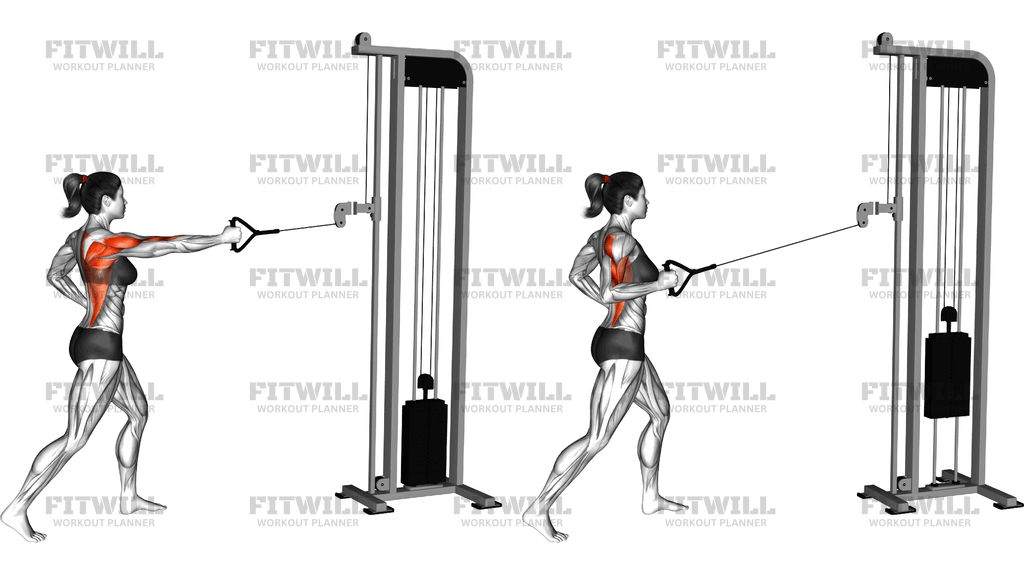
The Cable Split Stance Single Arm Row is a standing one-sided row performed on a cable machine with a single handle set at roughly chest height. You face the machine in a staggered stance, hold the handle with the arm opposite or same-side to your lead leg, and pull it back toward your lower ribs while keeping your torso upright and square. Because you are on your feet rather than seated or braced on a bench, your legs, hips, and trunk all contribute to keeping you steady while the arm does the pulling.
This exercise primarily targets the lats, with strong involvement from the rhomboids and middle trapezius as the shoulder blade retracts, plus the biceps and forearms as pulling assistants. The split stance adds a genuine stability demand: the glutes, quads, and calves of the front leg work isometrically, and the obliques resist the rotation the pulling arm naturally creates. That anti-rotation element is what separates it from a seated cable row.
It suits a wide range of trainees. Beginners appreciate the straightforward setup and the fact that the cable's tension is smooth and easy to dial in with the pin. More advanced lifters use it as an anti-rotation row, a hypertrophy movement for the upper back, or a unilateral fix for side-to-side strength differences. It is also a practical choice for people who find bent-over rows hard on the lower back, since the upright torso removes most of the spinal loading of a free-weight row.
The setup matters more than it looks. Standing too close or too far changes the resistance path: you want enough distance that the cable stays taut at full arm extension without yanking you forward. The split stance should be wide and comfortable, with most of your weight over the front leg. Square hips are essential — if your pelvis twists toward the handle, the obliques stop working and the pull loses its anti-rotation value.
Execution is simple but easy to rush. Extend the working arm fully toward the stack, brace the trunk, then drive the elbow back and slightly down until the handle reaches your lower chest or ribs, squeezing the shoulder blade back without shrugging. Pause briefly, then let the arm travel forward under control until the lat stretches. Exhale on the pull, inhale on the return, and complete all reps on one side before switching.
A few practical points keep this movement productive and safe. Keep the knee of the lead leg stacked over the ankle rather than caving inward. Choose a weight that lets you control the return for a full second or two — the eccentric is where the cable setup shines. And if the handle keeps pulling you onto your toes, step back and lighten the load rather than fighting the machine with your lower back.
[ Workout Log & Planner ]
Put your next workout in Fitwill
Keep your plan and training log ready when you are.


Instructions
- Set the pulley of the cable machine to around chest height and attach a single handle.
- Face the machine and step back so the working arm can extend fully with the cable taut; take a split stance with your front foot firmly planted and your back heel raised.
- Grip the handle with a neutral palm facing inward, and rest your free hand at your side or lightly on your hip.
- Brace your core and square your hips and shoulders toward the machine so the pull will not rotate your torso.
- Pull the handle back toward your lower ribs by driving your elbow behind you, keeping it close to your body rather than flaring it wide.
- At the end of the pull, squeeze your shoulder blade back and down without shrugging toward your ear.
- Hold the contracted position for a beat, then slowly extend your arm forward until it is nearly straight and you feel a stretch across the lat.
- Exhale as you pull the handle back and inhale as your arm returns toward the stack.
- Complete all repetitions on one arm, then re-square your stance and switch to the other side.
Tips & Tricks
- If the cable drags you forward onto your toes at full extension, take half a step back or drop the weight — leaning in turns this into a lower-back exercise instead of a back exercise.
- Watch that your lead knee stays stacked over your ankle; the split stance can drift as fatigue sets in, so reset your feet between sets if needed.
- Resist the urge to twist your torso into the pull. The anti-rotation work through the obliques is one of the main benefits, and twisting gives it away.
- Keep the elbow path close to your ribs to bias the lats; letting the elbow flare wide shifts emphasis toward the rear delts and traps.
- Do not shrug the working shoulder at the top of the pull — if your upper trap is burning, drop the weight and think about pulling the shoulder blade down and back instead.
- The free hand placement matters: pressing it lightly against your thigh or hip gives you a physical reference to check whether your torso has started rotating.
- Control the return deliberately for one to two seconds; letting the stack crash down wastes the stretched-position work on the lat.
- Use a full but not forced stretch at the start — reaching so far that your shoulder rolls forward puts unnecessary strain on the front of the joint.
Frequently Asked Questions
Which muscles does the Cable Split Stance Single Arm Row work the hardest?
The lats do most of the pulling, supported by the rhomboids and middle traps as the shoulder blade retracts. The biceps assist, while the obliques and the legs of the split stance work to keep you stable and prevent rotation.
Should the working arm match the front leg or the back leg in the split stance?
Either works, but most people find it easiest to row with the arm opposite the lead leg, which keeps the hips naturally squared. If you row on the same side as your front leg, be extra careful not to let the torso twist toward the handle.
Is the Cable Split Stance Single Arm Row good for beginners?
Yes. The stance is stable, the cable provides smooth resistance, and the chest-height pulley makes the setup intuitive. Start with a light weight to learn the anti-rotation demand before adding load.
Why stand in a split stance instead of just standing square to the machine?
The staggered stance widens your base front to back, which makes it easier to stay grounded against the cable's pull. It also adds an isometric demand on the front leg's glutes and quads that a parallel stance does not provide.
My torso keeps twisting toward the cable — how do I fix that?
Lighten the weight, re-square your hips before the first rep, and check your free hand as a reference point. Bracing the core as if bracing for a light punch also helps lock the ribcage over the pelvis.
What can I substitute if the cable machine is busy?
A single-arm dumbbell row with support on a bench trains similar muscles but with less anti-rotation demand. A band anchored at chest height and pulled in the same split stance is the closest match to the original movement.
How high should the pulley be set?
Around chest or upper-abdominal height works best, so the handle travels roughly horizontally back toward your ribs. A low pulley turns the movement into more of a lat pull-down angle, and a high one changes the pull direction significantly.
Is this exercise safe for the lower back?
For most people it is easier on the lower back than bent-over free-weight rows because the torso stays upright. Keep the load reasonable, brace the trunk, and avoid leaning or twisting, which is where strain usually creeps in.
How many sets and reps should I use?
Two to four sets of 8 to 12 reps per arm works well for general strength and muscle. Because it is a unilateral movement, always match the weaker side's rep count rather than the reverse.