Stability Ball Kneeling Rollout To Wall
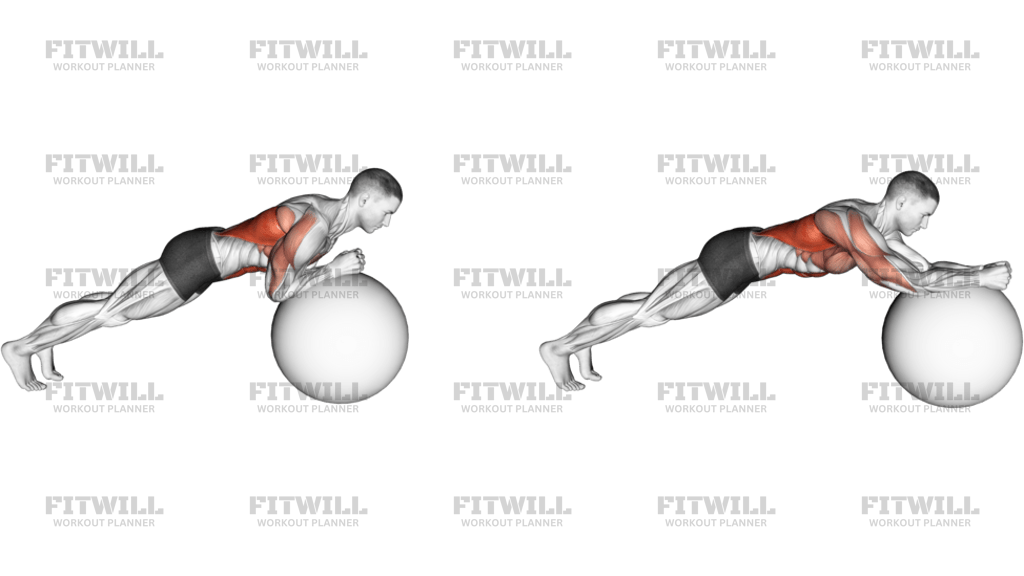
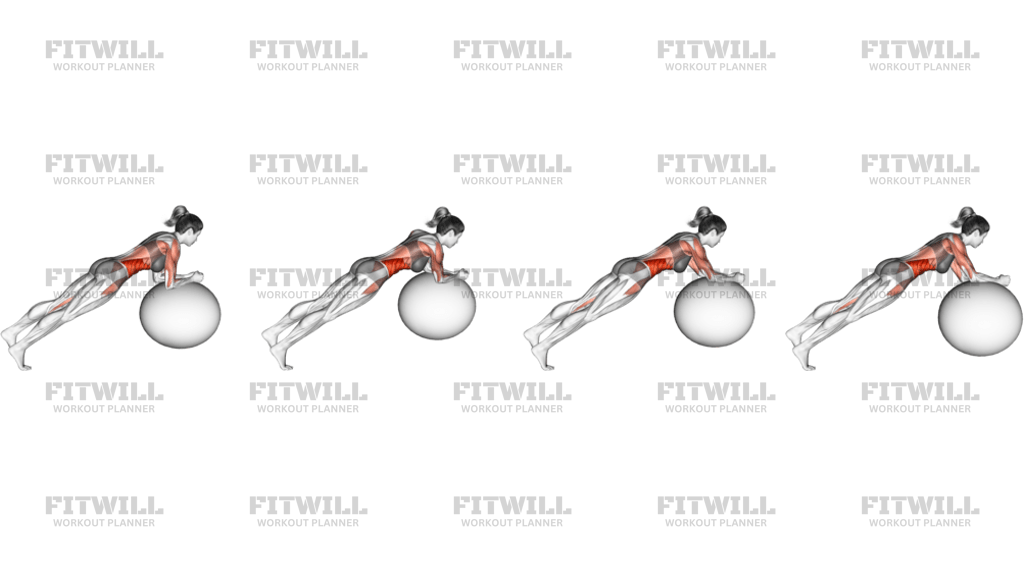
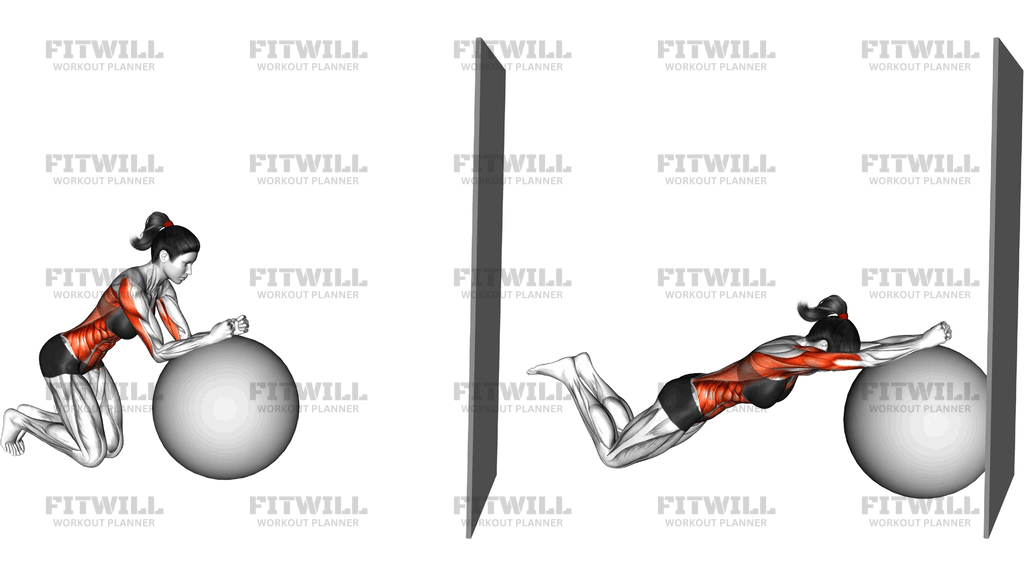
The Stability Ball Kneeling Rollout To Wall is an anti-extension core exercise where you start kneeling with your forearms resting on a stability ball and roll the ball forward until your body lengthens out over it, with a wall positioned in front of you to stop the ball at a set depth. The wall is what makes this version so useful: it gives you a built-in end point, so you can dial in exactly how far you roll depending on your current strength. Where a freestanding rollout forces you to judge your own limit and pull back before your form breaks, this setup lets you work right up to a controlled end range and focus entirely on keeping your trunk rigid.
The main demand falls on the abdominals, especially the deep core, which has to brace hard to stop your lower back from arching as your body moves from a tucked kneeling position into a long, near-plank line. Your shoulders and lats are heavily involved too, because you are pressing your forearms into a moving, unstable surface and using them to control the ball's path. The highlighted areas in this movement are the entire front of the trunk plus the shoulder complex, which is exactly what you feel on every rep.
Setup matters more here than in most core drills. The distance between your knees and the wall determines the difficulty: the closer the wall, the shorter and easier the roll; the farther away, the longer your body has to extend and the harder your abs must work. Because the ball is soft and shifts under your forearms, it also adds a balance component that a wheel or bar rollout does not, so you are training stability in multiple directions at once.
To execute it well, keep your hips tucked and your ribs down before you even start rolling, then move the ball forward slowly with your forearms rather than letting gravity drag you out. At the wall, your body should form one long diagonal from knees to head, with your arms extended overhead on the ball. Pause for a beat, then pull the ball back with your abs and lats rather than just flopping your hips backward.
This exercise suits intermediate trainees who find full floor rollouts too aggressive but have outgrown basic planks, as well as anyone who wants a forgiving way to build up rollout strength because the wall caps the range. It is also a good choice in rehab-adjacent or general fitness settings where controlling the end point reduces the risk of overextending the lower back. If you feel your lower back sagging or arching at any point, shorten the distance to the wall or stop the rollout earlier on the ball.
[ Workout Log & Planner ]
Put your next workout in Fitwill
Keep your plan and training log ready when you are.


Instructions
- Place a stability ball on the floor a few feet away from a clear wall, positioned so the ball will contact the wall when you reach full extension.
- Kneel on the floor with your knees about hip-width apart and rest both forearms on top of the ball, elbows bent and hands relaxed, with your hips above your knees.
- Tuck your pelvis under slightly, draw your ribs down, and squeeze your glutes to set a neutral spine before you move.
- Brace your trunk as if preparing to take a light push to the stomach, and keep that tension for the entire rep.
- Slowly roll the ball forward with your forearms, letting your body lower and lengthen until the ball reaches the wall and your arms are extended overhead.
- At the wall, your body should form a straight diagonal line from your knees to your head, with your core tight and no sagging in the lower back.
- Pause briefly at the wall, then pull the ball back toward your knees by driving your forearms down into the ball and pulling your hips forward and up.
- Exhale steadily as you roll out and inhale as you return, keeping your breathing smooth rather than holding your breath.
- Come back to the starting kneeling position with your hips stacked over your knees, reset your brace, then begin the next rep.
Tips & Tricks
- The most common mistake is letting the lower back arch as you approach the wall. If your ribs flare up or your belly drops toward the floor, stop the rollout earlier on the ball for a few sessions.
- Keep your forearms centered on the top of the ball. If one arm drifts toward the side, the ball will veer off course and your shoulders will twist, so consciously press both forearms evenly.
- Adjust difficulty by moving your knees closer to or farther from the wall rather than by changing how hard you brace. A shorter roll with a tight trunk beats a longer roll with a sagging lower back.
- Do not let your shoulders shrug up toward your ears at full extension. Press the ball away and think about reaching long through your arms to keep the upper back engaged.
- Move slower on the way back than on the way out. Most people roll out under control but yank their hips back, which skips the hardest part of the pulling work.
- If the ball slips on a smooth floor, train on a surface with a bit of grip or use a ball with a textured finish so the rollout feels predictable against the wall.
- Keep your head in line with your spine instead of craning to watch the wall. Looking down at the ball the whole rep tends to round the upper back early.
- Start with the ball already touching the wall to find your working distance, then shift your knees back in small increments once every rep stays clean.
Frequently Asked Questions
What muscles does the Stability Ball Kneeling Rollout To Wall work?
The abdominals, particularly the deep core, do most of the work to resist extension as your body lengthens out. Your lats, shoulders, and triceps assist by controlling and returning the ball.
Why does this rollout use a wall?
The wall gives the ball a fixed stopping point, so you can set the exact depth of each rep before you start. This makes it easier to train hard without accidentally rolling past the point where your form breaks down.
Is the Stability Ball Kneeling Rollout To Wall suitable for beginners?
Yes, if the wall is placed close so the rollout is short. Beginners should master keeping the lower back from arching over a small range before gradually moving the knees farther back.
How far should my knees be from the wall?
Start with the ball only needing to travel a short distance before it touches, which keeps the movement compact. Once you can complete all reps without your lower back arching, move your knees back a few inches at a time.
How is this different from a Stability Ball Rollout without a wall?
Without a wall you have to judge your own stopping point and reverse the ball under full tension, which is much harder. The wall caps the range, so you can pause and pull back with better control.
Why use a stability ball instead of an ab wheel?
The ball is soft and can shift in any direction, so your shoulders and core also have to stabilize side to side and in rotation. The wheel rolls in a fixed line and offers no such instability.
What should my body look like at the end position?
The ball should be touching the wall with your arms extended overhead, and your body should form one straight diagonal line from your knees to your head. Hips stay tucked, ribs down, and there should be no sag in the lower back.
My shoulders hurt during this exercise. What should I change?
You may be rolling too far for your current shoulder strength or shrugging at full extension. Reduce the range so the ball stops earlier, and focus on pressing the forearms down and reaching long rather than collapsing into the shoulders.
Can I substitute the Stability Ball Kneeling Rollout To Wall if I do not have a ball?
A wheel rollout to a marked stopping point or a plank on a sliding surface works similar muscles. If neither is available, a long-lever plank with slow reach-outs trains the same anti-extension quality with no equipment.