Exercise Ball Body Saw
Exercise Ball Body Saw is a stability-ball core drill that trains the abs to resist arching while the body shifts forward and back over a moving support. It looks simple, but the instability of the ball forces the trunk, shoulders, and hips to stay organized while the lever length changes. That makes it useful for anyone who wants stronger anti-extension control for planks, presses, carries, and athletic positions.
The exercise loads the front of the core especially hard, but the shoulders, serratus, glutes, and upper back all have to help keep the plank from folding. The goal is not to swing the body across the ball; it is to keep a long line from head to heels while the support point slides just enough to create a tougher plank. When the body stays stacked, the abs do the work instead of the low back taking over.
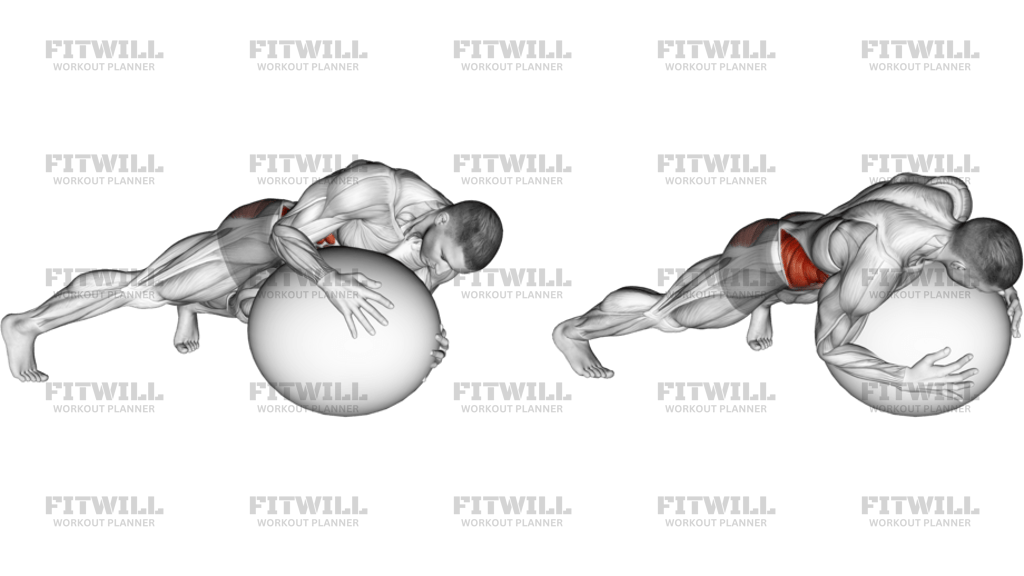
Setup matters more here than in a standard plank because the ball can amplify every mistake. Place the forearms on top of the stability ball with the elbows under the shoulders, step the feet back into a strong plank, and set the feet about hip-width apart for balance. Squeeze the glutes, lightly tuck the ribs, and keep the neck long so the head does not chase the ball.
Each rep should be a small, deliberate saw rather than a big rock. From the start position, press the forearms into the ball and let the body glide forward a few inches so the shoulders move slightly in front of the elbows; then pull back to the start without losing the straight line from shoulders through heels. The ball should roll, but the torso should stay quiet, and the breath should stay controlled instead of held through the whole set.
Exercise Ball Body Saw fits well in core-focused work, warmups, and accessory blocks when you want more plank difficulty without adding external load. It is also a good teaching drill for athletes who need better ribcage and pelvis control under fatigue. Keep the range short, stop the set the moment the low back sags, and treat each repetition as a test of position rather than a test of speed.
[ Workout Log & Planner ]
Put your next workout in Fitwill
Keep your plan and training log ready when you are.


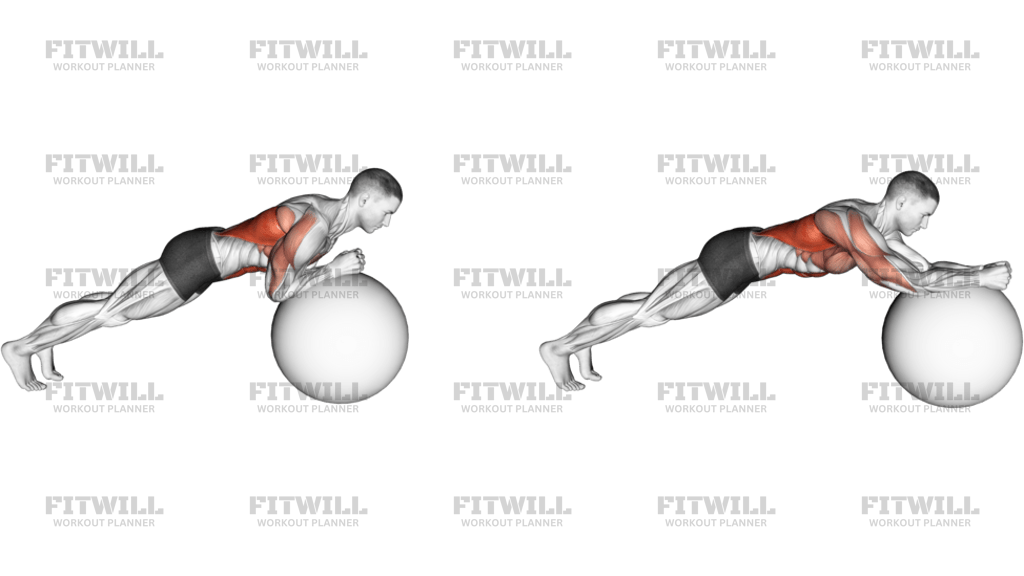
Instructions
- Kneel behind the stability ball and place both forearms on top of it, with your elbows under your shoulders and your hands clasped or stacked comfortably.
- Step your feet back into a forearm plank so your legs are straight, your feet are hip-width apart, and your body forms one line from head to heels.
- Press your forearms into the ball, squeeze your glutes, and draw your ribs down so your lower back does not arch before the first rep.
- Exhale and roll the ball forward a few inches by letting your shoulders travel slightly past your elbows while your torso stays rigid.
- Keep your hips level and your chin slightly tucked as the ball moves; do not let your midsection sag or your shoulders shrug toward your ears.
- Inhale and pull the ball back to the start by reversing the glide without bending at the waist or piking the hips.
- Repeat the forward-and-back saw for the planned reps with the same short range and the same plank tension on every repetition.
- When the set is over, lower your knees to the floor before taking your forearms off the ball.
Tips & Tricks
- Start with a tiny saw range; if the ball moves a lot, the low back usually starts to arch.
- Think about pushing the ball away with your forearms instead of pulling your chest toward it.
- Keep your feet a little wider if the ball feels unstable, then narrow the stance only after the plank stays clean.
- If your shoulders creep into your ears, reset and press the forearms down harder before the next rep.
- A soft exhale on the forward glide helps keep the ribs from flaring and makes the plank easier to hold.
- Look at the floor a few feet ahead of the ball so your neck does not crane during the saw.
- The set should feel like the abs are working to stop movement, not like the hips are being thrown around the ball.
- Stop the set as soon as you lose the straight line from shoulders to heels, even if the rep count is not finished.
Frequently Asked Questions
What muscles does Exercise Ball Body Saw work?
It mainly challenges the deep abs and rectus abdominis, with the shoulders, serratus, glutes, and upper back working to keep the plank from collapsing.
Is Exercise Ball Body Saw harder than a regular forearm plank?
Yes. The ball adds movement under the forearms, so the core has to resist extension while the support point keeps changing.
How far should the ball move during Exercise Ball Body Saw?
Only a few inches. If the glide is big enough to change your low-back shape, the range is too large.
Where should my elbows be on the ball?
Keep them on top of the ball with the elbows under the shoulders at the start, then let the body glide without sliding the forearms off the support.
Can beginners do Exercise Ball Body Saw safely?
Yes, if they use a short range, a wider foot stance, and stop as soon as the ribs flare or the hips drop.
What is the most common mistake in Exercise Ball Body Saw?
People usually turn it into a big rock and lose the plank. The fix is to keep the torso long and let the ball move only enough to make the abs work harder.
Should I feel this more in my abs or shoulders?
The abs should drive the effort, but the shoulders will work hard to stabilize the forearms on the ball, especially near the forward end of the saw.
What can I use instead of Exercise Ball Body Saw?
A forearm plank on the floor is easier, while a stability-ball plank hold or an ab rollout changes the challenge depending on how much movement and leverage you want.