Stability Ball Kneeling Rollout To Wall
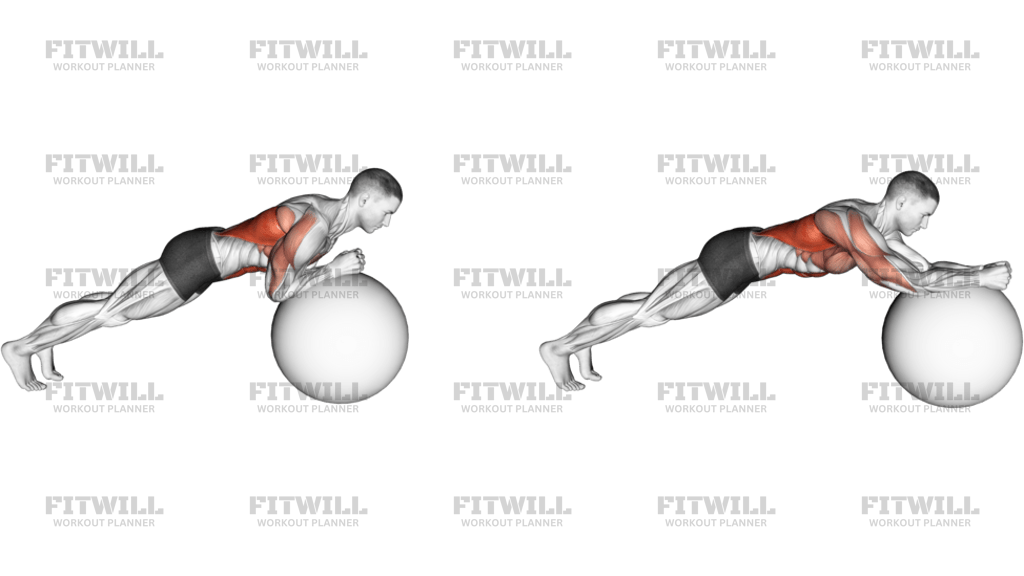
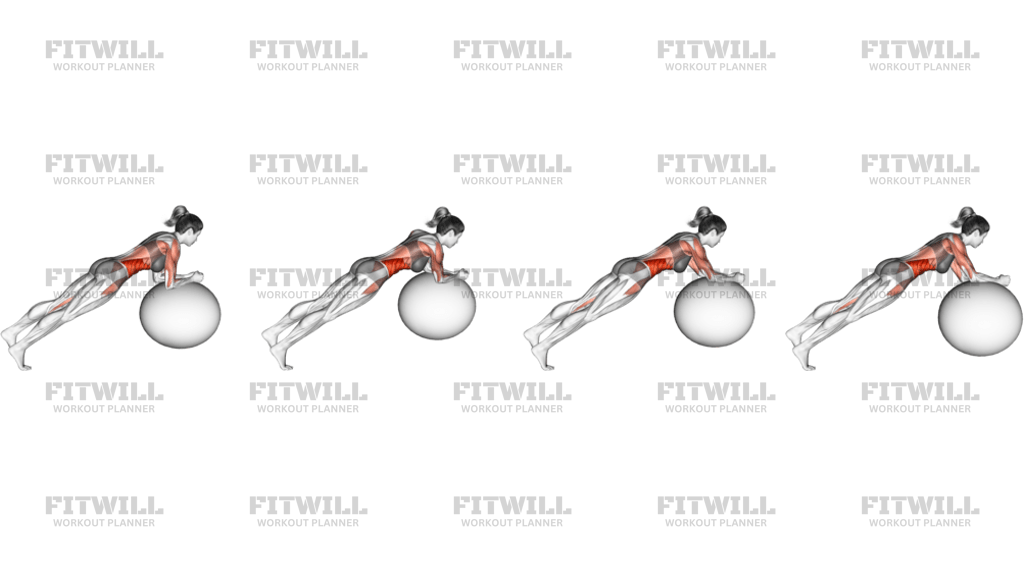
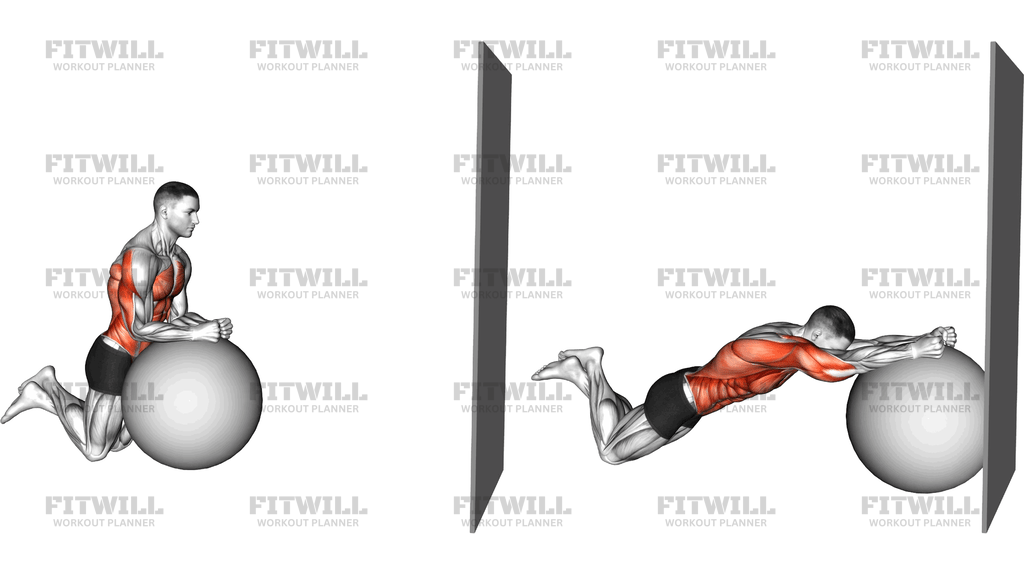
The Stability Ball Kneeling Rollout To Wall is an anti-extension core exercise where you kneel on the floor with your forearms resting on a large stability ball and roll the ball forward until it contacts a wall. The wall acts as a built-in range limiter: it stops the ball at a fixed end point, so you always know exactly how far the rollout goes. This makes the movement especially practical when you are training alone and want a repeatable, controlled rollout without the ball drifting too far and pulling you into a position you cannot reel back from.
The main demand is on the abdominal wall, particularly the rectus abdominis and the deep transverse abdominis, which must brace hard to keep your spine from sagging into an arch as your body lengthens over the ball. Your lats, shoulders, and triceps work to control the ball's path and pull it back, while your glutes and thighs hold your hips in line. Because you are on forearms rather than hands, wrist stress is low, which is one reason this version suits people who find wheel rollouts uncomfortable.
Setup matters more here than in most core drills. The ball should be inflated firmly enough that it does not sink under your forearms, and the wall you roll toward needs to be solid and close enough that the ball reaches it just as your body approaches full extension. Kneel on a mat or padded surface to protect your knees, and give yourself a couple of feet of clearance behind the ball so you can lean in without bumping anything.
To execute it well, think of the rollout as a slow, resisted reach rather than a fall forward. Tuck your pelvis slightly, squeeze your glutes, and let the ball travel away from you in a straight line while your hips and shoulders move together. At the wall, your body should be long and close to parallel with the floor, forearms stacked on top of the ball, neck neutral. Pause there for a beat, then drag the ball back with your forearms and drive your hips forward to return to the tall kneeling start.
This exercise fits well into intermediate and advanced core training, athletic conditioning for sports that demand trunk stiffness, and rehabilitation or general strength settings where a bounded rollout is preferred over a free one. It is also a useful stepping stone toward longer free rollouts: because the wall caps the range, you can progress by moving the starting position slightly farther from the wall over time.
The most common errors are letting the lower back arch as you extend, letting the hips drop, and rushing the return so the ball wobbles off line. Move deliberately, keep the ball tracking straight toward the wall, and stop the set as soon as your brace fatigues. If you feel it mostly in your lower back instead of your abdomen, reduce the range or re-tighten before continuing.
[ Workout Log & Planner ]
Put your next workout in Fitwill
Keep your plan and training log ready when you are.


Instructions
- Position a firmly inflated stability ball a short distance in front of a solid, flat wall, and kneel on an exercise mat behind the ball with your knees roughly hip-width apart.
- Place both forearms on top of the ball, elbows bent, hands relaxed, and lean your weight into the ball so it stays steady beneath you.
- Tuck your pelvis slightly, squeeze your glutes, and tighten your abdominal wall so your ribs are drawn down and your lower back is neutral before you move.
- Inhale, then slowly roll the ball forward along the floor by letting your arms glide away from your body, keeping your hips and shoulders moving as one unit.
- Continue rolling until the ball contacts the wall and your body is extended close to parallel with the floor, forearms stacked on the ball, head in line with your spine.
- Hold the extended position briefly while keeping your brace firm and your lower back from arching.
- Exhale and pull the ball back toward your knees with your forearms and lats, driving your hips forward until you return to the tall kneeling position.
- Pause at the top to reset your brace, then repeat for the desired number of repetitions, rolling the ball straight to the wall each time.
- When finished, lift your forearms off the ball carefully while kneeling so the ball does not roll away unexpectedly.
Tips & Tricks
- Set the starting distance from the wall so the ball just reaches it at full extension; if the ball hits the wall early, you are rolling at an angle or the setup is too close.
- If your lower back starts to arch at the wall, move the ball's starting position closer to the wall to shorten the rollout and rebuild range gradually.
- Keep your forearms flat and centered on the top of the ball; gripping or twisting the ball makes it veer sideways and wastes energy stabilizing off-plane.
- Point your toes and keep the tops of your feet relaxed on the mat so your calves and thighs stay out of the movement and your hips can hinge cleanly.
- The ball is unstable by design, so expect some wobble early; slow the tempo down rather than speeding up, since faster reps hide the wobble instead of fixing it.
- Do not let your shoulders shrug toward your ears as you extend; press lightly down through the ball to keep your shoulder blades stable.
- Breathe in on the way out and exhale on the pull back, keeping some air in your abdomen at the extended position to support your brace.
- If your knees are sore, double up your mat or use a thicker pad — kneeling discomfort is the most common reason people cut this exercise short.
- Aim for quality holds at the wall over total reps; three controlled rollouts with a solid pause beat eight rushed ones.
Frequently Asked Questions
What muscles does the Stability Ball Kneeling Rollout To Wall work?
The primary muscles are the abs, especially the rectus abdominis and deep transverse abdominis, which resist spinal extension as your body lengthens. Your lats, shoulders, and triceps control and return the ball, while your glutes and thighs stabilize your hips throughout.
Why does this rollout use a wall?
The wall caps the ball's travel at a fixed end point, so every rep finishes at the same range and the ball cannot roll farther than you can pull back. It is a simple way to control difficulty and train the movement safely on your own.
Is the Stability Ball Kneeling Rollout To Wall suitable for beginners?
It can be, because the wall limits the range, but complete beginners should start with the ball close to the wall so the rollout is short. Once you can hold a solid brace at the wall without arching, move the starting point farther back to progress.
How far should I roll out during this exercise?
Roll until the ball touches the wall, which should place your body close to parallel with the floor with your forearms stacked on top of the ball. If you cannot reach the wall without your lower back arching, reset closer to the wall.
Why do my lower back muscles work harder than my abs?
That usually means your pelvis is tipping forward and your brace is failing at the extended position, letting your spine arch. Squeeze your glutes harder, exhale as you pull back, and shorten the range until your abdomen does the work.
Can I use an ab wheel instead of a Stability Ball for this exercise?
An ab wheel changes the setup entirely because you support yourself on your hands and there is no ball to stop at the wall. The stability ball version is easier on the wrists and its bounce and give add a balance demand the wheel does not have.
How does this compare to a standard Stability Ball rollout without a wall?
The wall version has a fixed, repeatable end range, which makes it easier to gauge progress and safer to train alone. A free rollout lets you go past that point but requires more strength to reverse from the deepest position.
How should I breathe during the Stability Ball Kneeling Rollout To Wall?
Inhale before you roll out and hold a partial breath to support your trunk at the wall, then exhale as you pull the ball back to kneeling. Reset your breath at the top of each rep rather than rushing reps in one long breath.
What size stability ball should I use?
A large ball, typically around 65 to 75 centimeters, works for most people because it gives your forearms a broad, stable platform and keeps your knees low to the floor at full extension. Firmer inflation makes the exercise harder and more responsive.
Is kneeling on the floor hard on the knees?
It can be on a hard surface, so kneel on an exercise mat or folded towel and shift your weight slightly onto the ball as you lean in. If kneeling itself is a problem, padded knee sleeves or a thicker mat usually solve it.