Bodyweight Triceps Extension From Plank Position
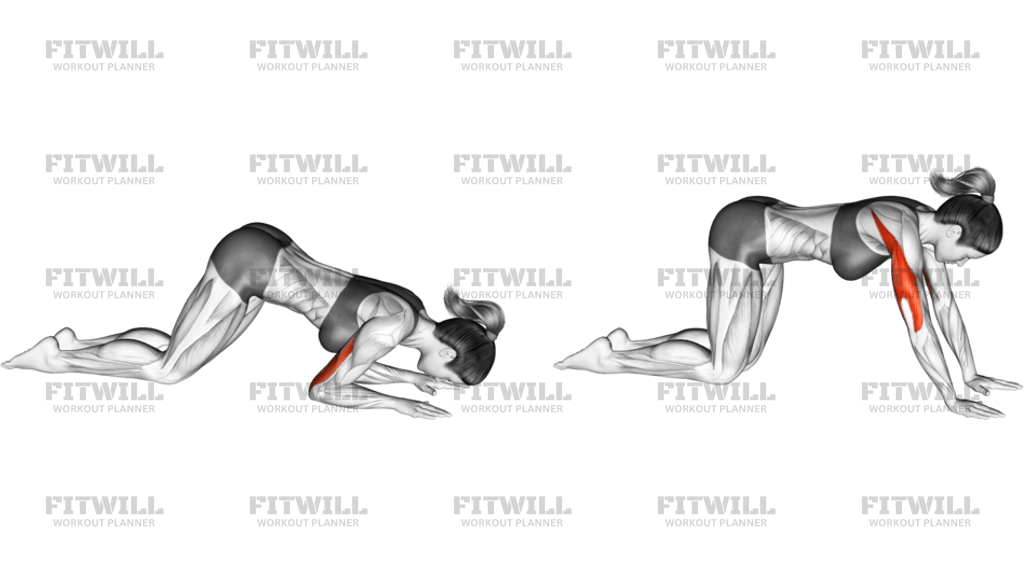
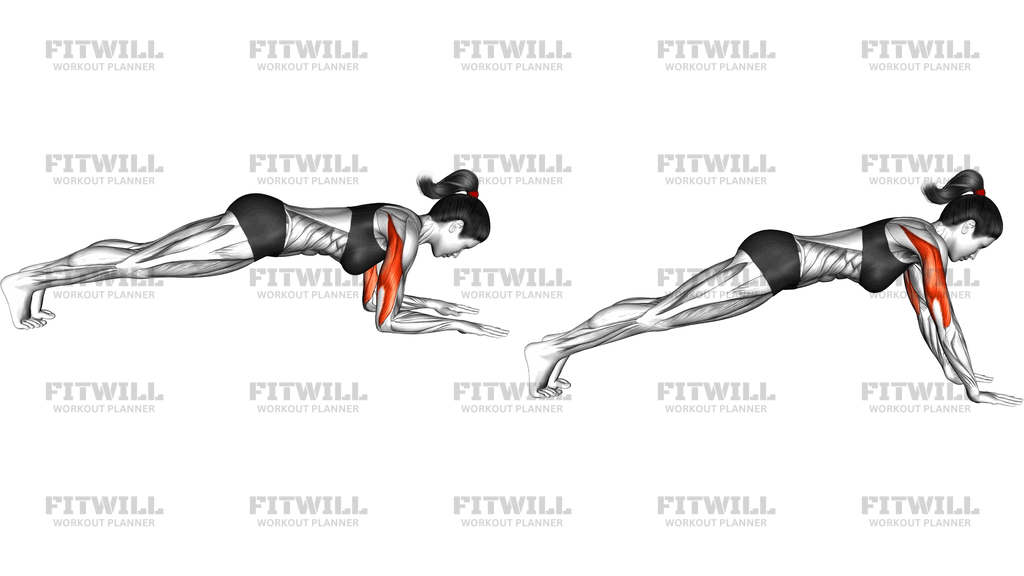
The Bodyweight Triceps Extension From Plank Position is a floor-based pressing movement that takes you from a forearm plank up to a straight-arm plank and back down again, using nothing but your own bodyweight and floor contact. Because your elbows start bent at roughly ninety degrees beneath your shoulders and must extend to press you up, the triceps do the bulk of the work, while your core, shoulders, and legs hold a rigid line the entire time.
This exercise is especially useful for people who train at home or travel frequently, since it needs no equipment beyond a mat or a comfortable floor surface. It also fits well into existing routines: anyone who finds full push-ups too demanding can use it as a triceps-focused pressing pattern, and more advanced lifters can use it as a finisher that fatigues the triceps under a stable, joint-friendly load.
Beyond the triceps, the movement trains a skill that transfers to other exercises: pressing your hands into the floor while keeping your hips, spine, and head in one line. That anti-sag requirement lights up the deep core and front shoulders isometrically, and the glutes and legs stay engaged to stop your hips from drifting upward as you press.
Setup matters more here than it might appear. If your elbows drift behind or beside your shoulders in the forearm plank, the press becomes a shoulder-dominant shimmy and the triceps lose their leverage. Lining the elbows directly under the shoulders, with forearms parallel and palms flat on the floor, puts the elbow joints in the ideal position to extend against your bodyweight.
To execute it well, think of driving your palms and fingertips down into the floor as your elbows straighten, lifting your chest and torso as one rigid piece rather than hinging at the hips. Lower back down by bending the elbows with control so your forearms meet the floor quietly instead of collapsing onto them. Both arms can work together as shown in the movement, or you can alternate hands one at a time if the simultaneous press is too hard at first.
In practice, you will see this movement used in home triceps sessions, warm-ups for pushing days, and circuits where the goal is to challenge the elbows without loading the shoulders through a full push-up range. Keep the reps smooth and the plank line honest — ten clean, controlled reps do far more for your triceps than twenty rushed ones with sagging hips.
Fitwill
Log Workouts, Track Progress & Build Strength.
Achieve more with Fitwill: explore over 9600 exercises with images and videos, access built-in and custom workouts, perfect for both gym and home sessions, and see real results.
Start your journey. Download today!




Instructions
- Place an exercise mat on the floor and set up on your knees with your forearms flat, elbows directly under your shoulders and forearms parallel to each other, palms pressed down with fingers facing forward.
- Step your feet back one at a time until your body forms a straight line from head to heels, resting on the balls of your feet with your legs about hip-width apart.
- Squeeze your glutes, brace your abs as if bracing for a light punch, and pull your shoulder blades down away from your ears so your lower back does not arch.
- Inhale and hold that rigid plank line before initiating any movement.
- Exhale and press both palms firmly into the floor, straightening your elbows to lift your chest and torso upward until your arms are fully extended and you are in a high plank on your hands.
- At the top, check that your shoulders are stacked over your wrists and your hips have not shot upward into a pike.
- Inhale as you bend your elbows with control, lowering your forearms back to the mat under your shoulders without letting your hips drop or your lower back sag.
- Pause briefly in the forearm plank to re-brace, then repeat for your target number of repetitions.
- To finish the set, step your feet forward one at a time and rest on your knees before standing up.
Tips & Tricks
- If your hands slide forward as you press, spread your fingers wide and grip the mat actively — slipping palms turn the press into a wrist strain.
- A common mistake is letting the hips pike upward as the elbows extend; fix it by keeping your glutes squeezed and imagining a straight board from your heels to your head.
- If the simultaneous two-arm press is too difficult, alternate hands: press up with the right, then the left, then lower with the right, then the left, which halves the demand at each elbow.
- Do not let your elbows flare outward behind you in the bottom plank; keep them stacked under your shoulders so the triceps, not the shoulder capsules, handle the load.
- Lowering fast and landing your forearms with a thud wastes the hardest part of the rep — take two to three seconds to bend the elbows so the triceps also work eccentrically.
- If your wrists ache at the top, check that your fingers point forward and your weight sits across the palm and fingertips, not jammed back into the heel of the hand.
- Keep your neck in line with your spine by looking at the floor slightly ahead of your hands rather than craning up to watch your arms.
- Breathe out on the press up and in on the way down; holding your breath is a sign the plank line has collapsed somewhere.
- If your lower back complains, narrow your stance slightly and squeeze your glutes harder — a sagging pelvis, not the movement itself, is usually the culprit.
Frequently Asked Questions
Which muscles does the Bodyweight Triceps Extension From Plank Position work hardest?
The triceps do the main work, since they must extend your elbows to press your bodyweight up from the forearms. Your core, front shoulders, and glutes work isometrically to keep the plank line straight throughout.
How is this different from a regular push-up?
A push-up lowers your whole body toward the floor and presses it back up, while this exercise starts from a forearm plank and extends the elbows from about ninety degrees to straight. The triceps handle more of the load and the shoulders go through a smaller range.
Is the Bodyweight Triceps Extension From Plank Position suitable for beginners?
Yes, and the easiest modification is to perform the entire movement from your knees instead of a full plank, which reduces the load on the triceps and core. Another option is pressing up one hand at a time.
Why do my hips keep rising into a pike when I press up?
That usually happens because the core and glutes are not braced, so the hips take the path of least resistance. Squeeze your glutes, tuck your pelvis slightly, and think of lifting your chest straight up rather than pushing your hips back.
Should my forearms be parallel or can I clasp my hands in the bottom position?
Parallel forearms with palms flat and fingers forward give you the best pressing surface and keep the elbows stacked under the shoulders. Clasping your hands shifts the effort toward the shoulders and makes the press less stable.
Can I substitute another exercise if my wrists bother me?
You can perform the same elbow-extension pattern on a pair of low parallel bars or the edge of a sturdy bench, or use dumbbell skull crushers on a bench. Avoid pushing through wrist pain — adjust the setup first.
How many reps should I aim for?
Start with two to three sets of six to ten controlled reps, focusing on a smooth press and a slow lower. Once you can complete twelve clean reps with a straight plank line, add a set or slow the lowering phase to three seconds.
Is it a problem if my elbows move backward as I lower down?
Yes — if the elbows drift behind or wide of your shoulders in the forearm plank, the triceps lose leverage and the shoulder joints take extra stress. Reset each rep with the elbows stacked directly under the shoulders.
Can I train this movement every day?
Because it uses only your bodyweight, it recovers faster than heavy pressing, but the triceps still need rest to adapt. Two to four sessions per week with at least a day between hard sets is a sensible rhythm.
What should I do between reps to keep form sharp?
Pause for a breath in the forearm plank, re-squeeze your glutes and abs, and confirm your elbows are still under your shoulders before pressing again. That brief reset stops the small form leaks that creep in as fatigue builds.