Kettlebell Half Kneeling Lift And Chop
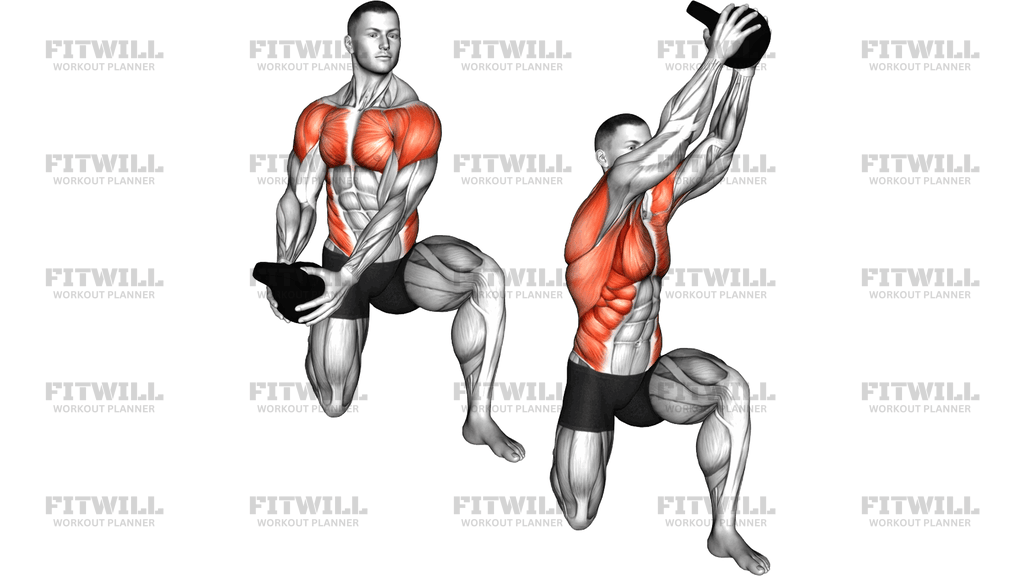
The Kettlebell Half Kneeling Lift And Chop is a diagonal core exercise performed from a half-kneeling stance, with one knee down and the other foot planted forward. You hold a kettlebell with both hands, start with it low beside your hip, and sweep it diagonally across your body until your arms finish overhead on the opposite side. The half-kneeling position is what makes this version special: by taking your legs out of the equation, it forces your trunk and hips to do the work instead of letting momentum from a standing stance carry the weight.
This movement trains rotational strength and anti-rotation control through the obliques, deep core, and lower back, while the shoulders, upper back, and grip handle the load through a long arc. The front leg's glute and the down-knee hip stabilizer work quietly the whole time to keep your pelvis square. Because the kettlebell travels from low to high (the lift) you can also reverse the pattern from high to low (the chop) to train the same diagonal in the opposite direction, which is how the exercise earns its full name.
The half-kneeling setup matters more than people expect. Your front shin should be roughly vertical, your front foot flat and gripping the floor, and your down knee directly under your hip. If that base is sloppy, the rotation leaks into your lumbar spine and the exercise stops challenging the trunk the way it should. A tall spine, level hips, and a braced midsection give the kettlebell a stable platform to move from.
To execute it well, think of the movement as your ribcage and arms rotating together as one unit around a quiet pelvis. The kettlebell should travel close to your body through the middle of the arc, not swing wide in a long pendulum. Finish with the weight stacked over your front shoulder with straight arms, then lower it along the same path with control. The descent is where most people get lazy, and it is also where a large share of the core work happens.
This exercise fits well into warm-ups, core circuits, and rotational power progressions for throwing, swinging, and striking sports. It is equally useful for general lifters who spend most of their training in sagittal-plane movements like squats, presses, and hinges and rarely challenge their trunk in rotation. Start with a light kettlebell, even a 8-12 kg bell for most men, because the long lever arm and kneeling base make moderate loads feel heavy quickly. If your knee or lower back complains, reduce the range before reducing the weight, and keep the bell's path tight to your torso.
[ Workout Log & Planner ]
Put your next workout in Fitwill
Keep your plan and training log ready when you are.


Instructions
- Place a kettlebell on the floor beside your outside hip and set up in a half-kneeling position: left knee down on the floor (use a mat if needed), right foot flat in front with the shin vertical.
- Grip the kettlebell's handle with both hands, fingers interlocked around the horn, and sit tall with your hips level and squared toward the front.
- Brace your midsection as if preparing for a light push, and squeeze the glute on your down-knee side to lock the pelvis in place.
- Starting with the kettlebell beside your lower hip, rotate your ribcage and sweep the bell diagonally across your torso, keeping it close to your body through the middle of the arc.
- Continue the path up and across until both arms are straight and the kettlebell finishes overhead on the side of your front foot, stacked over that shoulder.
- Pause briefly at the top with your biceps near your ears and your ribs down, resisting the urge to arch your lower back.
- Reverse the path slowly, lowering the kettlebell along the same diagonal back to the starting position beside your hip.
- Exhale as you lift or chop the weight up, and inhale as you lower it back down with control.
- Complete all reps on one side, then switch so the opposite knee is down and the kettlebell starts beside the other hip.
- Between sets, stand up carefully rather than twisting out of the kneeling position while holding the bell.
Tips & Tricks
- The most common mistake is letting the pelvis rotate with the arms. Point a towel or marker at your down knee and keep it facing forward the entire set so your trunk does the rotating.
- If the kettlebell swings wide like a pendulum, it is usually too heavy or the arms are doing the steering. Keep the bell within a few inches of your chest through the middle third of the arc.
- Watch for the front heel lifting as you rotate. Drive that heel into the floor to keep the glute engaged and the knee tracking over the toes.
- Ribs flaring at the top position means your lower back is arching to finish the lift. Exhale hard as you reach the overhead point and keep a slight posterior tilt in the pelvis.
- Start with the lift (low to high) if you are new to diagonal patterns, then add the chop (high to low) once you can control the return without the bell dropping away from your body.
- A down knee that aches on hard floors is a setup problem, not a strength problem. Pad the knee and make sure the shin on your front leg stays vertical rather than drifting forward.
- Do not let the head chase the kettlebell. Your eyes follow the bell, but your neck stays long, with the shoulders pulled down away from the ears.
- If your grip fails before your core does, switch to a lighter bell or hold it by the body of the kettlebell with both hands cupped around the sphere for shorter sets.
- Breathe in a rhythm rather than holding your breath; the brace should come from your trunk tension, not from air you are trapping in your chest.
Frequently Asked Questions
Which muscles does the Kettlebell Half Kneeling Lift And Chop work the most?
The obliques and deep core do the bulk of the rotational work, with the lower back stabilizing the spine. The shoulders, upper back, and forearms handle the kettlebell through the long diagonal arc, while the glutes and hips stabilize the half-kneeling base.
What kettlebell weight should a beginner use for the Kettlebell Half Kneeling Lift And Chop?
Start with a light bell, roughly 8-12 kg for most men, and prioritize a controlled path over load. Because the kneeling base removes leg drive, even a modest kettlebell challenges the trunk significantly.
Why is this exercise done from a half-kneeling position instead of standing?
The half-kneeling stance locks the pelvis in place so momentum from the legs cannot contribute to the rotation. That forces the obliques and deep core to drive and control the kettlebell, and it exposes any side-to-side imbalance between your left and right sides.
What is the difference between the lift and the chop in this exercise?
The lift travels low to high, starting beside the hip and finishing overhead, while the chop travels high to low from above the shoulder down to the opposite hip. They train the same diagonal pattern in opposite directions, and doing both keeps the trunk balanced.
How do I stop my lower back from arching when the kettlebell goes overhead?
Squeeze the glute of your front leg and exhale as you reach the top so your ribs stay down and your pelvis stays tucked. If you still arch, the bell is likely too heavy or you are extending past the point where your shoulders can stack the weight.
Should the kettlebell stay close to my body or swing out wide?
Keep it close through the middle of the arc, within a few inches of your torso. A wide pendulum path means your arms are steering instead of your ribcage rotating, and it puts unnecessary strain on the shoulders and lower back.
What can I substitute if kneeling is uncomfortable for my knee?
Try an exercise mat under the down knee first, and keep your front shin vertical so less weight shifts forward onto the knee. If kneeling still does not suit you, a standing kettlebell lift and chop with a narrower stance is the closest alternative, though it allows more leg momentum.
How many reps and sets should I do?
Two to three sets of 6-10 reps per side works well for strength and control, or 8-12 reps per side with a lighter bell as part of a warm-up. Always match the work on both sides, starting with the weaker side.
Is the Kettlebell Half Kneeling Lift And Chop safe for people with back issues?
The half-kneeling setup with a braced trunk is generally spine-friendly, but anyone with a history of back problems should keep the range moderate and the load light at first. Stop if you feel sharp pain, and consult a qualified professional for individual guidance.