Kettlebell Goblet Marching On Spot
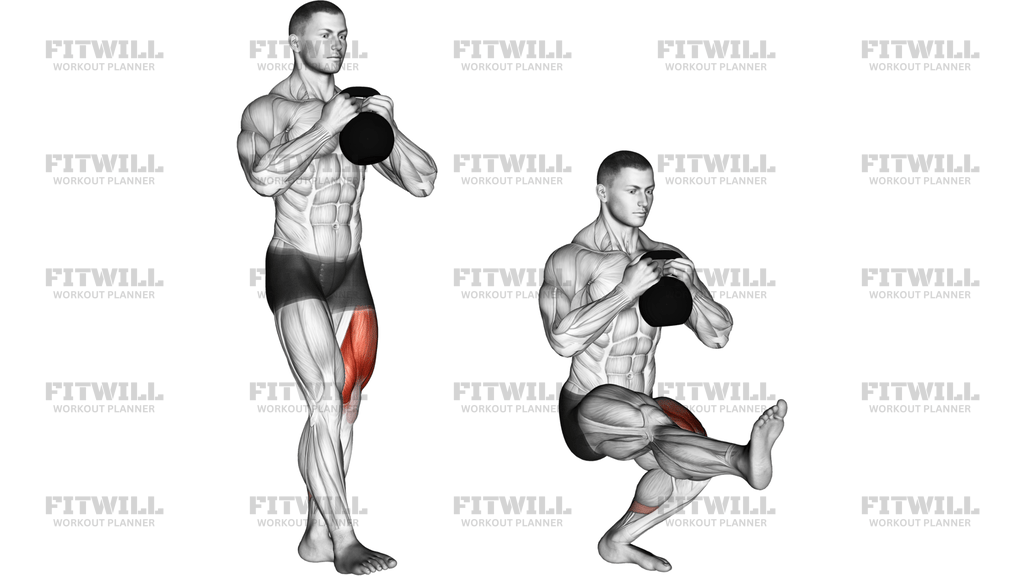
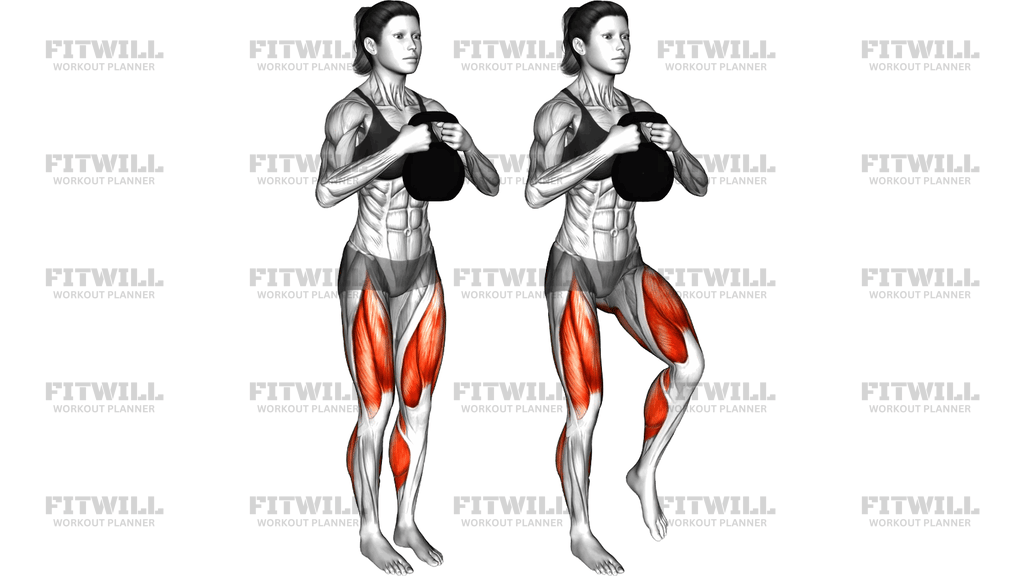
The Kettlebell Goblet Marching On Spot combines a classic goblet hold with high-knee marching in place. You hold a single kettlebell by the horns at chest height, brace your trunk, and lift each knee toward hip level in an alternating rhythm without traveling anywhere. It looks simple, but the loaded front carry plus the single-leg stance turns a basic march into a demanding full-body drill.
This movement pulls double duty as strength work and conditioning. The supporting leg works through the quads, glutes, and calves to keep you tall and stable, while the hip flexors drive each knee lift against the load pressing down on your ribcage. Meanwhile, your deep core and obliques fight to stop the kettlebell from pulling you forward or twisting you sideways every time one foot leaves the floor.
It is a great fit for beginners learning to own an upright torso under load, and equally useful for experienced lifters as a warm-up, a finisher, or a low-impact conditioning interval. Because you march in place with no jumping or impact, it suits home gym setups, small spaces, and anyone who wants single-leg stability work without heavy external loading on the spine.
Setup matters more than most people expect. The kettlebell should sit against your sternum with elbows tucked down, not flared out to the sides, and your feet should stay about hip-width apart with weight spread across the whole foot. If the bell drifts away from your body or your elbows wing upward, your shoulders and lower back take over work that your core should be doing.
To execute it well, think tall spine, ribs stacked over pelvis, and slow deliberate knee drives to roughly hip height. Pause briefly with each knee up, feel the stance leg gripping the floor, then lower the foot under control before switching. Rushing turns the march into a bouncing toe-tap and robs you of the balance and hip flexor benefit.
Common use cases include metabolic circuits, active recovery days, pre-run activation, and as a progression from unloaded marching before attempting weighted carries or single-leg strength work. Start with a light kettlebell you can hold cleanly for 30-60 seconds and prioritize posture over knee height; the load can grow once your position stops breaking down.
[ Workout Log & Planner ]
Put your next workout in Fitwill
Keep your plan and training log ready when you are.


Instructions
- Stand with feet hip-width apart, toes pointing forward, and set a kettlebell on the floor in front of you.
- Deadlift or clean the kettlebell to your chest, gripping the horns with both hands so the bell rests against your sternum and your elbows point down close to your ribs.
- Pull your shoulders back and down, stack your ribs over your pelvis, and brace your core as if bracing for a light push to the stomach.
- Shift your weight onto one leg, pressing the whole foot into the floor while keeping a soft knee.
- Drive the opposite knee up toward hip height, keeping the kettlebell glued to your chest and your torso upright.
- Pause for a beat at the top of the knee lift, feeling your hip flexors lift and your stance leg hold you steady.
- Lower the foot back to the floor under control, then immediately lift the other knee to continue marching in place.
- Breathe steadily throughout, inhaling as one leg lowers and exhaling as the other knee drives up.
- Keep your gaze forward and your hips level, avoiding any lean back or side-to-side sway as you alternate legs.
- When finished, stop marching with both feet down, then set the kettlebell back on the floor with a flat back by hinging at the hips.
Tips & Tricks
- If the kettlebell pulls your chest forward, it is sitting too low or too far from your body—reposition it so the bell actually contacts your sternum rather than floating at arm's length.
- A common mistake is driving the knee up but letting the pelvis tilt forward and the lower back arch; squeeze the glute of the standing leg to keep your hips level and squared.
- Keep the marching knee in line with your hip rather than letting it drift inward or cross the midline, which loads the hip flexors and outer hips properly.
- If your forearms burn before your legs do, your grip is squeezing far harder than needed and your elbows are probably flared—relax the hands slightly and pin the elbows down by your ribs.
- Start with knee lifts to just below hip height and earn higher lifts gradually; cranking the knee up by leaning back cheats the movement and strains the lower back.
- Land each foot with the whole sole, not just the toes—repeated toe-first landings shift stress to the calves and turn the drill into a bouncing rhythm.
- Slow the tempo before adding weight: a two-second lift with a one-second pause builds far more control than fast marching with a heavy bell.
- If balance is the limiting factor, lightly touch a wall or rack with one fingertip rather than widening your stance or leaning back.
- Your stance leg should stay soft, not locked—slightly bent knees absorb each foot contact and keep the quads and glutes engaged throughout.
Frequently Asked Questions
Which muscles does the Kettlebell Goblet Marching On Spot work the most?
The quads, hip flexors, and calves of the moving and supporting legs do the primary work, while the glutes stabilize each stance. The core, especially the deep trunk muscles and obliques, stays highly active holding the kettlebell steady at your chest.
How heavy should the kettlebell be for this exercise?
Choose a weight you can hold at your chest with elbows tucked for the full set without your upper back rounding or the bell drifting away from your sternum. For most people, a light to moderate bell in the 4-12 kg range is plenty, since the balance demand adds difficulty beyond the load itself.
Is the Kettlebell Goblet Marching On Spot good for beginners?
Yes, it is an excellent beginner drill because the march has no impact and the goblet hold naturally teaches an upright, braced torso. Start with a very light kettlebell or even just body weight until you can march for 30-60 seconds without wobbling or leaning.
Why does my lower back ache during this movement?
That usually means your ribs are flaring and your pelvis is tipping forward as you lift each knee, which arches the lower back under load. Rebrace your core, squeeze the standing leg's glute, and reduce the knee height slightly so your trunk stays stacked.
How high should I raise each knee?
Aim for roughly hip height, or the highest point you can reach while keeping your torso tall and the kettlebell against your chest. If you have to lean back or bounce to get the knee up, shorten the lift instead.
Can I substitute the Kettlebell Goblet Marching On Spot with another exercise?
A bodyweight high-knee march with hands pressed together at the chest works as an easier substitute, while a dumbbell held vertically at the chest mimics the goblet position if you have no kettlebell. For a harder version, slow the tempo and add a two-second pause at the top of each knee lift.
How is this different from regular marching in place?
The kettlebell held goblet-style adds a front load that forces your core, upper back, and shoulders to work continuously, and it raises the balance demand every time one foot leaves the floor. It also turns the march from light cardio into genuine strength and stability work for the hips and trunk.
How many reps and sets should I do?
Work in time or steps rather than single-leg reps: 20-40 total steps, or 30-60 seconds of marching, counts as one set. Two to four sets works well as a warm-up primer, while longer sets of 60-90 seconds fit conditioning circuits.
Is it safe to do this exercise if I struggle with balance?
Yes, with small adjustments: keep the knee lifts lower, slow the tempo, and stand near a wall or rack you can lightly touch for reassurance. The single-leg stance itself is what gradually improves your balance, so start conservatively and progress as your stability grows.
Should my elbows stay down or can I let them lift while marching?
Keep your elbows pointed down and close to your ribs the entire time. When they flare up and out, your shoulders take over the load, the bell drifts from your chest, and you lose the core-bracing benefit that makes the goblet position worthwhile.