Cable Side Plank Row (Version 3)
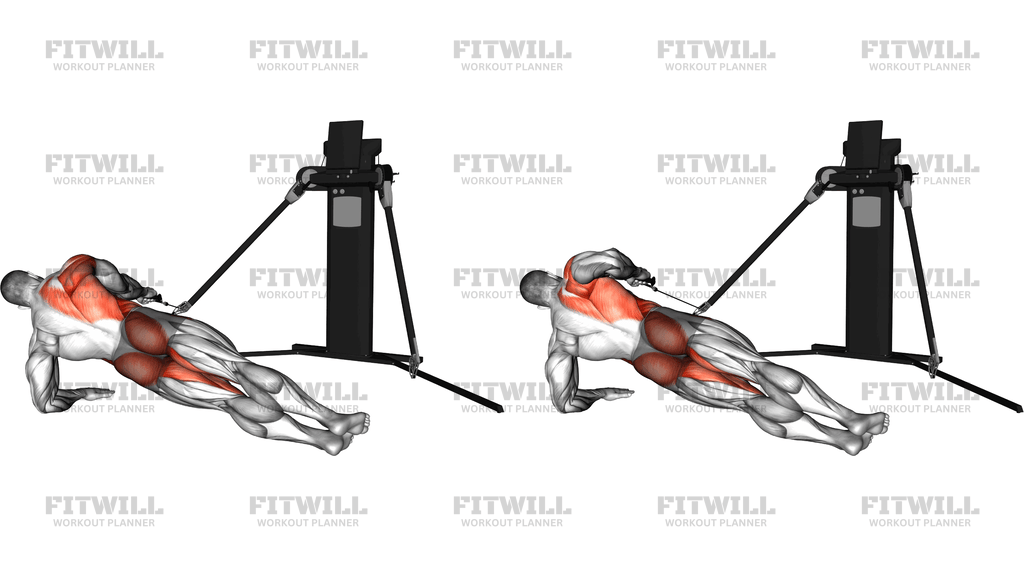
The Cable Side Plank Row (Version 3) combines two demands into one exercise: holding a stable side plank on your forearm while your upper arm performs a single-arm row against a low cable. You set up sideways to a cable machine with the pulley near the bottom, drop into a side plank, and pull the handle toward your ribs with the free top arm. The result is a row that your core has to earn — every pull tries to rotate your torso, and your obliques, hips, and shoulders have to fight that pull the whole time.
This is a strong choice for lifters who want more from their rowing than back growth alone. Because the plank position loads the lateral core isometrically, the movement trains the lats, rhomboids, and rear delts through the row while the obliques and hip stabilizers work to keep your body in a straight line. It is especially useful for athletes in rotating sports — tennis, baseball, golf, martial arts — where the ability to hold the trunk rigid while the arm pulls or swings across the body transfers directly to performance.
The setup matters more here than in most rows. The cable should run from a low pulley to your working hand with light tension before you even start the plank, and your supporting elbow should sit directly under your shoulder so the plank itself is sound before any load is added. If the pulley is too high or you set the plank too far from the machine, the angle of pull changes and the exercise drifts away from the intended line.
To execute it well, think of it as two skills layered together. First, build the plank: feet stacked or staggered, hips lifted, body in one line from head to heels. Second, row: drive the elbow back past your ribs, let the shoulder blade travel with the arm, and pause briefly at the top before lowering the handle under control. The torso should not twist toward or away from the machine — if it does, the weight is telling you the plank is the weak link, not the row.
Use moderate weights and clean reps. This movement rewards control, not ego loading, and heavy sets usually just turn it into a twisted, hip-dropping row with a plank costume on. Start with lighter loads and 8–12 reps per side, and treat any loss of hip height or trunk rotation as the end of the set.
[ Workout Log & Planner ]
Put your next workout in Fitwill
Keep your plan and training log ready when you are.


Instructions
- Set the pulley of the cable machine to a low position, just above the bottom of the tower, and clip on a single handle.
- Stand sideways to the machine with your working side closest to it, grab the handle with your top hand, and step your feet out until you can lower into a side plank with the cable running taut.
- Place your bottom forearm on the floor directly under your shoulder, stack or stagger your feet, and lift your hips so your body forms one straight line from head to heels.
- Brace your abs and squeeze your glutes before the first rep so the trunk is rigid while the cable pulls on you.
- Row the handle toward your lower ribs by driving your elbow back and slightly up, letting the shoulder blade pull back with the arm.
- Pause for a beat at the end of the pull with the elbow just behind your ribs, keeping your hips at the same height.
- Lower the handle back toward the pulley slowly, resisting the cable's pull on your trunk rather than letting it yank your torso forward.
- Exhale as you row the handle in, inhale as you return it, and keep breathing steadily instead of holding your breath through the set.
- Finish all reps on one side, set the handle down safely, then rest before switching to the other side with the opposite arm.
Tips & Tricks
- If your hips sag after a few reps, the plank is failing before the row is — lower the weight or shorten the set rather than grinding through a dropped-hip position.
- Do not let your supporting shoulder shrug up toward your ear; press the floor away with the forearm and keep space between the ear and shoulder.
- Grabbing the handle and walking out without pre-tension lets the cable slacken at the top of each rep; step out far enough that the weight is already loaded when you set the plank.
- A common mistake is pulling the handle toward the machine-side shoulder and rotating the chest downward; aim the elbow for the ceiling side of your ribs and keep the chest facing forward.
- Staggering the feet is a fair modification if stacking them makes the plank unstable — keep both feet on the floor and hips level either way.
- The trunk rotation at the end of a heavy set is the usual failure point; if you find yourself winding up toward the machine before each pull, that is the signal the load is too heavy.
- Chalk or a slightly damp forearm can help on smooth floors, since the supporting arm slides forward as the cable load increases.
- Think of gluing the hips in place and letting only the arm move; the exercise stops being a plank row the moment the pelvis starts tilting with each rep.
Frequently Asked Questions
Which muscles does the Cable Side Plank Row work?
The rowing arm targets the lats, rhomboids, mid traps, and rear delts, while the side plank position keeps the obliques, glutes, and hip stabilizers working isometrically. The biceps and forearms assist with gripping and pulling the handle.
Why is the cable set to a low pulley for this exercise?
A low pulley makes the cable pull forward and slightly down on your hand, which forces the lateral core to resist rotation throughout the set. A higher pulley changes the line of pull and turns the movement into a different, less plank-oriented row.
Is the Cable Side Plank Row suitable for beginners?
Beginners should first be comfortable holding a solid forearm side plank for 30 or more seconds. If that baseline is there, starting with very light weight and 6–8 reps per side is a reasonable way to learn the movement.
Should my feet be stacked or staggered during the plank?
Either works, as long as the hips stay level and lifted. Stacking is harder on balance, so staggering the top foot slightly in front is a practical adjustment when the plank position is the limiting factor.
What is the most common mistake in this exercise?
Letting the trunk rotate toward the machine as the arm rows, usually paired with dropping hips. Fix it by reducing the weight, bracing hard before each rep, and cueing yourself to keep the chest facing forward.
Can I substitute this movement if my gym has no cable machine?
A resistance band anchored low to a rack or sturdy post is the closest substitute, since it preserves the same low line of pull. The plank component stays identical; you simply lose the constant tension profile of the cable stack.
How many reps and sets should I do?
Two to three sets of 8–12 controlled reps per side is a solid working range. Because the core fatigues isometrically, quality usually drops fast after that, and extra volume rarely improves the set.
Is it safe for my lower back?
The side plank position is actually quite spine-friendly because the trunk is loaded laterally rather than flexed or extended. Keep the body in a straight line, avoid twisting under load, and stop the set if hip height or control breaks down.