Weighted Push Up With Vest
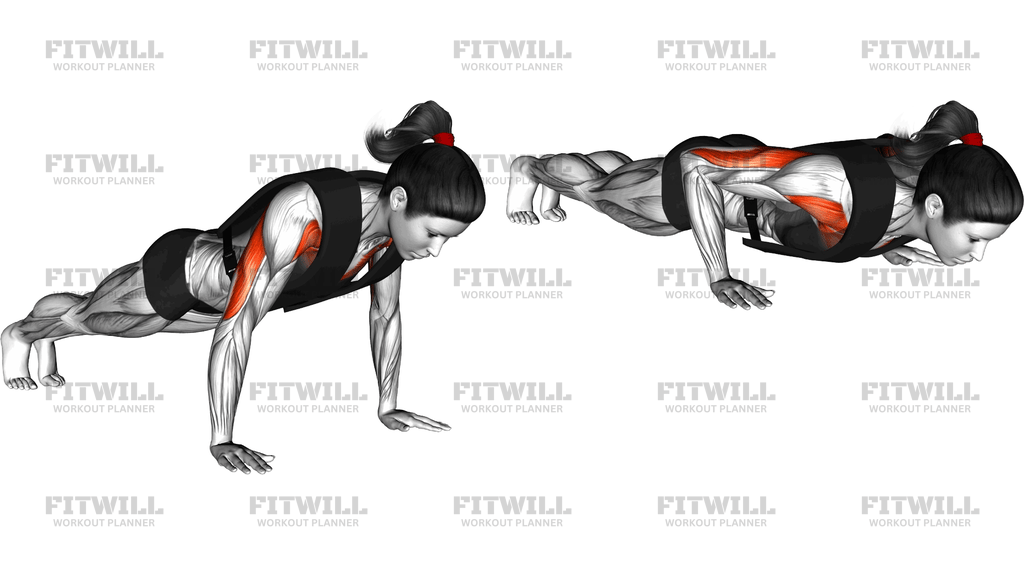
Weighted Push Up With Vest is a loaded version of the classic push-up. Instead of adding plates to your back or elevating your feet, you wear a weighted vest strapped snugly around your torso, which keeps the extra load distributed across your chest and upper back while your hands stay planted on the floor. This makes it one of the cleanest ways to progress the push-up once body weight alone has stopped feeling challenging.
The movement targets the chest as the primary mover, with the triceps extending the elbows and the front shoulders assisting through the pressing path. Because the vest adds load without changing your contact points, your core, hips, and legs also work harder than in a regular push-up to keep your body in one straight line from shoulders to heels.
Setup matters more here than in a standard push-up. The vest should sit high on the torso and fit tight enough that it does not slide toward your neck as you descend, and its weight should be balanced front to back. A vest that shifts or hangs low will pull your posture out of alignment and change where you feel the movement.
Execution is straightforward: from a solid plank position with hands slightly wider than shoulder width, lower your chest toward the floor with your elbows tracking back at roughly a 45-degree angle to your torso, then press back up until your arms are straight. The loaded version demands the same strict path as the bodyweight version — resist the urge to let the hips sag or the head drop as fatigue builds.
This exercise suits intermediate and advanced trainees, calisthenics practitioners working toward one-arm or one-arm push-up progressions, and anyone who wants to build pressing strength without a bench or barbell. It is also common in military, combat sport, and general conditioning programs, where higher-rep loaded push-ups develop both strength and work capacity.
Practically speaking, start with a modest vest weight — even 10 to 20 percent of body weight changes the movement noticeably. Keep the floor area clear, use a surface with enough grip for your palms, and stop the set when your body line breaks down rather than when your chest gives out completely.
[ Workout Log & Planner ]
Put your next workout in Fitwill
Keep your plan and training log ready when you are.


Instructions
- Put on a weighted vest and tighten the straps so it sits high on your torso and does not shift when you lean forward into a plank.
- Set your hands on the floor slightly wider than shoulder width, fingers spread, with your wrists stacked directly under your shoulders.
- Step back into a plank with your legs straight, feet about hip width apart, forming one straight line from your head through your heels.
- Brace your abdominal wall, squeeze your glutes lightly, and pull your shoulder blades down away from your ears before you descend.
- Inhale, then lower your body by bending your elbows until your chest is close to the floor, keeping your elbows at about a 45-degree angle to your sides.
- Pause briefly at the bottom without letting your chest or hips touch down.
- Exhale and press the floor away, driving up until your elbows are fully straight and your shoulder blades are spread wide at the top.
- Lower back down under control over roughly two seconds rather than dropping into the bottom position.
- Complete all reps in place, keeping your neck neutral and eyes on the floor about a foot ahead of your hands.
- After your final rep, step your feet forward slowly, stand up carefully with the vest on, and loosen the straps before removing it.
Tips & Tricks
- Position the vest high on your chest and upper back; if it rides up toward your neck as you descend, the straps are too loose and your breathing will suffer at the bottom.
- Balance the vest's weight evenly front to back — a back-heavy vest pulls your torso backward and makes your hips sag, while a front-heavy one dumps weight into your shoulders.
- If your lower back arches at the bottom of the rep, the load has outpaced your core strength; reduce the vest weight before you change anything else.
- Keep your elbows at roughly 45 degrees to your torso rather than flaring them out to 90 degrees, which stresses the shoulder joints under the added load.
- Do not let your head lead the descent — dropping your chin to touch your chest is a common way to shorten the range and lose your body line under load.
- Full lockout matters more with a vest: straighten your arms completely at the top and spread your shoulder blades so the serratus muscles get work, not just the pressing muscles.
- Start with bodyweight push-ups as a warm-up to confirm your line is solid before adding the vest.
- If your wrists ache under the extra load, try push-up handles or fists on a mat to keep your wrists straighter while preserving the same movement path.
- Stop the set when your hips start to sag or your elbows drift wide — the last two sloppy reps teach your body a worse pattern than the first ten good ones.
Frequently Asked Questions
What muscles does the Weighted Push Up With Vest work?
The chest is the primary muscle, supported heavily by the triceps and front shoulders. Your core, glutes, and legs also work harder than in a regular push-up because the vest adds load across your whole torso.
How much weight should I put in the vest?
Start with 10 to 20 percent of your body weight and only add more once you can complete your target reps with a strict body line. Most people get plenty of stimulus from a light to moderate vest.
Is the Weighted Push Up With Vest good for beginners?
It is better suited to lifters who can already perform 15 to 20 clean bodyweight push-ups. Beginners should build volume with regular push-ups first, since extra load amplifies every flaw in technique.
Where should the vest sit on my torso?
High on the chest and upper back with the straps snug. A vest sitting low on the waist slides around, restricts breathing at the bottom, and pulls your posture out of line.
Why do my hips sag when I wear the vest?
The added weight increases the demand on your core, so your abs and glutes are fatiguing before your chest does. Brace harder before each rep, and if sagging continues, reduce the vest weight.
Can I substitute the Weighted Push Up With Vest with a barbell bench press?
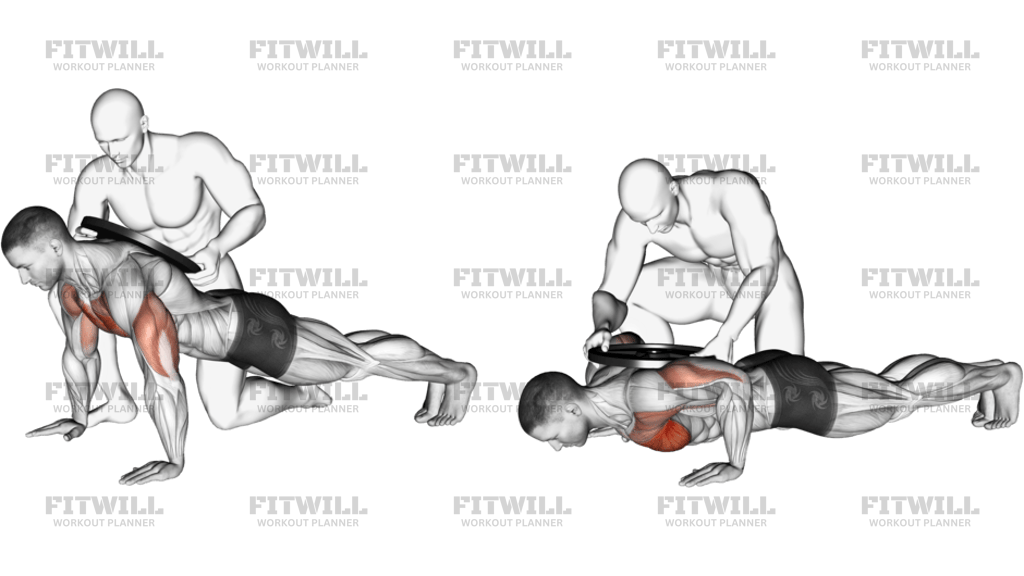
They train overlapping pressing muscles, but the push-up keeps your shoulder blades free to move and demands more full-body tension. A close substitute is a push-up with a plate or chain draped over your upper back, though the vest is more secure and comfortable.
How close to failure should I take each set?
Stop one or two reps before your chest gives out, since form breakdown with a vest usually shows up as sagging hips or flared elbows first. You can do more sets to make up the volume.
Is it safe on the wrists and shoulders?
It is generally well tolerated when your wrists stay stacked under your shoulders and your elbows track at about 45 degrees. If you have cranky wrists, push-up handles let you keep a neutral wrist without changing the movement.
How does the Weighted Push Up With Vest differ from a regular push-up?
The movement path and body position are identical, but the added load increases the strength demand and the core-stabilization requirement, making it a true progressive strength exercise rather than mainly an endurance one.