Assisted Weighted Push-Up
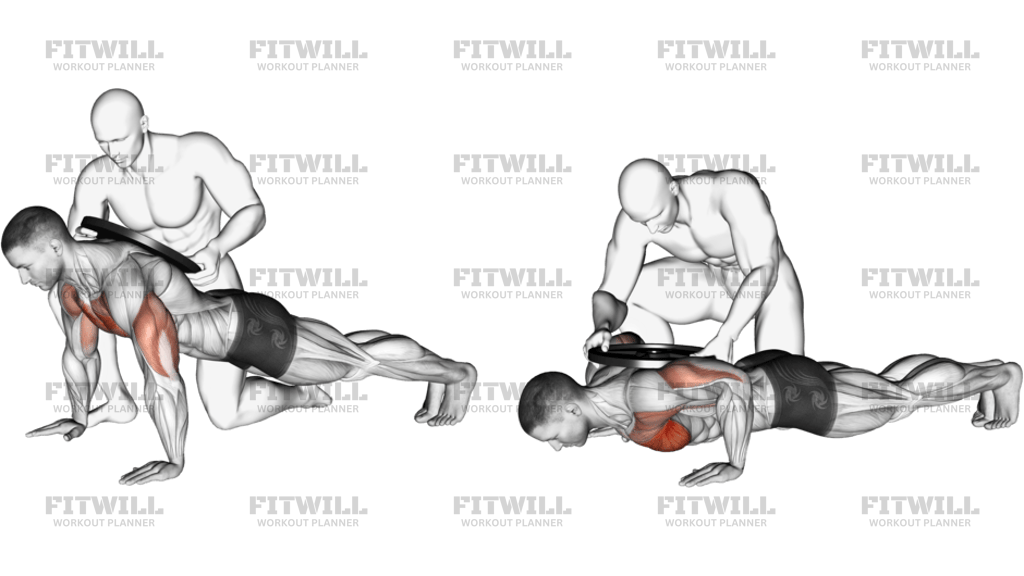
Assisted Weighted Push-Up is a loaded push-up variation that adds resistance while a partner helps keep the weight centered on your upper back. It is a practical way to make the standard floor push-up more demanding without changing the basic pressing pattern, which makes it useful for lifters who already own the bodyweight version and want more chest-focused work.
The main training emphasis is the Pecs, with the Front Shoulders, Triceps, and Core working hard to keep the torso rigid and the press path clean. In technical terms, the Pectoralis major does most of the horizontal pressing, while the Anterior deltoid, Triceps brachii, and Rectus abdominis help control the descent and keep the body from twisting or sagging under the added load.
The setup matters because the weight must sit high enough on the upper back to stay stable, but not so high that it rolls toward the neck. A good Assisted Weighted Push-Up starts with the hands planted on the floor just wider than shoulder width, the feet set into a solid plank, and the load centered across the shoulder blades while the helper keeps it from shifting. When the body is lined up correctly, the chest, hips, and legs lower together instead of the load forcing the torso to break shape.
During each repetition, the chest should travel toward the floor under control and then press back up as one solid unit. Keep the elbows angled slightly back rather than flaring straight out, and lower far enough to get a clear chest stretch without losing tension through the middle. On the way up, push the floor away until the elbows are straight and the body returns to a firm plank, then reset the breath before the next rep.
This exercise works well as an accessory press, a push-up progression, or a heavier horizontal pressing option when a bench is not the main focus. It is also useful for athletes who want chest and triceps strength with a more athletic body position than a barbell bench press. Because the load is balanced on the back, clean reps depend on communication with the partner, controlled tempo, and a load that can be held steady from the first rep to the last.
[ Workout Log & Planner ]
Put your next workout in Fitwill
Keep your plan and training log ready when you are.


Instructions
- Place your hands on the floor just wider than shoulder width and walk your feet back into a straight plank.
- Have a partner kneel over your torso and center a weight plate, sandbag, or padded load across your upper mid-back, just below the shoulder blades.
- Set your feet hip-width apart or closer, squeeze your glutes, and keep your head in line with your spine.
- Lower your chest toward the floor by bending your elbows at roughly 30 to 45 degrees from your torso.
- Keep the load centered on your back as you descend, and stop when your chest is close to the floor or you feel the shoulders start to lose position.
- Briefly pause at the bottom without letting your hips sag or your shoulders shrug up toward your ears.
- Press the floor away until your elbows are straight and your chest returns to a firm plank.
- Exhale as you press up, inhale as you lower, and let your partner remove or reset the load after the set.
Tips & Tricks
- Keep the load over the upper back, not on the neck or lower spine.
- If the weight shifts while you lower, reduce the load or use a sandbag or thick pad instead of a hard plate.
- Let your elbows travel slightly back, not straight out to the sides, to keep the shoulders in a stronger pressing line.
- Use a bodyline that stays rigid from head to heels; if the hips dip first, the set is too heavy.
- Touch the floor with the chest at the same depth each rep so the partner can keep the load stable.
- A slower descent makes the upper back work harder and gives the partner more time to keep the load centered.
- Keep your wrists stacked under the shoulders so the press does not turn into a forward lean.
- Stop the set as soon as the weight starts rolling, bouncing, or pressing into the neck.
- Use fewer reps than a regular push-up set because the added load makes form break down faster.
Frequently Asked Questions
What muscles does Assisted Weighted Push-Up work?
It mainly trains the Pecs, with the Front Shoulders, Triceps, and Core helping to stabilize the press and keep the torso from collapsing.
Do I need a partner for Assisted Weighted Push-Up?
Yes, the assisted version is meant to keep the load centered on your upper back while you press. If you train alone, a weighted vest or backpack is usually a safer alternative.
Where should the weight sit during Assisted Weighted Push-Up?
Place it across the upper mid-back, around the shoulder blade area. If it rides up toward the neck or slides toward the hips, the setup is off.
Can beginners do Assisted Weighted Push-Up?
Beginners should start with a regular push-up or a very light assisted load first. The extra resistance makes the set more demanding on both the chest and shoulder stability.
How do I keep the weight from sliding on Assisted Weighted Push-Up?
Use a flat, stable pad or sandbag, keep the hands directly under control, and ask the partner to keep the load centered as the chest lowers. A hard plate can shift more easily than a softer implement.
What is a common mistake in Assisted Weighted Push-Up?
Letting the hips sag first is the big one. That usually means the load is too heavy or the body lost its plank position before the rep finished.
What can I use instead of a weight plate?
A sandbag, padded dumbbell arrangement, or weighted vest can work, as long as the resistance stays centered and does not dig into the spine.
Should I use a full push-up range of motion?
Use the deepest range you can control without the load shifting or the shoulders rounding forward. The chest should stay under tension, not bounce off the floor.