Dumbbell Plank Pass Through
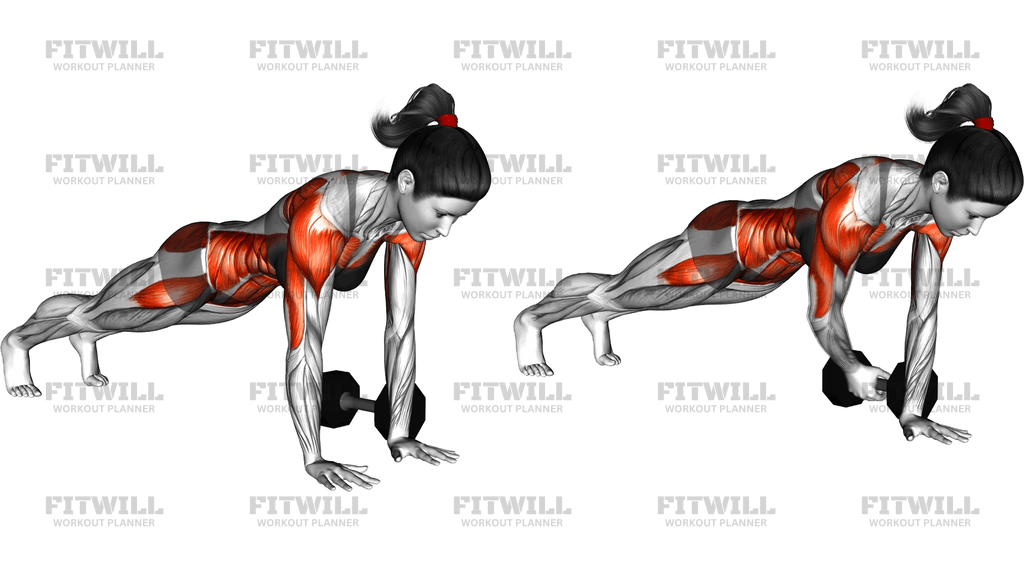
The Dumbbell Plank Pass Through is an anti-rotation core exercise performed from a high plank position. You place a single dumbbell on the floor beside one hand, pick it up with that hand, slide it across the floor underneath your torso, and set it down on the opposite side. Then the other hand takes over and passes it back. Every rep forces your trunk to resist the twist that naturally wants to happen when one hand leaves the floor and moves a load across your midline.
This movement is useful for anyone who already holds a solid plank and wants to make it harder and more dynamic. Because you are moving a weight from side to side while balanced on one arm and two feet, your deep core and obliques work hard to keep your hips square, while the supporting shoulder, chest, and arm stabilize through the wrist and elbow. It also trains coordinated weight transfer, which carries over to exercises like renegade rows, push-up variations, and anything requiring you to brace while handling a load with one hand.
Setup matters more here than in most floor core work. Place the dumbbell on a non-slip surface near your supporting hand, not centered under your chest, so you are not reaching or twisting to grab it. Choose a flat-sided or hex dumbbell that will not roll, and keep it light at first. Your hands should sit directly under your shoulders and your feet slightly wider than hip width, because the wider stance gives you a more stable base to fight rotation from.
To execute it well, brace your abs and glutes before your hand ever leaves the floor, then grip the dumbbell and pass it in a low, controlled arc under your torso. The dumbbell should travel close to the floor the whole way, not lifted in a big sweeping motion. Set it down gently on the far side, reset your plank, and repeat with the other hand. That gentle placement is where most of the control is built, so resist the urge to drop it.
Common use cases include core finishers after strength training, circuit work, and warm-ups for pressing or overhead days where you want the trunk and shoulders primed to resist rotation. A typical set runs eight to twelve passes per side, or a timed interval of twenty to forty seconds.
The main safety points are simple. Keep the ribs down and hips level rather than letting the loaded side of the waist sag or the opposite hip hike up. Stop the set as soon as your lower back starts to arch or your hips begin to sway, because fatigue in this position usually shows up as rotation or back extension rather than clean movement. If your wrists get uncomfortable supporting your weight on one hand, drop to a lighter dumbbell or shorten the set rather than pushing through.
[ Workout Log & Planner ]
Put your next workout in Fitwill
Keep your plan and training log ready when you are.


Instructions
- Place a light dumbbell on the floor beside the outside of your right hand, with the flat side resting so it cannot roll.
- Set up in a high plank with your hands under your shoulders, arms straight, and your feet about shoulder-width apart or slightly wider.
- Squeeze your glutes, brace your abs, and pull your ribs down so your body forms one straight line from head to heels.
- Grip the dumbbell with your right hand, keeping your left palm pressed firmly into the floor with fingers spread.
- Pass the dumbbell across the floor underneath your torso in a low, controlled arc toward the left side, keeping your hips square to the ground.
- Set the dumbbell down gently on the left side beside your left hand, then return your right palm to the floor.
- Reset your plank position, re-brace, and pass the dumbbell back from left to right with your left hand to complete the next rep.
- Exhale as you lift and pass the dumbbell, and inhale as you set it down and settle back into the plank.
- Continue alternating sides for your target reps, and finish the set by moving the dumbbell clear of your hands before standing up.
Tips & Tricks
- A hex or flat-sided dumbbell works best because a round adjustable dumbbell can roll toward your supporting hand mid-pass.
- If your hips twist every time you lift the dumbbell, widen your feet slightly before making the weight any heavier.
- Keep the dumbbell low and close to the floor during the pass. Lifting it in a high arc turns the move into a rotation drill instead of an anti-rotation drill.
- Watch for the loaded-side shoulder shrugging toward your ear on the passing hand. Keep that shoulder blade pressed down and forward as you reach.
- Setting the dumbbell down quietly is a good built-in check. A loud clunk usually means you lost brace and let gravity take the weight.
- Do not let the hand that stays on the floor rotate outward. Keep the fingers spread and the middle finger pointing forward so the wrist stays stacked.
- If you feel it in your lower back instead of your abs, your ribs are probably flaring. Exhale hard and tuck the pelvis slightly before starting the pass.
- Start with a weight you could comfortably curl. The point is trunk control, and a heavy dumbbell pulls your torso toward the moving side.
- On soft or slick flooring, place the dumbbell on a stable mat section so it does not slide out from under your hand as you reach.
Frequently Asked Questions
What muscles does the Dumbbell Plank Pass Through work?
The primary work comes from your deep core and obliques holding your trunk square while one hand moves a load across your midline. Your shoulders, chest, triceps, and the stabilizing wrist and forearm of the supporting arm also work to hold the plank.
Is the Dumbbell Plank Pass Through suitable for beginners?
It can be, as long as you can already hold a solid high plank for thirty seconds without your hips sagging. Beginners should use a very light dumbbell and slow down the passes rather than adding weight.
Why should my feet be wider than hip width during the Dumbbell Plank Pass Through?
A slightly wider stance gives you a broader base of support, which makes it much easier to keep your hips from rotating when one hand leaves the floor. As your anti-rotation control improves, you can narrow the stance to make it harder.
How heavy should the dumbbell be for this exercise?
Start with something in the five to fifteen pound range. If the weight forces your shoulders or hips to twist, or your lower back to arch, it is too heavy regardless of how strong you are elsewhere.
What is the most common mistake in the Dumbbell Plank Pass Through?
Letting the hips rotate or the lower back arch while the dumbbell travels across. The pass should come from the arm and shoulder with a locked-down trunk, not from a twisting torso.
Can I do a no-equipment version of the Dumbbell Plank Pass Through?
Yes. Simply slide an object such as a water bottle or small weight plate across the floor, or mimic the reaching motion without anything in hand. The anti-rotation demand comes from the moving arm, not the load itself.
How is the Dumbbell Plank Pass Through different from a plank shoulder tap?
Both train anti-rotation, but the pass through adds a weighted object traveling under your torso, which lengthens the moment arm and increases the pull toward rotation. It also demands more grip and shoulder stability on the supporting side.
Where should the dumbbell start each set of the Dumbbell Plank Pass Through?
Place it just outside the hand that will pass it first, so you can grip it without reaching sideways or twisting your torso before the rep even starts.
Is it safe for my wrists to support my weight on one hand during this exercise?
It is generally fine if your wrist is stacked directly under the shoulder and your fingers are spread to distribute pressure. If one-handed support bothers your wrists, shorten your sets or hold a plank on forearms and pass the dumbbell along the floor beside you instead.
How many reps of the Dumbbell Pass Through should I do?
Eight to twelve passes per side works well for strength and control, or twenty to forty seconds for a timed core finisher. Stop the set when your hips start to sway or your back arches, since that means your brace has given out.