Dumbbell Over The Chest Lying Abduction
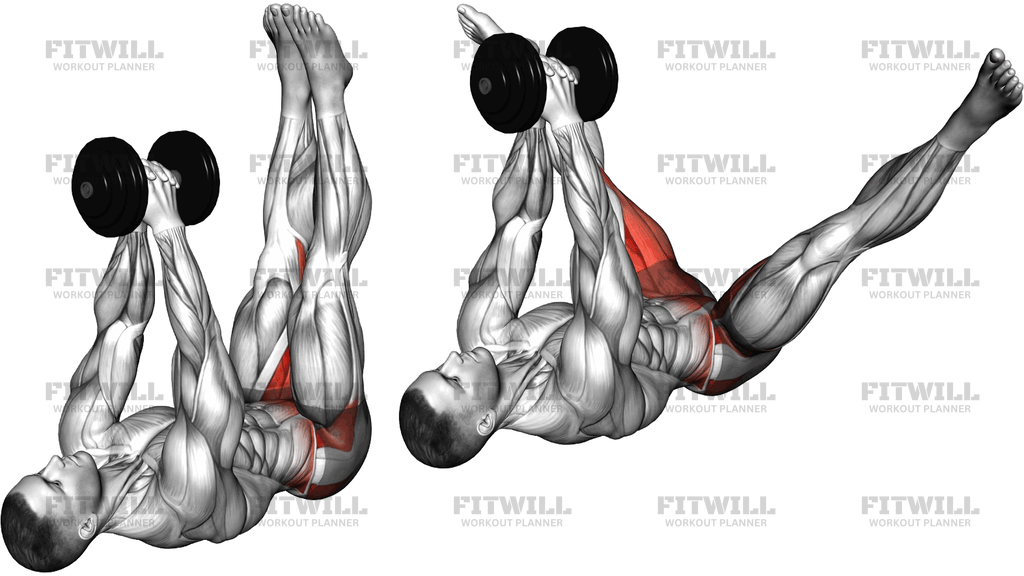
The Dumbbell Over The Chest Lying Abduction is a floor-based hip movement that combines weighted stabilization with leg abduction. You lie on your back and hold a single dumbbell with both hands, arms locked out straight above your chest. From there, with your legs together and pointing at the ceiling, you lower one straight leg out to the side toward the floor, then pull it back up to meet the other leg. The dumbbell acts as a constant overhead load that forces your trunk to stay braced while your hip does the moving.
The main work comes from the abductors of the moving leg — the gluteus medius, gluteus minimus, and tensor fasciae latae — as they control the leg down and lift it back to vertical. The adductors of the stationary leg work hard in reverse, gripping to keep that leg from drifting as the other one sweeps away from it. Meanwhile, your shoulders, triceps, and deep core hold the dumbbell perfectly still over your chest, which is exactly why the setup is unusual and useful.
This is a smart choice for anyone who wants to train hip abduction without bands or machines. It suits lifters who want more hip stability for squats and single-leg work, runners looking for controlled abductor strength, and anyone rebuilding hip control after long periods of sitting. Because you are lying down, the lower back is supported and the movement is easy to regulate with leg speed and dumbbell weight.
Setup matters more than it looks. If the dumbbell wanders away from a position directly over your chest, your shoulder and trunk start compensating and the hip work becomes sloppy. Keep the working knee straight throughout, since bending it shortens the lever and removes much of the challenge. Lower the leg only as far as you can keep both hips flat on the floor — letting the pelvis roll toward the working side is the most common fault and it quietly steals the tension.
In practice, the movement looks simple but feels demanding fast. Light dumbbells in the 5-10 kg range are plenty for most people, and even an unloaded version is worthwhile while you learn the hip position. Use it as an accessory at the end of a lower body session, or pair it with core work since the two demands overlap heavily here.
[ Workout Log & Planner ]
Put your next workout in Fitwill
Keep your plan and training log ready when you are.


Instructions
- Lie flat on your back on the floor with your legs together and extended straight up so your feet point at the ceiling.
- Hold one dumbbell with both hands by pressing the plates together above your chest, palms facing each other, and push it straight up until your elbows are locked out.
- Point the dumbbell at the ceiling directly over the middle of your chest and keep it there for the entire set.
- Brace your abdominal wall and press your lower back gently toward the floor so your ribs stay down.
- Keeping both knees straight and toes pulled back, slowly lower one leg out to the side, letting the hip rotate outward as the leg descends toward the floor.
- Stop when you feel the outer hip working hard or the opposite hip begins to lift off the floor.
- Squeeze the outer hip to draw the leg back up until it is alongside the other leg, with both feet together at the top.
- Exhale as you raise the leg, and inhale steadily while lowering it, never holding your breath against the weight.
- Complete all repetitions on one side or alternate legs, then bend your knees, sit up carefully, and set the dumbbell down on the floor beside you.
Tips & Tricks
- Squeeze the dumbbell plates hard with both palms; a loose grip lets the weight drift out of line over your chest and pulls your shoulders into the set.
- If your pelvis rolls toward the working leg, you are going past your available range — shorten the descent until both hip bones stay flat on the floor.
- Do not let the stationary leg tilt inward as the other leg drops. Think of pressing that leg upward and slightly inward to keep the adductors engaged.
- A bent working knee is the most common shortcut on this exercise. If you catch yourself softening the knee, slow the tempo down and treat the leg like a rigid lever.
- Lower the leg over a three-second count instead of dropping it. The eccentric portion is where the abductors do most of their work in this position.
- Start with a lighter dumbbell than your pressing numbers suggest. The shoulder is holding weight overhead in a fixed position for the whole set, which adds up quickly.
- Keep your neck relaxed and eyes straight up rather than craning to watch your leg, which strains the front of the neck as the set progresses.
- If your lower back arches off the floor when the leg descends, reduce the range and focus on exhaling as the leg lowers to keep the ribs down.
- Set the dumbbell down by first bending your knees and lowering your legs, then sitting up — never roll sideways while still holding the weight overhead.
Frequently Asked Questions
Which muscles does the Dumbbell Over The Chest Lying Abduction work?
The abductors of the moving leg — the gluteus medius, gluteus minimus, and tensor fasciae latae — do the primary work. The adductors of the stationary leg, plus your shoulders, triceps, and deep core, work to hold the legs vertical and the dumbbell steady over your chest.
Why hold the dumbbell over the chest instead of resting it on the floor?
Holding the weight straight overhead keeps your trunk braced and adds a stabilization demand through the shoulders and core while the hip moves. It also gives you a simple way to progress the exercise without bands or a machine.
Is the Dumbbell Over The Chest Lying Abduction suitable for beginners?
Yes, provided you start with a light dumbbell or no weight at all and respect your hip range. Beginners should focus on keeping both hips flat on the floor and the working knee fully straight before adding load.
How far should I lower my leg toward the floor?
Lower it only until you feel the outer hip fully engaged or the opposite side of your pelvis starts to lift. Once the pelvis rolls, the abductors stop controlling the movement and your lower back takes over.
Should I alternate legs or complete all reps on one side?
Either works. Alternating legs keeps the set symmetric and gives each hip a brief rest, while completing one side at a time makes it easier to feel and compare left-right differences in strength or range.
What is the most common mistake in this exercise?
Letting the dumbbell drift away from its position over the middle of the chest, usually because the grip relaxes or the shoulders fatigue. A wandering weight shifts the load from the intended hip work into the neck and shoulders.
What can I use instead of a dumbbell for the Dumbbell Over The Chest Lying Abduction?
You can perform the same leg movement with no weight at all, or use a small weight plate, kettlebell, or medicine ball held in both hands overhead. Resistance bands around the thighs are another option if you prefer loading the abduction directly.
How heavy should the dumbbell be?
Choose a weight you can hold locked out over your chest with steady shoulders for the entire set — for most people that is far less than a pressing weight. If your arms shake before your hips fatigue, the dumbbell is too heavy.
Can this exercise help with hip stability for squats and running?
It can, because it trains the abductors to control the leg through a slow eccentric while the pelvis stays level — the same job they do during single-leg stance. Keep the tempo slow and the pelvis flat to get that carryover.
Is it safe if I have hip or lower back issues?
The supine position supports the spine, but anyone with a known hip or back condition should reduce the range, use no weight, and stop if the movement produces pain rather than muscular effort. Check with a qualified professional before adding load.