Dumbbell Half Kneeling Single Arm Clean Press
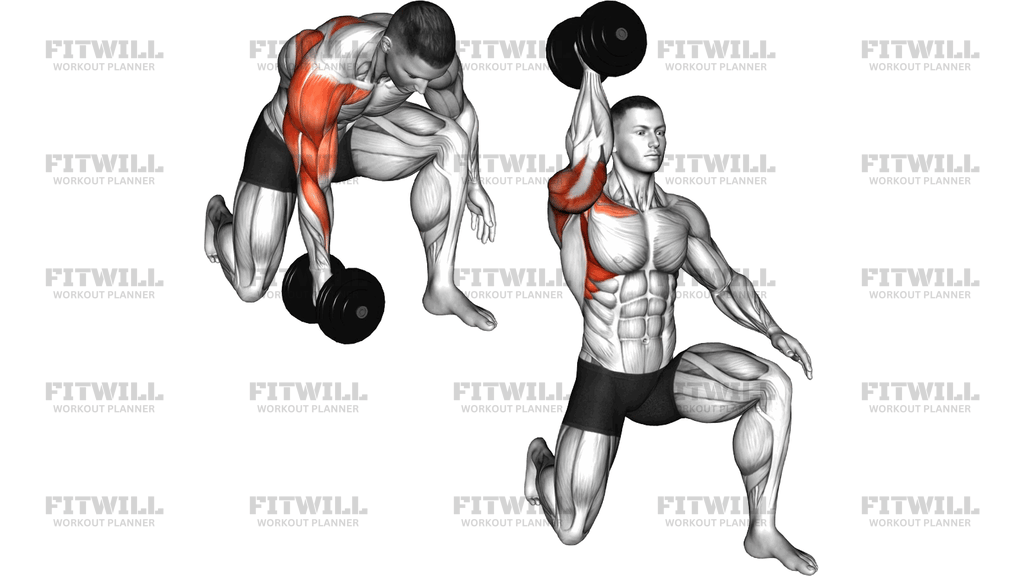
The Dumbbell Half Kneeling Single Arm Clean Press combines two movements into one sequence: a single-arm dumbbell clean from a hanging position, followed immediately by an overhead press, all performed from a half-kneeling stance. In the starting position, one knee rests on the floor with the other foot planted forward, the dumbbell hangs at arm's length, and each rep pulls the weight up to the shoulder and drives it straight overhead before reversing the whole path under control.
The half-kneeling position is what makes this variation special. With one knee down, you cannot use the heavy leg drive and hip pop that a standing clean relies on, so the arm, upper back, and core have to do the real work of bringing the dumbbell to the shoulder. At the same time, the kneeling stance challenges the glutes and hip stabilizers of the front leg to keep your pelvis level and your torso facing forward instead of twisting toward the working arm.
This movement trains the shoulders and triceps as the primary movers, but the demand spreads widely: the lats and upper back control the descent of the clean, the traps help guide the elbow through the catch, and the deep core works overtime to stop rotation as the weight travels from hip height to overhead in one continuous motion. Because the base of support is narrow, even a moderate dumbbell feels substantially heavier than it would in a standing version.
This exercise suits lifters who already have a comfortable overhead press and want to add an anti-rotation and coordination element, as well as field and combat athletes who need to transfer force from the ground through the trunk to the arm. It also works well as a conditioning tool, since each rep covers a long path and keeps several muscle groups engaged at once.
Setup matters more here than in most presses. Keep the front shin close to vertical, squeeze the glute of the down-knee side, and brace the core before the dumbbell ever leaves the hanging position. During the clean, let the elbow stay close to the body and rotate the palm in to catch the weight at the shoulder rather than swinging it wide. Then press vertically, finishing with the dumbbell over the shoulder and the bicep near the ear.
Start lighter than you think you need. The most common errors are leaning the torso toward the working side, letting the hips drift back, and muscling the dumbbell up with a sideways swing. Use a weight you can catch quietly at the shoulder, exhale on the press, and reset your brace and stance every few reps so fatigue does not erode your kneeling position.
[ Workout Log & Planner ]
Put your next workout in Fitwill
Keep your plan and training log ready when you are.


Instructions
- Set up in a half-kneeling stance: one knee on the floor directly under your hip, the other foot planted flat in front with the front shin roughly vertical.
- Hold a dumbbell in one hand at arm's length in front of the hip of your forward leg, palm facing in, with a firm over-the-bar grip.
- Tall through the spine, squeeze the glute on the down-knee side and brace your abdominals so your hips stay square to the front.
- Initiate the clean by driving the elbow back and up along your ribs, letting the dumbbell travel up the front of your body rather than swinging out to the side.
- Rotate your hand under the dumbbell as it rises so you catch it at shoulder height with your palm facing forward and elbow tucked below the weight.
- Without pausing longer than a beat, press the dumbbell straight up until your arm is locked out overhead with the weight stacked over your shoulder.
- Reverse the path: lower the dumbbell back to the shoulder with control, then guide it down the front of your body to the hanging position, keeping your torso upright.
- Exhale as you press, inhale on the way down, and avoid holding your breath through the full sequence.
- Complete all reps on one side, then switch so the opposite knee is down and the other arm works, keeping the same stance rules.
- Reset your brace and hip position between reps if you feel your pelvis twisting or your low back starting to arch.
Tips & Tricks
- If the dumbbell swings away from your body during the clean, you are pulling with the hand instead of driving the elbow back along the ribs — think row-and-rotate, not swing.
- A collapsing or rolling front ankle usually means the front foot is too far forward; shorten the stance until the shin is close to vertical so the knee tracks over the foot.
- Squeeze the glute on the kneeling side the entire set. When it relaxes, the low back arches and the press drifts in front of the shoulder instead of straight up.
- Catch the clean softly. A loud, jarring catch at the shoulder means the weight was too heavy or the pull was too fast for your current control.
- Do not let the elbow flare wide during the press; keep it slightly in front of the shoulder as you press so the deltoid, not the joint capsule, takes the load.
- If your torso rotates toward the working arm, lighten the load and imagine a wall in front of your chest — the half-kneeling clean press is as much an anti-rotation drill as a press.
- Keep the wrist neutral and stacked over the forearm at lockout; a bent-back wrist at the top is a sign the dumbbell has drifted behind the shoulder.
- Place the kneeling knee on a padded mat if the floor is hard, but do not widen the stance to make it comfortable at the cost of hip alignment.
- Rest 10 to 15 seconds between sides rather than rushing the switch, so the second set is performed with the same brace quality as the first.
Frequently Asked Questions
Which muscles does the Dumbbell Half Kneeling Single Arm Clean Press work the most?
The shoulders and triceps do the pressing, while the upper back and traps guide the clean. The glutes, hip stabilizers, and core work hard to keep you square and upright in the kneeling position.
Why perform this exercise half kneeling instead of standing?
Half kneeling removes the leg drive you would normally use to heave the dumbbell up, forcing the arm and upper back to perform the clean honestly. It also makes torso rotation easy to spot and correct, which improves trunk control.
Is the Dumbbell Half Kneeling Single Arm Clean Press suitable for beginners?
It can be, but only after the basic half-kneeling overhead press and a light single-arm clean feel comfortable separately. Start with a very light dumbbell and learn the catch before adding speed or load.
Which knee should be down when pressing with a given arm?
Either works — pressing with the arm on the same side as the down knee is the more common setup and emphasizes anti-rotation on that side. Train both combinations over time for balanced development.
How heavy should the dumbbell be for this movement?
Choose a weight you can catch quietly at the shoulder and press overhead without your torso leaning sideways. Because the kneeling base is narrow, most people need roughly the weight they would use for a standing single-arm clean or less.
What is the most common mistake in this exercise?
Swinging the dumbbell out wide and muscling it up with a sideways heave. Fix it by driving the elbow back along the ribs and letting the weight travel up the front of your body in a tight arc.
Can I do the Dumbbell Half Kneeling Single Arm Clean Press if pressing overhead bothers my shoulder?
If overhead pressing already causes discomfort, address that first rather than adding the clean component. A landmine-style press or a neutral-grip half-kneeling press without the clean may be a better temporary substitute, and persistent pain should be checked by a professional.
How does this exercise differ from a kettlebell clean and press?
The dumbbell has a symmetrical, non-offset handle, so the clean requires more deliberate hand rotation to catch at the shoulder. The kettlebell's offset center of mass makes the catch settle against the forearm naturally.
Should the clean and press be one fluid rep or two separate movements?
The intention is one continuous rep: clean to the shoulder, brief moment to stabilize, then press without a long pause. Separate the two only if you are learning the pattern and need to check each position.
How many reps and sets work well for this exercise?
Two to four sets of 5 to 8 reps per side works well for strength and control, while higher-rep sets of 10 to 12 per side turn it into a demanding conditioning movement. Stop the set when your kneeling posture or catch quality deteriorates.