Cable Side Lying Single Arm Lateral Raise
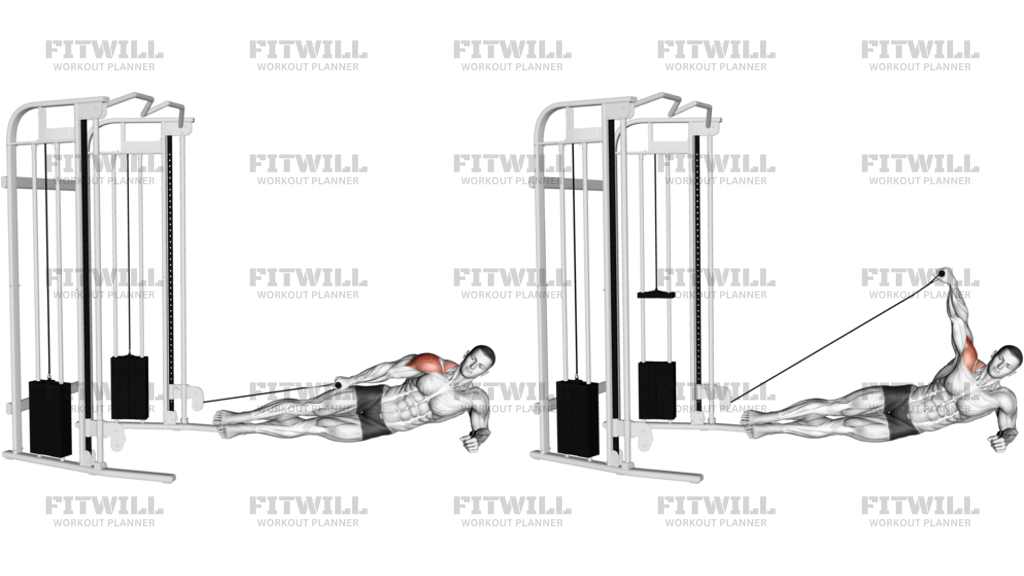
The Cable Side Lying Single Arm Lateral Raise is a shoulder isolation exercise performed lying on your side on a flat bench, with a single handle attached to the low pulley of a cable machine behind you. From this position, you raise your top arm in a wide arc until it points toward the ceiling, then lower it back down under control. Because the cable pulls from behind and below your body, the resistance on the side delts is actually strongest at the start of the rep and challenges the muscle through a different strength curve than dumbbells, which are hardest at the top.
This setup is especially useful for lifters who feel standing dumbbell lateral raises mostly in their traps or front delts. Lying on your side locks your torso in place, which removes the body English, swinging, and lean-back that often creep into standing raises. The side-lying position also keeps tension on the side delts near the bottom of the range, where a dumbbell would go almost slack.
The primary muscle worked is the lateral deltoid, the middle head of the shoulder that gives the shoulder its width. The front delts and upper traps assist, and the supraspinatus contributes in the first portion of the lift. Your bottom arm, braced against the floor, and your core work to keep you stable on the bench throughout the set.
This is a good choice for intermediate lifters who want to add focused volume to their side delts without loading the spine or standing, for anyone rehabbing or managing shoulder irritation who needs a smooth, joint-friendly resistance profile, and for people whose side delts lag behind their front delts. It also pairs well with pressing movements as a secondary shoulder exercise late in a workout.
To execute it well, the bench and your body position matter more than the weight. Set the bench close enough to the low pulley that the cable runs behind your body, not over your working shoulder. Keep your torso perpendicular to the bench rather than rolled back, and let your bottom arm reach down to the floor for support. A slight bend in the elbow of the working arm should stay fixed as the shoulder does the moving.
Choose a light weight at first. The cable pulls continuously, so there is no resting point at the bottom, and the small side delt fatigues quickly. Controlled reps in the 10 to 15 range per side work well. Stop the set when your raising arc shortens or you start rolling your torso backward to help the handle up.
Fitwill
Log Workouts, Track Progress & Build Strength.
Achieve more with Fitwill: explore over 9600 exercises with images and videos, access built-in and custom workouts, perfect for both gym and home sessions, and see real results.
Start your journey. Download today!




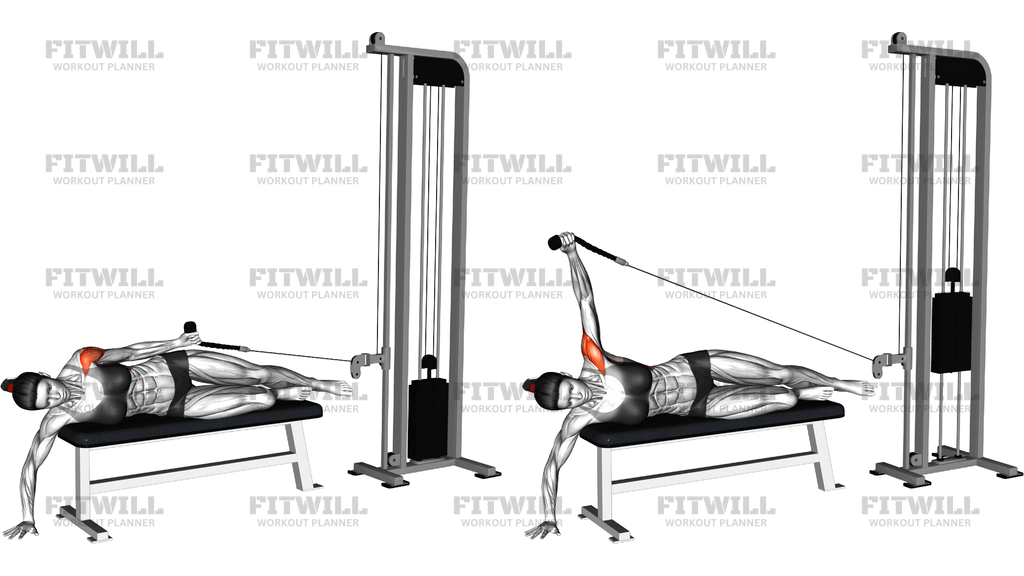
Instructions
- Set a flat bench beside a cable machine so that when you lie on your side, the low pulley is behind your hips. Attach a single handle to the low pulley and select a light weight.
- Lie on your side on the bench with your body in a straight line, torso perpendicular to the bench, legs stacked, and your bottom arm reaching down to grip the bench leg or press into the floor for support.
- Reach your top arm across your body and grip the handle with your palm facing down or slightly toward your body, keeping a small, fixed bend in the elbow.
- Check that the cable runs behind your body, not over your working shoulder, and that there is already light tension on the side delt before you start the rep.
- Brace your core and keep your torso still; do not let your chest roll toward the ceiling as you pull.
- Raise your arm out to the side in a wide arc, leading with the elbow, until your arm points up toward the ceiling or slightly past shoulder height.
- Pause briefly at the top, then lower the handle back down in a slow, controlled arc until your arm rests over your side and the cable tension stays taut.
- Exhale as you raise the handle, inhale as you lower it, keeping your breathing steady throughout the set.
- Complete all reps on one side, then carefully set the handle down, switch sides, and repeat with the same weight and rep count.
- Stand up slowly after finishing, as lying sideways with a loaded cable can pull you if you release the handle abruptly.
Tips & Tricks
- The most common fault is rolling the torso backward to help the arm up. If your chest turns toward the ceiling during the raise, the weight is too heavy or you are losing the locked-in position that makes this exercise effective.
- Keep the elbow bend constant. Straightening the arm at the top or bending it more at the bottom turns the movement into a partial triceps-assisted swing instead of a deltoid raise.
- Do not let the handle slam back to the starting position. The cable keeps pulling even at the bottom, so an uncontrolled descent is the easiest way to strain the shoulder.
- If the cable drags across your shoulder or the bench edge, adjust the bench distance from the pulley first before changing your arm path.
- Lead with the elbow, not the hand. Lifting the hand first shifts work toward the front delts and reduces side delt involvement.
- Stop around shoulder height. Raising far past that point lets the traps take over without adding much benefit to the side delts.
- Use a lighter weight than you would for a standing dumbbell lateral raise. Lying down changes the leverage and the side delts get no break between reps.
- Set your head in a neutral position, resting lightly on the bench or your bottom arm, rather than craning it up to watch the handle.
- Grip the handle just firmly enough to hold it. A death grip tends to tense the whole arm and neck, which makes the raise feel jerky.
Frequently Asked Questions
Which muscles does the Cable Side Lying Single Arm Lateral Raise work?
The lateral deltoids on the side of the shoulder are the primary movers, with the front delts and upper traps assisting. The core and bottom arm mainly provide stability while you lie on the bench.
Why do this lying on a bench instead of standing like a normal lateral raise?
Lying on your side prevents torso swinging and keeps the resistance curve different from dumbbells, since the cable tension is highest at the bottom of the rep rather than at the top. It also isolates each shoulder completely.
Is the Cable Side Lying Single Arm Lateral Raise suitable for beginners?
Yes, as long as beginners start with very light weight and focus on keeping the torso still. The locked side-lying position actually helps beginners learn what a clean lateral raise should feel like.
How high should I raise my arm during the Cable Side Lying Single Arm Lateral Raise?
Raise until your arm points roughly toward the ceiling, at or slightly above shoulder height. Going much higher mostly shifts the effort into the upper traps.
Why does the cable keep pulling even when my arm is down?
A low pulley pulls from behind and below you, so unlike a dumbbell, there is no point in the range where the tension disappears. This is why you should lower the handle slowly and never let it snap back.
What can I use instead of a bench for this exercise?
You can perform the same movement lying on a mat on the floor, positioned sideways in front of a low pulley. The bench simply raises you and can make the top of the arc slightly more comfortable.
What is the most common mistake with this setup?
Rolling the torso backward to help lift the handle, usually because the weight is too heavy. Keep your chest square to the bench and reduce the load if you cannot raise the arm without rolling.
How many reps and sets should I do?
Because the side delts are small and the cable provides constant tension, 2 to 4 sets of 10 to 15 reps per side works well for most lifters. Stop the set if your arc shortens noticeably.
Is this exercise safe for my shoulders?
The cable's smooth resistance makes it generally shoulder-friendly, but anyone with a current or recent shoulder injury should get clearance from a qualified professional first. Stop immediately if you feel sharp pain rather than normal muscle effort.