Kettlebell Seated Reverse Wrist Curl
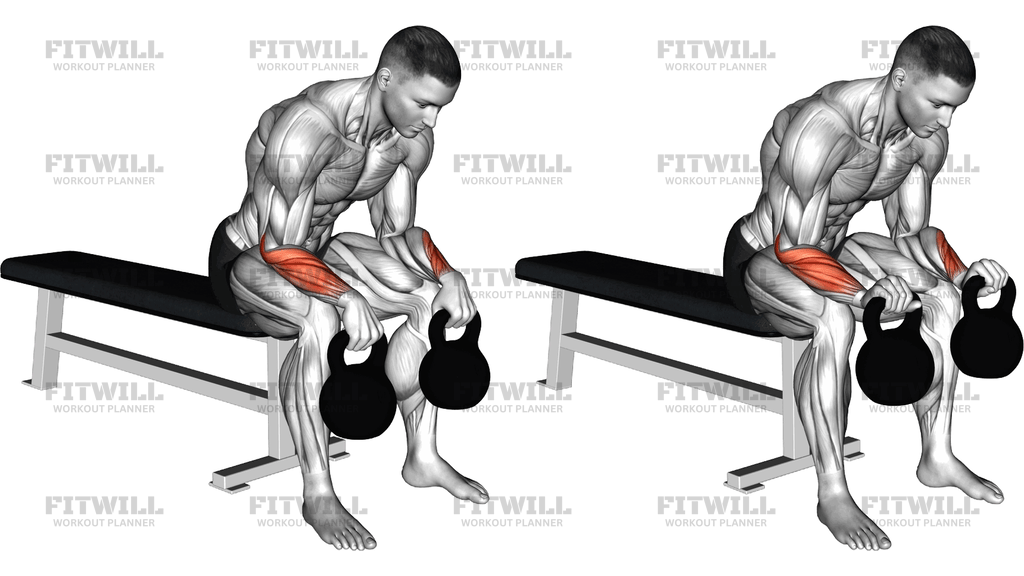
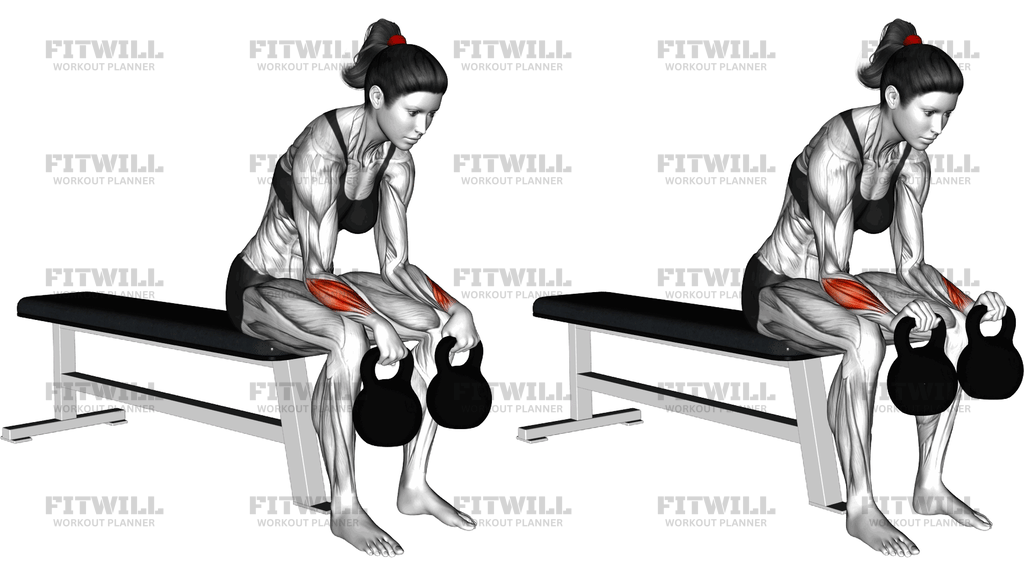
The Kettlebell Seated Reverse Wrist Curl is a focused forearm exercise performed with a kettlebell in each hand while seated on a bench, forearms braced against your thighs, and your wrists hanging over your knees. Instead of curling your palms up toward you as in a standard wrist curl, the reverse version curls the backs of your hands up toward your shins and then lifts them toward the ceiling of your range, loading the muscles on the top of the forearm. The highlighted area in this movement is the wrist extensor group, which runs from just below the outer elbow down to the wrist.
This lift is a good fit for anyone whose grip tends to give out before their larger muscles do. Climbers, martial artists, tennis and golf players, and lifters who struggle to hold onto heavy bars during rows or deadlifts all benefit from direct extensor work. It is also a practical choice for people who spend long hours typing, since balanced forearm training helps offset the constant flexed-wrist position that many daily activities demand. Because the bench supports your forearms and your torso is braced against your thighs, you can isolate the wrists without worrying about stabilizing the rest of your body.
The kettlebell itself changes the feel of the exercise compared to a barbell or dumbbell. The handle sits in your fingers with the bell hanging below your hand, which creates a slightly offset load and gives your grip extra work just holding position. Lean forward from the hips and rest the backs of your forearms flat along your thighs so your wrists can move freely past the edge of your knees. That lean is not optional; without it, the wrists drift back toward your body and the exercise turns into an awkward shoulder and biceps effort.
Execution is deliberately small and controlled. From a position where your knuckles point down and the kettlebells hang below your knees, extend your wrists up until the backs of your forearms engage and your hands rise toward parallel, then lower the bells slowly back into the stretched starting position. Most lifters need far less weight here than they expect. The wrist extensors are small muscles, and the kettlebell's hanging load amplifies every centimeter of movement.
Use this exercise as a finisher after pulling work, or as a standalone forearm session two to three times per week. Higher repetitions in the 12 to 20 range tend to work best, since the goal is endurance and control in a small range rather than maximal loading. If either wrist aches sharply during the movement, reduce the weight, shorten the range, and make sure your forearms stay firmly planted on your thighs for the entire set.
[ Workout Log & Planner ]
Put your next workout in Fitwill
Keep your plan and training log ready when you are.


Instructions
- Sit on a flat bench with your feet flat on the floor, about hip-width apart, and place one kettlebell on the floor beside each foot.
- Lean forward from the hips and rest the backs of your forearms flat along the tops of your thighs so your wrists extend just past your knees.
- Grip each kettlebell handle with an overhand grip, palms facing down, and let the bells hang below your knees with your knuckles pointing toward the floor.
- Brace your core and press your forearms gently into your thighs to lock your arm position before starting the set.
- Exhale and pull the backs of your hands up toward the ceiling, curling at the wrists only, until your hands rise toward parallel with the floor.
- Squeeze the tops of your forearms briefly at the top without letting your forearms lift off your thighs.
- Inhale and lower the kettlebells slowly, letting your wrists bend down until the bells hang in the stretched starting position.
- Keep the movement confined to the wrists; if your elbows or shoulders start moving, the weight is too heavy or you are losing your brace.
- Complete all repetitions, then set the kettlebells on the floor by hinging down rather than releasing your grip from height.
Tips & Tricks
- If the kettlebell handles feel slick or the bells rotate in your hands, chalk your palms or dry your hands; a slipping grip is the most common reason this exercise feels unstable.
- Do not let your forearms peel away from your thighs as you curl up. Once they lift, your biceps and shoulders take over and the wrist extensors stop doing the work.
- Stop the downward phase just before your wrists feel pinched at the end range. Chasing a deeper stretch with heavy bells is where wrist discomfort usually starts.
- Because the load hangs below your hand, kettlebells exaggerate every wobble. If your wrists shake, drop to one bell and work one side at a time instead of abandoning the exercise.
- Keep your grip reasonably loose at the fingers. Squeezing the handles as hard as possible shifts effort to the forearm flexors, which defeats the purpose of the reverse curl.
- If your knees are lower than the bench edge, shift forward slightly on the seat so your wrists clear your kneecaps fully and the bells can hang straight down.
- Warm up with a few bodyweight wrist extensions before picking up the kettlebells; cold extensors tend to complain at the stretched bottom position.
- Stay upright enough that your upper back, not your neck, holds the forward lean. Looking down at the floor with a rounded upper spine for a whole set leads to neck tension.
Frequently Asked Questions
Which muscles does the Kettlebell Seated Reverse Wrist Curl work?
It primarily trains the wrist extensors on the top of the forearm, including the extensor carpi radialis and extensor carpi ulnaris. The grip muscles and the brachioradialis assist as you hold and control the kettlebells.
How is a reverse wrist curl different from a regular wrist curl?
A regular wrist curl uses an underhand grip and curls your palms upward, working the forearm flexors. The reverse version uses an overhand grip with the backs of your forearms on your thighs, targeting the extensors instead.
Why use kettlebells instead of a barbell for this exercise?
The kettlebell hangs below your hand from a handle, which adds a slight stability demand and extra grip work. It also lets you train each wrist independently, which is useful if one side is weaker.
How far forward should I lean on the bench?
Lean forward enough that the backs of your forearms rest flat along your thighs and your wrists hang fully past your knees. If your wrists sit on top of your kneecaps, the kettlebells will not hang straight down and your range will be restricted.
Can beginners do the Kettlebell Seated Reverse Wrist Curl?
Yes, it is one of the more approachable forearm exercises because the bench supports your forearms and the range of motion is short. Start with light kettlebells and 12 to 15 controlled repetitions per set.
Why do my biceps feel this exercise instead of my forearms?
That usually means your forearms have lifted off your thighs and you are flexing your elbows to raise the bells. Press your forearms back down into your legs and think about moving only at the wrists.
What can I substitute if I do not have two kettlebells?
A single kettlebell worked one side at a time, a pair of dumbbells, or a light barbell held with an overhand grip all replicate the same wrist extension pattern. The braced seated position matters more than the exact implement.
How heavy should the kettlebells be for this movement?
Choose a weight you can control for 12 to 20 slow repetitions without your forearms leaving your thighs. Most lifters use noticeably less load here than for regular wrist curls, since the extensors are smaller and the hanging bell amplifies the effort.
Is it normal to feel this at the outer elbow?
Mild working effort near the outside of the forearm is normal, but sharp or pinpoint discomfort at the elbow joint is a signal to reduce the weight and shorten the range. Persistent irritation warrants backing off the exercise entirely and rebuilding with lighter, higher-repetition sets.
Where should I place this exercise in my workout?
Treat it as a finishing movement after your main pulling or grip work, when direct wrist extension will not interfere with heavier lifts. Two to three sets two or three times per week is plenty for most people.