Wrist Circles
Wrist Circles is a standing wrist and forearm mobility drill that uses small, controlled rotations to warm up the joints and the muscles that guide the hand. The movement is about smooth joint control, not load. When it is done well, the forearm stays quiet while the hand traces a clean circle, which helps prepare the wrists for pressing, pulling, hanging, climbing, striking, or any session where the hands have to take repeated force.
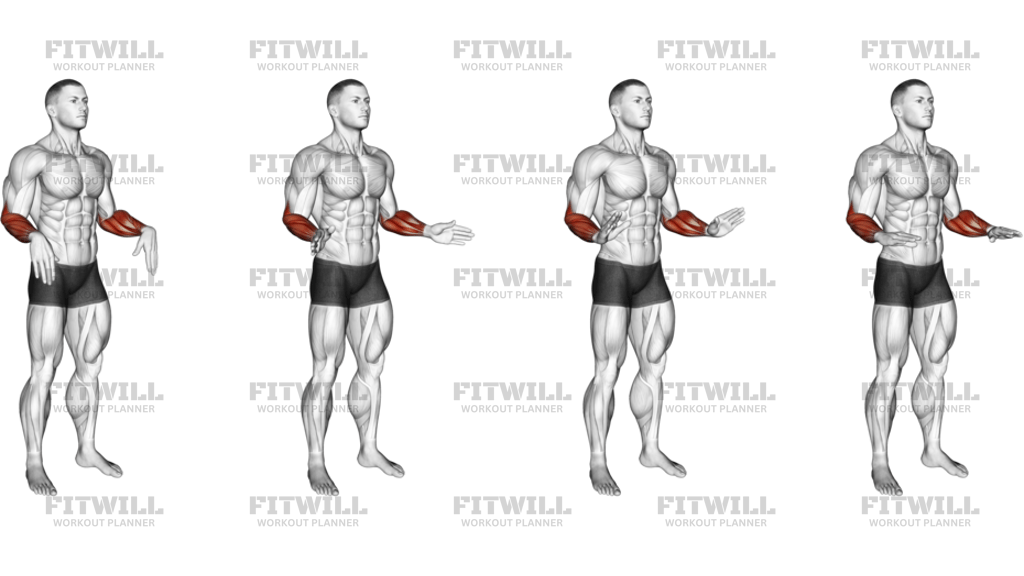
The setup matters because the image shows the elbows held close to the torso, the arms bent, and the hands working in front of the body rather than drifting into a shoulder exercise. Stand tall with your ribs stacked over your pelvis, keep the elbows softly bent, and position the forearms so the wrists can move freely. That shape keeps the motion where it belongs and prevents the shoulders from taking over the drill.
The circle should be small enough to control and smooth enough to feel continuous. Move through wrist flexion, extension, radial deviation, and ulnar deviation without snapping into the end ranges. The hand should lead the motion while the upper arm stays calm. Breathe normally, keep the fingers relaxed, and reverse direction after finishing one side so both directions get equal attention.
This exercise works best as a warm-up, cool-down, or recovery drill. It is useful before heavy benching, overhead work, front rack training, kettlebell work, or bodyweight sessions that load the hands. It also works well for people who spend long hours typing or gripping tools, because it restores awareness to the wrist joint and the small forearm muscles that control it.
Stay inside a pain-free range and treat any sharp pinch, tingling, or catching sensation as a reason to stop and reduce the circle. A mild stretch in the forearm is normal, but the drill should never feel forced. Over time, better progress usually looks like smoother circles, less tension in the hands, and more even motion from side to side rather than a bigger and bigger range.
Fitwill
Log Workouts, Track Progress & Build Strength.
Achieve more with Fitwill: explore over 9600 exercises with images and videos, access built-in and custom workouts, perfect for both gym and home sessions, and see real results.
Start your journey. Download today!




Instructions
- Stand tall with your feet about hip-width apart and soften the knees so the body stays quiet.
- Bend both elbows to roughly 90 degrees and hold the upper arms close to your sides.
- Bring the forearms slightly forward in front of the torso so the wrists have room to move.
- Relax the fingers and hands instead of gripping hard before the first circle begins.
- Trace a slow, controlled circle with both wrists in the same direction.
- Keep the elbows and shoulders as still as possible while the hands draw the path.
- Reverse the direction after the planned repetitions or time on the first side.
- Breathe steadily through the drill and stop if the motion becomes painful or jerky.
Tips & Tricks
- Keep the circles small enough that your shoulders do not roll forward or shrug.
- If one wrist feels sticky, slow the tempo and shrink the circle instead of forcing more range.
- Hold the elbows in place; if they swing, the drill turns into a shoulder motion.
- Open hands make the motion easier to see and usually reduce unnecessary forearm tension.
- Use equal time in both directions so the wrists do not become biased toward one rotation.
- A gentle stretch in the forearm is fine, but pinching at the wrist joint is a sign to back off.
- This works well for warm-ups before pressing, hanging, rack positions, or climbing sessions.
- Stop the set when the circles stop looking smooth, even if you have not reached a high rep count.
Frequently Asked Questions
What does Wrist Circles train most?
It mainly trains wrist mobility and the forearm muscles that control flexion, extension, and rotation.
Is this a strength exercise or a mobility drill?
It is primarily a mobility and warm-up drill. The goal is clean wrist control, not loading the movement.
Do I need equipment for Wrist Circles?
No. The version shown is a bodyweight drill, so you only need enough space to hold your arms in front of your torso.
Should my elbows stay bent or straight?
Keep a soft bend in the elbows. That lets the wrists circle freely without turning the movement into a shoulder swing.
How big should the circle be?
Small enough to control smoothly. If the shoulders move or the hands snap through the path, the circle is too large.
Can I use Wrist Circles before lifting?
Yes. They fit well before pressing, rack work, kettlebell training, handstands, and other sessions that load the wrists.
What if one wrist clicks or feels tight?
Use a smaller, slower circle and stay in a pain-free range. Mild tightness is common, but sharp pain or catching is not.
How can I make this more challenging?
Make the circle slower, more controlled, and more symmetrical in both directions. For a harder version, hold the arms longer or add light wrist-loading drills afterward.