Plate Hyperextension
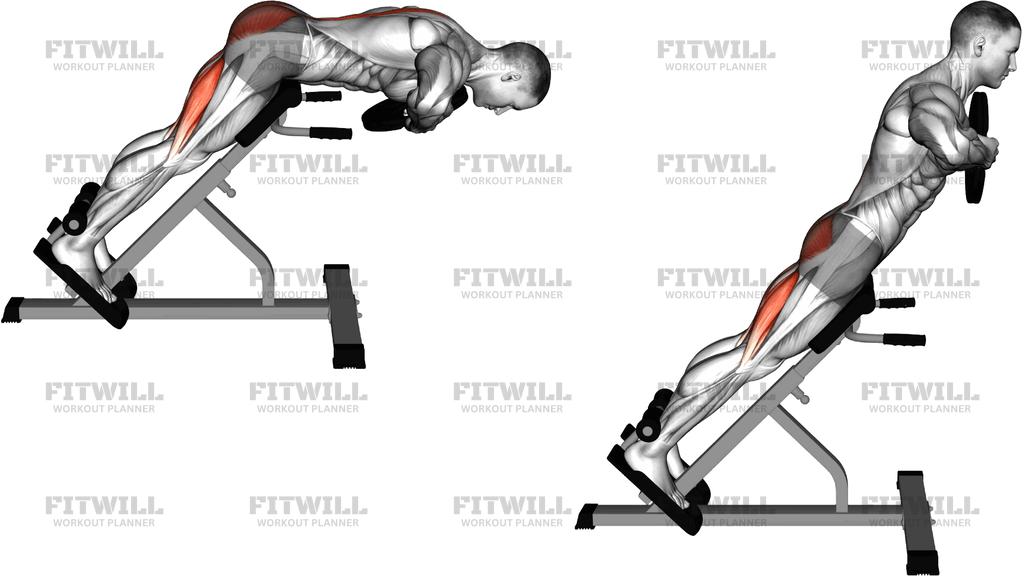
Plate Hyperextension is a weighted back-extension exercise performed on a 45-degree hyperextension bench or Roman chair. In the image, the feet are locked in place, the hips are supported on the pad, and the plate is held tight to the chest while the torso moves from a folded position to a straight, neutral line. That setup makes the movement useful for building the posterior chain with much more control than a loose standing hinge.
This exercise trains the glutes, hamstrings, and spinal erectors together, with the bench helping you isolate hip extension while still demanding a stable trunk. The load sits close to the body, so the rep feels smoother and more centered than holding a plate away from the chest. That close carry also matters because it keeps the spine from being pulled into an ugly arch at the top of the rep.
The setup is what decides whether the movement feels like a strong hip extension or a sloppy low-back bend. Your upper thighs should rest just above the pad so you can hinge freely, and your ankles need to be firmly anchored so the torso can move without sliding. From there, brace before every rep, keep the neck long, and think about lifting the torso by driving the hips forward rather than throwing the chest upward.
At the top of the rep, stop when your body reaches a straight line or just a slight extension past neutral if the bench and your own mobility allow it comfortably. There is no benefit to cranking back hard and compressing the low back. On the way down, fold under control until the posterior chain lengthens again, then repeat with the same tempo and body position.
Plate Hyperextension fits well in accessory work after squats, deadlifts, running, jumping, or any session that needs more posterior-chain volume without loading the spine the way a heavy barbell hinge does. Beginners can use it if they keep the range short, the plate light, and the movement strict. The goal is clean hip-driven reps that stay consistent from the first repetition to the last, not a bigger arc or a heavier plate.
Fitwill
Log Workouts, Track Progress & Build Strength.
Achieve more with Fitwill: explore over 9600 exercises with images and videos, access built-in and custom workouts, perfect for both gym and home sessions, and see real results.
Start your journey. Download today!




Instructions
- Set your upper thighs on the pad so your hips can hinge freely, and lock your ankles under the rollers.
- Hold a weight plate tight to your chest with both forearms wrapped around it.
- Let your torso hang forward with a long spine and your eyes angled down toward the floor.
- Brace your abs and lightly squeeze your glutes before you start the first rep.
- Drive your hips forward to raise your torso until your body forms a straight line from head to heels.
- Stop at neutral or only a small amount past neutral, without leaning back hard.
- Lower slowly by folding at the hips until you feel the hamstrings and glutes lengthen again.
- Reset your brace at the bottom, exhale as you rise, and repeat for the planned reps.
Tips & Tricks
- Keep the plate pinned high on your chest so it does not pull you into a sloppy arch.
- Adjust the bench so the hip crease can move freely instead of resting directly on the pad edge.
- Think about driving the hips forward, not lifting the chest first.
- Keep your chin tucked and your neck in line with your spine throughout the rep.
- Control the lowering phase; a bounce off the bottom turns the set into momentum work.
- Stop when the torso reaches neutral if your low back starts to take over.
- If your hamstrings cramp, reduce the load and shorten the range slightly.
- Choose a plate that lets you hold the same torso position on every rep.
Frequently Asked Questions
What muscles does Plate Hyperextension work?
It targets the glutes, hamstrings, and spinal erectors, with the abs and upper back helping you stay braced.
Is this the same as a back extension?
It is the weighted version of a back extension on a hyperextension bench, with the plate adding resistance at the chest.
Where should I hold the plate?
Hold it tight to the chest or upper ribs so the load stays close to your center of mass and does not tug on the spine.
How far should I come up at the top?
Rise until your body is straight or only slightly above straight; do not keep leaning back once the hips are extended.
Should I feel this mostly in my lower back?
You should feel the glutes and hamstrings working hard, with the lower back stabilizing rather than taking over the whole rep.
Can beginners do Plate Hyperextension?
Yes, if they start with bodyweight or a very light plate and keep the range controlled.
What is the most common mistake?
The biggest mistake is snapping the torso up and overextending the low back instead of finishing with the hips.
How can I make the exercise harder without using a bigger plate?
Slow the lowering phase, pause briefly at the bottom, or add a longer set with the same strict torso position.