Weighted Front Plank
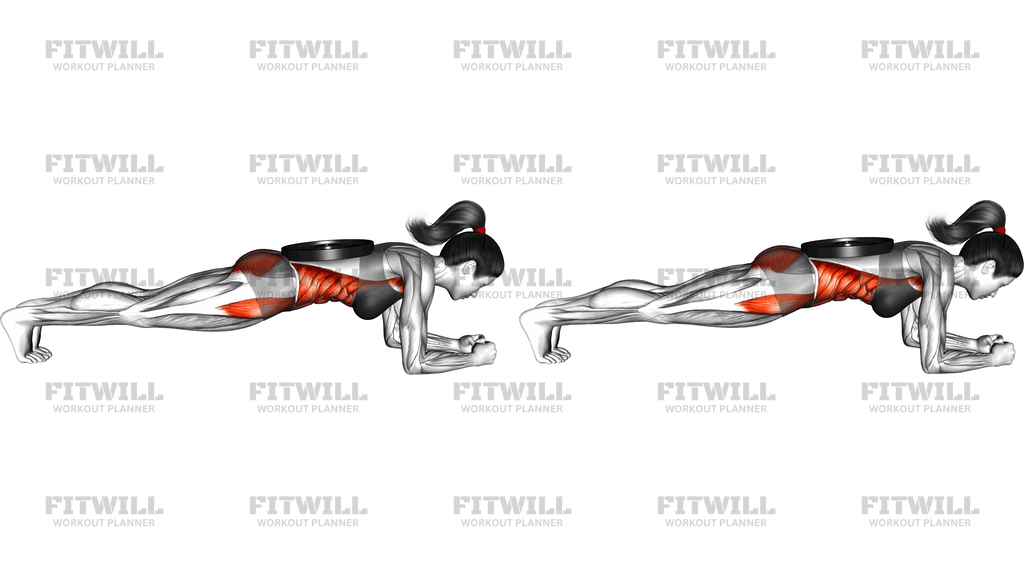
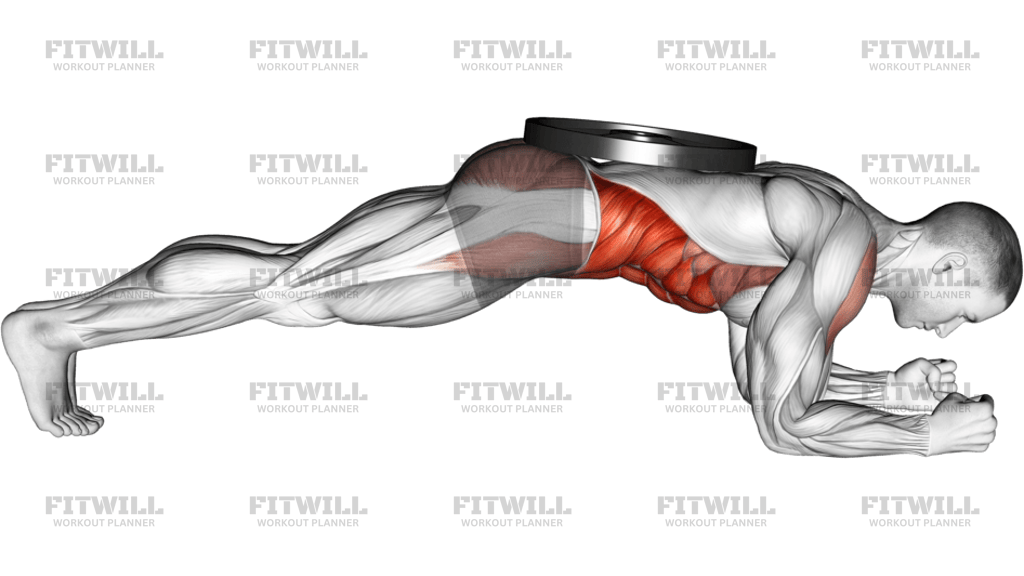
Weighted Front Plank is a loaded forearm plank that uses a weight plate on the upper back to raise the demand on the front of the trunk. In the image, the body is held straight from head to heels while the elbows stay under the shoulders and the toes press into the floor. The exercise is not about moving through a big range of motion; it is about holding a rigid position long enough for the abs, obliques, deep core, glutes, and shoulder stabilizers to keep the torso from sagging or rotating.
The load changes the exercise in a practical way. A bodyweight plank already asks you to resist spinal extension, but the plate makes the midline work harder because the trunk has to stay braced under extra compression. That is why the plate should sit securely across the upper back, not on the neck or low back. When the setup is correct, the weight settles into the torso and the ribs can stay stacked over the pelvis without the lower back taking over.
Treat this as an isometric strength drill. Set the forearms firmly on the floor, press the elbows down, and use the toes to create a long line through the legs. Then tighten the glutes, gently tuck the pelvis, and breathe behind the brace instead of holding your breath the whole time. The goal is a calm, steady hold where the plate stays quiet and the body shape does not change from the first second to the last.
Weighted Front Plank is useful for core-focused sessions, accessory work, or finishers when you want a hard anti-extension challenge without fast repetitions. It also fits well when you need a simple progression from a bodyweight plank and want to add difficulty without changing the movement pattern. Beginners can use it only after they can hold a clean forearm plank without the hips dropping or the shoulders shrugging.
The main safety point is load control. Use a plate that you can balance safely, lower out of the position with care, and stop the hold as soon as the low back starts to arch or the plate shifts. If the forearms, shoulders, or neck are doing more work than the abs, the setup is off and the hold should be shortened or the load reduced.
[ Workout Log & Planner ]
Put your next workout in Fitwill
Keep your plan and training log ready when you are.


Instructions
- Place your forearms on the floor with your elbows directly under your shoulders and your hands relaxed or lightly clenched.
- Extend both legs behind you and set your toes down so your body can form one straight line from head to heels.
- Rest the weight plate centered across your upper back, just below the neck and across the shoulder blades, with help if you need it to get into position safely.
- Squeeze your glutes and quads, then tuck the pelvis slightly so your ribs stay stacked over your hips.
- Press your forearms and toes into the floor to lift the torso into a firm forearm plank.
- Hold the position without letting the lower back sag, the hips rise, or the shoulders creep up toward your ears.
- Breathe in short, controlled breaths while keeping the abdomen braced and the plate steady.
- End the hold by lowering one knee or both knees to the floor before removing the plate carefully.
Tips & Tricks
- A plate with a flat face and clean edges usually sits more securely on the upper back than one that rocks or slides.
- If the plate moves at the start, reduce the load or ask for a handoff instead of trying to catch it mid-hold.
- Keep your elbows slightly in front of the shoulders only if it helps you keep the forearms vertical and the neck relaxed.
- A gentle posterior pelvic tilt usually turns on the abs better than letting the low back arch to chase a longer hold.
- Keep the chin tucked lightly so the neck stays in line with the rest of the spine.
- If your shoulders burn before your abs, shorten the hold and press the floor away a little more through the forearms.
- Use a mat under the elbows if pressure on the forearms makes you lose position before the core does.
- Stop the set the moment the plate starts to shift or the ribs flare hard, because the rep quality is already gone.
Frequently Asked Questions
What muscles does Weighted Front Plank train most?
It primarily trains the rectus abdominis, with strong help from the obliques, transverse abdominis, glutes, and shoulder stabilizers.
Where should the weight plate sit during the plank?
The plate should rest across the upper back and shoulder blade area, not on the neck or down on the lower spine.
How long should I hold the plank?
Hold it only as long as you can keep the ribs stacked, the hips level, and the plate completely still. For many people that means short sets of 10 to 45 seconds.
Can beginners do a weighted forearm plank?
Yes, but only after they can hold a clean bodyweight forearm plank first. Start with a very light plate or no load at all if the position breaks down.
What is the biggest form mistake in this exercise?
Letting the low back sag is the most common problem. If that happens, the hold becomes a lumbar extension exercise instead of a core hold.
Do I need someone to place the weight on my back?
A handoff is safer, especially with heavier plates. It helps keep the torso steady while the load is positioned across the upper back.
How do I breathe during a weighted front plank?
Take short, controlled breaths while keeping the abdomen braced. Avoid completely holding your breath for the whole set.
What should I do if the plate shifts on my back?
Stop the hold, reset the plate, and lighten the load if needed. A shifting plate usually means the setup is too heavy or the torso is losing position.