Barbell Good Morning
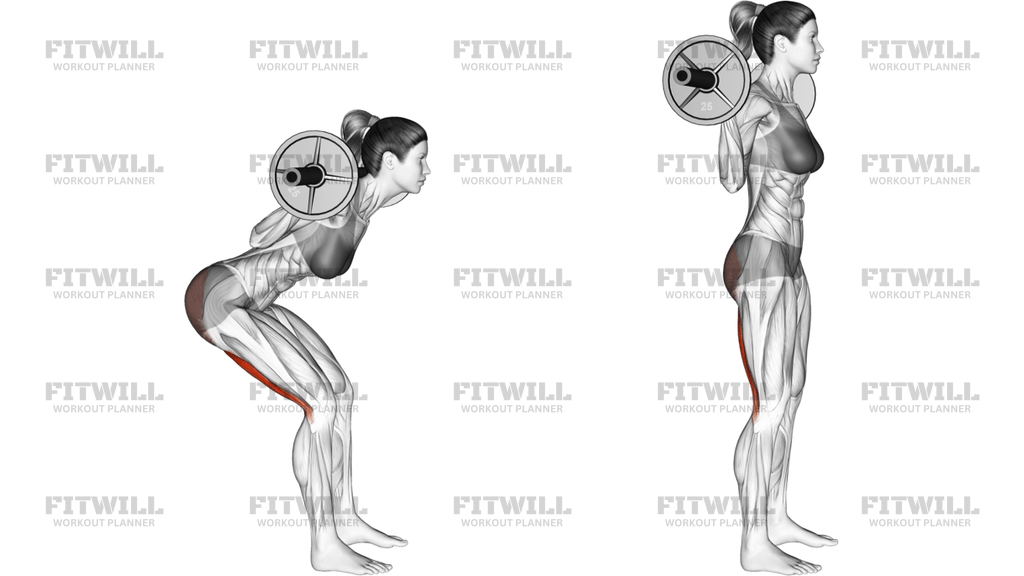
Barbell Good Morning is a loaded hip hinge that teaches you to keep a strong back position while the hips travel back and the torso leans forward under control. The bar sits across the upper back, so the movement challenges the hamstrings, glutes, spinal erectors, and bracing muscles together rather than isolating one area. It is a useful strength and accessory exercise when you want better posterior-chain control, stronger hinge mechanics, and more confidence under a barbell.
The setup matters because the bar position and stance determine whether the lift feels organized or unstable. In Barbell Good Morning, the feet stay planted, the knees keep a soft bend, and the hips initiate the motion by moving straight back. If the bar sits too high on the neck, the knees bend too much, or the ribs flare, the hinge turns into a sloppy forward fold instead of a controlled back-and-hip drill.
Each repetition should feel like a deliberate bow from the hips while the torso stays braced and the spine stays long. You descend only as far as you can keep the lower back neutral and the hamstrings loaded, then stand by driving the hips forward and squeezing the glutes. The bar should remain fixed against the upper back the whole time, and the neck should stay neutral instead of craning up to chase balance.
Barbell Good Morning is often used as a strength accessory, a posterior-chain builder, or a technical hinge drill before deadlifts and squats. Light to moderate loading usually works best because the leverage gets demanding quickly and the low back can take over if the set becomes too heavy. That makes it especially valuable for lifters who want to improve hinge control without needing a huge range of motion.
The main safety rule is to stop the descent before your pelvis tucks under or your back rounds. A clean rep is more important than reaching the floor, and a shorter range with better positioning is usually the better training choice. When the load stays reasonable and the tempo stays controlled, Barbell Good Morning becomes a precise way to train the back side of the body without turning the set into a guesswork movement.
Fitwill
Log Workouts, Track Progress & Build Strength.
Achieve more with Fitwill: explore over 9600 exercises with images and videos, access built-in and custom workouts, perfect for both gym and home sessions, and see real results.
Start your journey. Download today!




Instructions
- Place a barbell across your upper back and rear delts, grip it just outside shoulder width, unrack it, and take two short steps back.
- Stand with your feet about hip to shoulder width apart, unlock your knees slightly, and stack your ribs over your pelvis.
- Focus your eyes on the floor a few feet ahead and keep your neck in line with your spine.
- Take a breath into your belly and brace your midsection before the first hinge.
- Push your hips straight back and let your torso tip forward while the bar stays pinned to your upper back.
- Keep a soft bend in the knees without turning the movement into a squat.
- Lower until your hamstrings are stretched and your back position can stay neutral, then pause briefly without bouncing.
- Drive your hips forward to stand tall, squeeze your glutes at the top, and avoid leaning back to finish the rep.
- Reset your breath at the top, then repeat for the planned reps before stepping forward and re-racking the bar.
Tips & Tricks
- If the bar rests too high on your neck, the movement feels unstable; keep it on the upper traps and rear delts instead.
- Think about sending your hips back, not dropping your chest down.
- Stop the descent when your pelvis wants to tuck under; that is usually your real range of motion for the day.
- Keep the knees softly bent and mostly fixed so the lift stays a hinge rather than a partial squat.
- Use a lighter load than you think at first; Barbell Good Morning gets demanding fast because of the long lever.
- Keep pressure through the whole foot, especially the midfoot and heel, so the bar path does not drift forward.
- If your lower back takes over early, shorten the range and slow the lowering phase before adding weight.
- Set safety pins in a rack if you are learning the lift, so you have a clear stop point if the hinge gets away from you.
Frequently Asked Questions
What muscles does Barbell Good Morning work most?
It mainly trains the hamstrings, glutes, and spinal erectors, with the core helping you keep the torso braced.
Is Barbell Good Morning a squat or a deadlift?
Neither. It is a hip hinge, so the hips travel back while the knees stay softly bent and fairly fixed.
How low should I go in Barbell Good Morning?
Only as low as you can keep a long spine and strong brace. For many lifters that is well before the torso is parallel to the floor.
Why do I feel Barbell Good Morning in my lower back?
Some lower-back work is normal, but if it dominates the rep the load is usually too heavy or the hips are not moving back far enough.
Should my knees bend a lot during Barbell Good Morning?
No. Keep a small, soft bend and hold that knee angle mostly steady while the hips hinge backward.
Can beginners do Barbell Good Morning safely?
Yes, but start very light and keep the range short until the hinge pattern feels consistent. A dowel or empty bar is a better starting point than heavy weight.
What is a good variation if the barbell bothers my upper back?
A light dumbbell Romanian deadlift or banded good morning can train the same hinge pattern with less bar pressure on the shoulders.
Do I need a spotter for Barbell Good Morning?
A spotter is not required, but rack safety pins are smart when you are learning or using a challenging load.