Front Leg Hook Kick Kickboxing
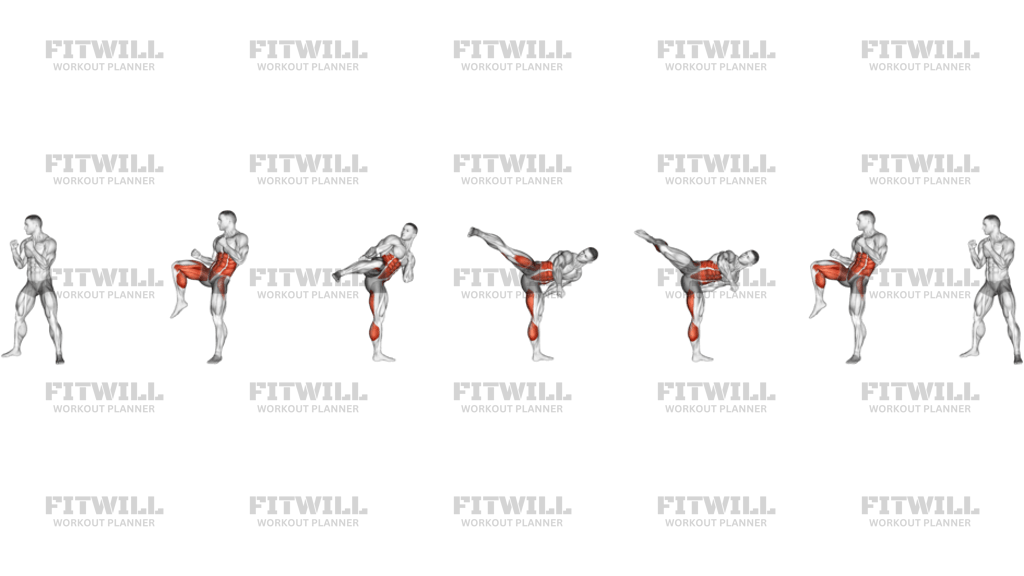
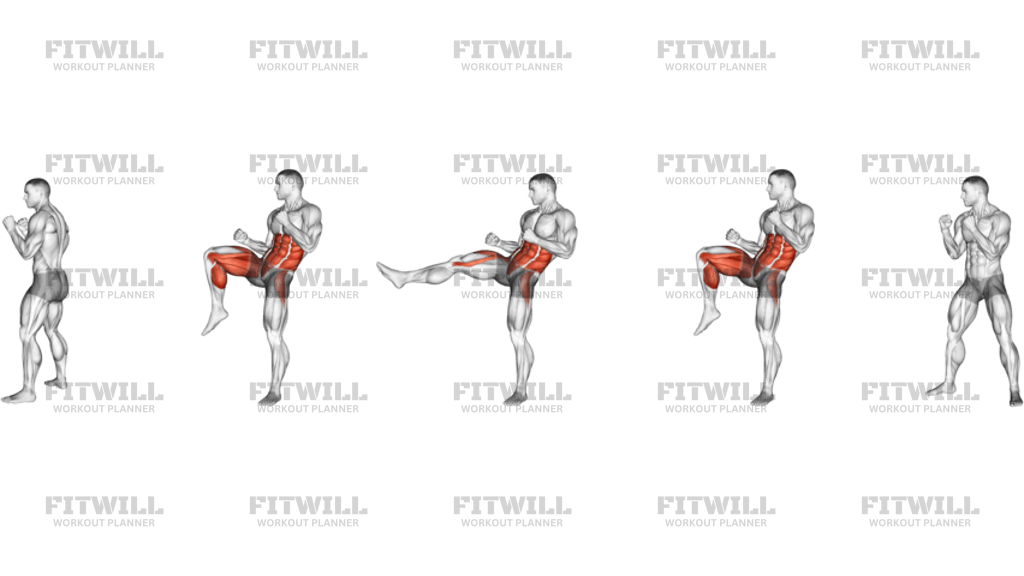
Front Leg Hook Kick Kickboxing is a lead-leg striking drill that teaches you how to chamber the knee, pivot the support foot, and whip the heel around in a hooked arc. It is not a brute-force strength movement; the value comes from clean timing, hip rotation, balance, and the ability to retract the leg as quickly as you throw it.
Because the kick travels across the front of the body, the setup matters as much as the strike. A stable fighting stance, active guard, and a quiet torso help the lead leg move without the upper body drifting off line. The support leg has to do its share of the work too, especially through the foot pivot and the small balance corrections that keep the kick controlled.
Front Leg Hook Kick Kickboxing is useful for striking practice, coordination work, and conditioning in martial arts sessions. It trains the hips, glutes, quads, hamstrings, calves, obliques, and the smaller stabilizers that keep the pelvis organized while one leg leaves the floor. The movement also asks for good range through the hip and a fast return to stance, which makes it more technical than it looks.
The cleanest reps usually start with the knee lifting first, not the lower leg swinging first. From there, the heel travels on a hooked path while the standing foot turns enough to let the hip open. If you force height by leaning back or throwing the torso, the kick gets harder to control and the standing leg absorbs more stress.
Most people should practice Front Leg Hook Kick Kickboxing slowly at first, ideally in shadowboxing or on a bag or pad at a moderate height. Use the motion to build sharpness, balance, and return speed before trying to kick higher or faster. If the standing knee, hip, or groin feels pinchy, shorten the range and keep the chamber compact until the movement feels smooth and repeatable.
[ Workout Log & Planner ]
Put your next workout in Fitwill
Keep your plan and training log ready when you are.


Instructions
- Stand in a kickboxing fighting stance with your lead foot forward, rear heel light, hands up, and chin tucked.
- Shift your weight slightly onto the rear leg so the lead leg can lift without your torso falling forward.
- Lift the lead knee across the front of your body and chamber it before the kick starts to unfold.
- Pivot the support foot on the ball of the foot so the hip can open and the knee can travel cleanly.
- Snap the lower leg outward in a hooked path, leading with the heel as the kick comes around the front of the body.
- Keep the opposite hand high and the ribs stacked so the upper body stays quiet while the leg swings.
- Retract the foot back along the same path immediately after the strike instead of letting the leg hang out in space.
- Set the kicking foot back under control and re-establish your stance before the next repetition.
- Breathe out sharply during the kick and reset your guard before switching sides or starting the next rep.
Tips & Tricks
- Let the support foot pivot early; if it stays planted, the knee and hip usually twist instead of the kick turning over cleanly.
- Think of the motion as a chamber and whip, not a big leg swing from the floor.
- Keep the kick at a height you can retract quickly; a lower clean hook kick is better than a high kick that leaves you off balance.
- Aim with the heel or lower heel edge, not the toes, so the kick path stays true to the hook shape.
- Do not lean your shoulders far back to fake extra height; that usually pulls the pelvis out of position.
- If your standing knee collapses inward, shorten the kick and widen the stance slightly before trying more speed.
- Keep both hands active in guard so the upper body does not drift open as the leg swings.
- Practice the return as aggressively as the strike; the retraction is what makes the kick look sharp and controlled.
- Use shadowboxing first, then add a bag or pad once the chamber, pivot, and recoil all feel consistent.
Frequently Asked Questions
What muscles does Front Leg Hook Kick Kickboxing work?
It mainly uses the hips, glutes, quads, hamstrings, calves, and obliques, with the support leg doing a lot of stabilizing work.
Is Front Leg Hook Kick Kickboxing beginner friendly?
Yes, if you start with slow shadow kicks at waist height and focus on the chamber, pivot, and retraction before adding speed.
Should the support foot pivot during a Front Leg Hook Kick Kickboxing rep?
Yes. The pivot lets the hip open and keeps the standing knee from taking the twist that belongs in the leg and hip.
Do I strike with the heel or the toes in a Front Leg Hook Kick Kickboxing kick?
Use the heel or lower heel edge. That keeps the hook path tight and gives the kick a cleaner striking surface.
Why does my Front Leg Hook Kick Kickboxing kick feel unbalanced?
You are probably leaning the torso or swinging the lower leg before the chamber is set. Keep the knee lifted first and let the strike come after the pivot.
Can I practice Front Leg Hook Kick Kickboxing on a heavy bag?
Yes, but only after you can shadow the kick cleanly. A bag makes timing and recoil more obvious, so it is better for sharpening technique than learning the motion from scratch.
What is the most common mistake in Front Leg Hook Kick Kickboxing?
Throwing the leg from the floor without a real chamber. That usually makes the kick slow, wide, and harder to recover.
How high should I kick in Front Leg Hook Kick Kickboxing?
Kick only as high as you can retract without losing your stance. Waist to chest height is a sensible place to build speed and control first.