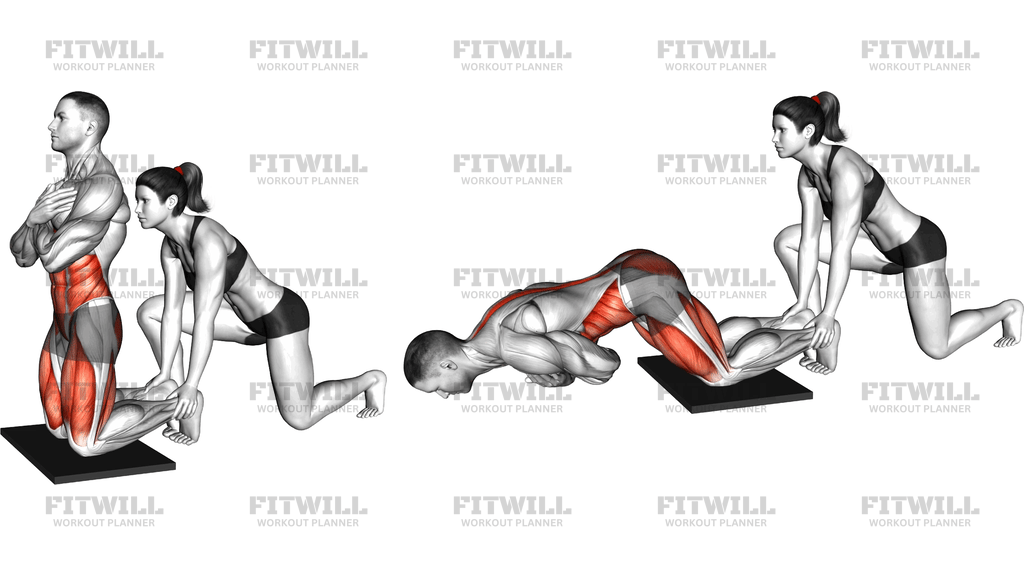
Glute-Ham Raise
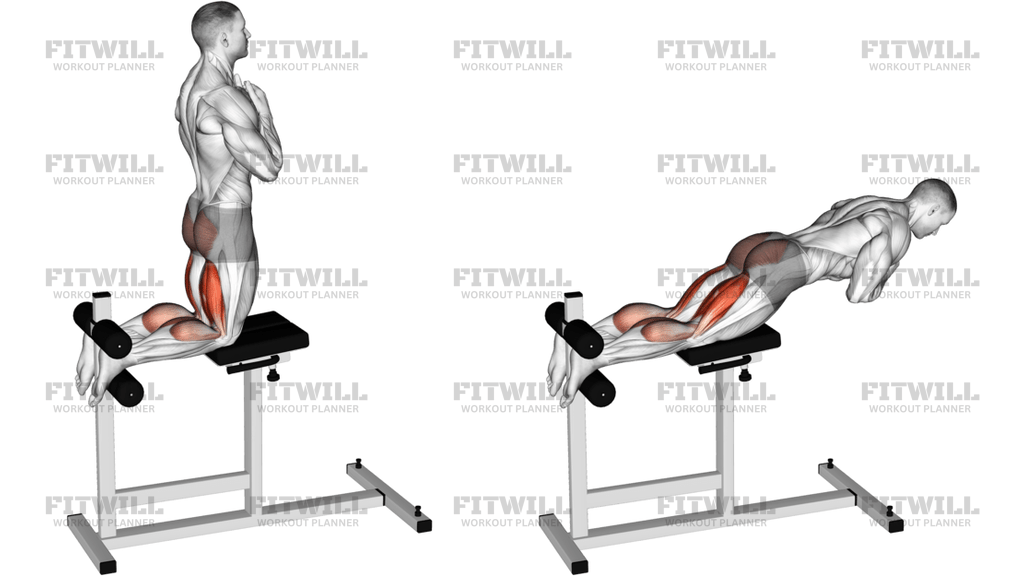
The glute-ham raise is a body-weight posterior-chain exercise performed on a glute-ham developer, with the lower legs anchored and the thighs supported on the pad. It is built around a long lever from the knees to the shoulders, so the hamstrings have to control both the lowering phase and the return. That makes it one of the clearest exercises for training hamstring strength through knee flexion while also asking the glutes and spinal stabilizers to keep the trunk organized.
The setup matters more here than on many other body-weight drills. Your knees should sit just in front of or on the front edge of the pad, the ankles should be locked securely under the rollers, and the hips should start tall enough that you can fold at the knees without collapsing at the waist. If the legs are too far forward or the rollers are loose, the rep turns into a bad lower-back movement. When the alignment is right, the hamstrings can stay loaded through a smooth, controlled arc.
At the start of each rep, hold a straight line from the knees through the hips and shoulders, then lower the torso forward under control until the body is nearly straight or as low as you can maintain without losing position. The return should come from pulling the heels down and curling the torso back to upright, not from throwing the chest up or arching hard through the lower back. Keep the neck long, the ribs stacked, and the hips extended so the hamstrings stay the main limiter.
This movement is useful for athletes, lifters, and anyone who needs stronger hamstrings for sprinting, hinging, deceleration, or injury-prevention work. It is demanding even with no added load, so quality usually matters more than volume. Use assistance, a band, or a shorter range if needed, and stop the set when the torso starts breaking at the hips or the rep becomes a back extension instead of a hamstring curl.
[ Workout Log & Planner ]
Put your next workout in Fitwill
Keep your plan and training log ready when you are.


Instructions
- Adjust the GHD so your knees are just in front of the pad edge and your ankles are locked firmly under the rollers.
- Start tall with your thighs supported on the pad, hips extended, and your torso stacked in a straight line from knees to shoulders.
- Cross your arms over your chest or hold them lightly at your chest if the setup allows it.
- Brace your midsection before you move so your ribs stay down and your lower back does not overextend.
- Lower your torso forward by letting the knees open while keeping the thighs and hips long.
- Continue the descent under control until your body is nearly straight or as low as you can stay aligned.
- Pull your heels down into the rollers and curl your torso back to the start without jerking.
- Finish tall again with the glutes squeezed, then begin the next rep or step off the pad safely.
Tips & Tricks
- Keep the ankles locked firmly under the rollers; if your feet slip, the rep becomes hard to control fast.
- Think of lowering as a long knee-open and return as a hard hamstring curl, not as a back extension.
- Keep the hips extended on the way down so the torso and thighs move together instead of folding at the waist.
- Do not chase depth if your pelvis tips forward or your lower back starts to arch aggressively.
- Exhale as you pull yourself back to upright, then reset your brace before the next descent.
- Use a shorter range or light assistance if you cannot control the full eccentric on your own.
- Keep the neck neutral and look slightly ahead of the pad rather than craning to reach the floor.
- Stop the set when the return becomes a hip hinge or a yank through the spine.
Frequently Asked Questions
What does the glute-ham raise train most?
It primarily trains the hamstrings, especially their ability to control knee flexion through a long range.
Where should my knees and ankles sit on the GHD?
Your knees should be just in front of the pad edge and your ankles should be locked securely under the rollers so you can move without sliding.
How low should I go on each rep?
Lower only as far as you can keep the torso, hips, and thighs in one controlled line without folding at the waist.
Should I feel this in my lower back?
The lower back should stabilize, but the main effort should stay on the hamstrings and glutes. If your back is doing most of the work, the setup or range is off.
Can beginners use the glute-ham raise?
Yes, but usually with assistance, a shorter range, or very low reps. It is a demanding body-weight exercise even before extra load is added.
What is the most common form mistake?
The most common mistake is breaking at the hips and turning the rep into a lower-back extension instead of a hamstring-dominant curl.
How can I make the exercise easier?
Reduce the range, use a band or hand assistance, or perform fewer controlled reps instead of forcing a full unassisted set.
What breathing pattern works best?
Brace before each descent, then exhale as you pull back to the top and reset before the next rep.