Rear Axe Kick Kickboxing
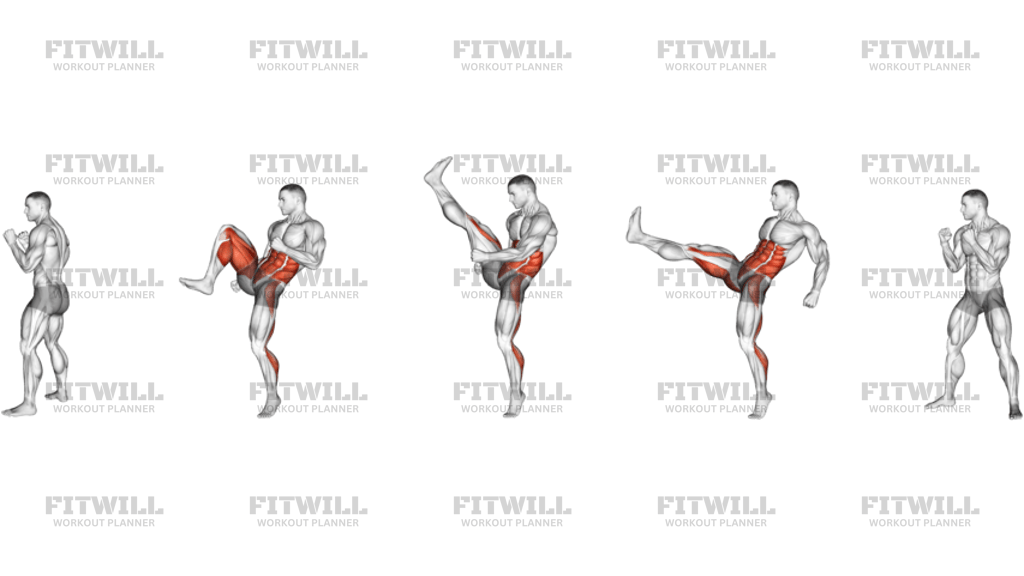
Rear Axe Kick Kickboxing is a bodyweight striking drill built around balance, hip control, and a clean vertical kicking path. It trains the ability to lift the kicking leg high, control the torso on the support leg, and strike downward with the heel in a straight line. Because the movement is fast and high-amplitude, the quality of the setup matters as much as the kick itself.
The exercise is most useful when you want a kickboxing drill that develops coordination, mobility, and lower-body control without external load. The support leg, standing foot, hips, and trunk all have to stay organized while the kicking leg rises and drops. That makes the movement especially valuable for warmups, technique rounds, conditioning circuits, and sport-specific accessory work where precision matters more than brute force.
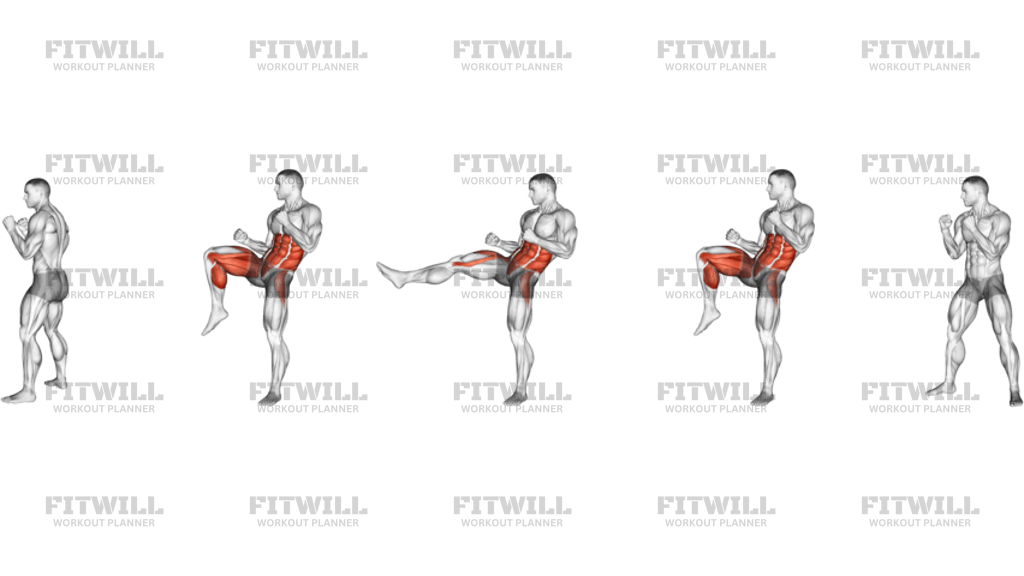
A good rear axe kick starts from a stable fighting stance with the hands up and the weight centered before the lift. The kicking knee should rise under control, the torso should stay tall, and the leg should travel up on a clean line rather than swinging wildly across the body. At the top, the heel drives downward as if cutting through a target, then the foot returns to the floor under control so the stance stays ready for the next rep.
The biggest performance limiter is usually balance, not strength. If the body leans too far, the kick turns into a backbend and the heel loses its line. If the chamber is rushed, the strike becomes sloppy and the landing is unstable. Keep the motion crisp, breathe out on the kick, and use a height you can repeat cleanly. That is how this drill builds useful kickboxing mechanics instead of just looking dramatic.
For most people, this is best treated as a technical drill first and a power drill second. Shadowbox it, work it on pads, or use it in controlled striking combinations once the path is consistent. It is not a move to force through pain, and it should not be turned into a spin or a wild jump unless that is part of a separate, coached variation. When performed well, the rear axe kick teaches control through the full arc of the strike while reinforcing posture, timing, and lower-body coordination.
[ Workout Log & Planner ]
Put your next workout in Fitwill
Keep your plan and training log ready when you are.


Instructions
- Stand in a fighting stance with your hands up, feet under you, and most of your weight centered over the support leg.
- Keep the kicking-side knee soft and the support heel light so you can shift without losing balance.
- Lift the kicking knee upward under control until the thigh is high and the torso stays tall.
- Extend the kicking leg up on a straight path, aiming the heel above the target rather than throwing the foot outward.
- Drive the heel straight down as if chopping through a vertical line in front of you.
- Keep the non-kicking arm active for balance and stop the torso from collapsing backward.
- Place the foot back under your hips in the same stance you started from.
- Exhale sharply on the downward strike and reset before the next rep.
- Repeat for the planned number of kicks, staying smooth instead of rushing the chamber or landing.
Tips & Tricks
- Keep the support knee slightly bent so the stance leg can absorb the shift without locking out.
- Think of the kick as a vertical chop: up, then straight down, not a looping roundhouse motion.
- If your upper body is tipping back, lower the kick height and keep the ribs stacked over the hips.
- Point the toes only enough to keep the leg long; do not overextend the ankle and lose control of the heel line.
- Let the chamber happen first, then strike. Rushing the lift is the fastest way to lose balance.
- Use the glute and hip to lift the leg, not a big swing from the lower back.
- A slower return to stance is useful for skill work because it forces you to own the landing.
- If the kicking knee opens out to the side, narrow the path and aim more directly down the centerline.
- Stop the set when the heel no longer tracks cleanly or the support foot starts spinning.
Frequently Asked Questions
What is a rear axe kick in kickboxing?
It is a vertical kicking drill where you lift the leg high and bring the heel straight down through the target line.
Can beginners perform this exercise?
Yes, as long as they keep the kick low, move slowly, and stay balanced on the support leg.
What muscles do rear axe kicks work?
They primarily challenge the hips, glutes, hamstrings, quads, calves, and core while demanding balance and coordination.
Should the heel travel straight down or around the body?
It should travel straight down on a vertical line. If the kick loops around, the strike loses its axe-like path.
Do I need a bag or pad for this movement?
No. You can shadow kick it for technique, then move to a pad or bag once the line and balance are consistent.
What is the most common mistake with a rear axe kick?
Leaning back too far or swinging the leg without a controlled chamber usually causes the biggest loss of balance.
How high should I kick?
Only as high as you can raise the leg without tipping the torso or losing the support-foot position.
Is this more of a power move or a technique drill?
It can be either, but it is usually best trained as a technique and mobility drill before you try to add speed or power.
How do I regress the exercise if balance is poor?
Reduce the range of motion, slow the tempo, and practice the chamber and landing separately before combining them.