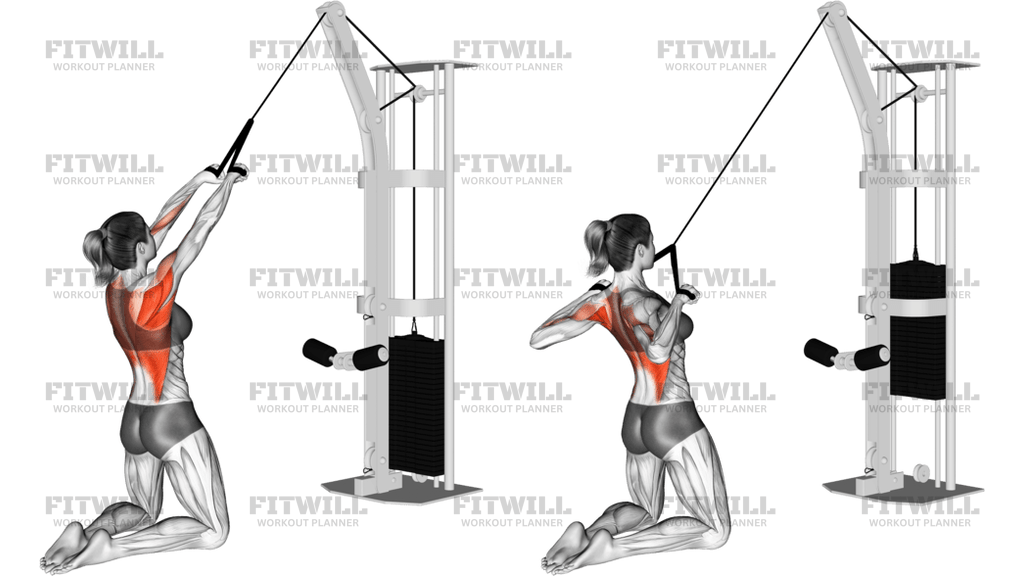
Cable Reverse-Grip Pulldown
Cable Reverse-Grip Pulldown is a vertical pulling exercise that uses an underhand grip on a straight bar or lat-pulldown attachment. It is especially useful when you want to train the lats hard while letting the biceps, rear shoulders, and upper back contribute to the pull. The reverse grip changes the elbow path and usually makes it easier to keep the elbows tucked, which is why many lifters feel this variation more in the lower and outer part of the back.
The setup matters more than people think. Sit tall on the pulldown seat, lock your thighs under the pad, plant your feet, and take a grip that is just inside shoulder width. From there, keep your chest lifted, ribs stacked, and shoulders set down away from your ears before the first rep. If the torso is loose at the start, the set usually turns into a swing instead of a back-driven pull.
Each repetition should start with the bar overhead and the arms fully extended without shrugging into the ears. Pull the elbows down and in toward your sides until the bar reaches the upper chest or collarbone line, then squeeze for a brief pause before guiding the bar back up under control. The return matters as much as the pull because it keeps tension on the lats and teaches the shoulder to move smoothly through the full range.
Cable Reverse-Grip Pulldown fits well as an accessory lift after heavier rows or pull-ups, or as a main pulldown option for people who want a stronger arm-assisted back movement without losing control. It is also a useful choice when a standard overhand pulldown feels too upper-back dominant or when a lifter wants more biceps involvement without turning the exercise into a curl. Keep the load honest, keep the body quiet, and stop the set once the bar path starts to drift or the shoulders begin to shrug.
[ Workout Log & Planner ]
Put your next workout in Fitwill
Keep your plan and training log ready when you are.


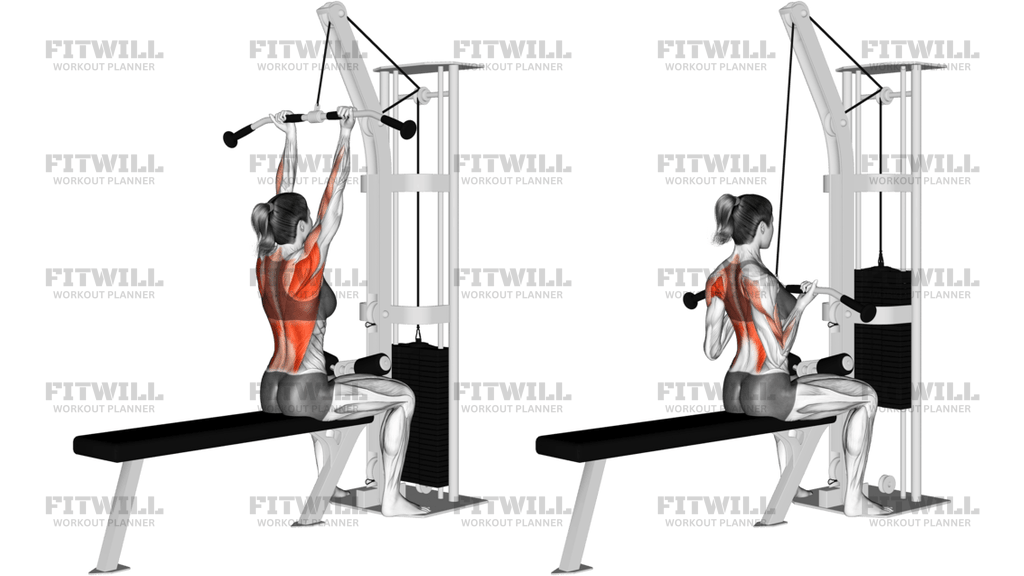
Instructions
- Sit on the pulldown seat facing the cable stack and secure your thighs firmly under the pad.
- Take a shoulder-width or slightly narrower underhand grip on the straight bar with your palms facing you.
- Plant both feet flat on the floor, lift your chest, and keep a small natural arch in your lower back.
- Set your shoulders down away from your ears and brace your midsection before you start the first rep.
- Begin with your arms straight overhead and the bar just in front of your face, not behind your head.
- Pull your elbows down and in toward your sides until the bar reaches your upper chest or collarbone line.
- Pause briefly at the bottom while keeping your torso mostly still and your wrists straight.
- Guide the bar back up slowly until your elbows are fully extended and you feel a stretch through your lats.
- Exhale as you pull, inhale as the bar rises, and re-rack the handle carefully when the set is finished.
Tips & Tricks
- Keep the grip just inside shoulder width; a wider underhand grip usually turns this into more of a shoulder and upper-back pull.
- Think about driving your elbows toward your ribs instead of pulling with your hands.
- Keep your wrists stacked over your forearms so the bar does not fold your hands back.
- Let the bar finish at the upper chest line; pulling lower usually adds extra lean and shoulder travel.
- Keep the thigh pad tight enough that your hips do not rise when the weight gets heavy.
- A small torso lean is fine, but if your chest swings back and forth, the load is too heavy.
- Lower the bar for two to three seconds to keep the lats loaded through the stretched position.
- If you feel the set mostly in your biceps, lighten the load and slow the pull so the elbows lead the movement.
- Use straps if your grip gives out before your back does.
- Skip behind-the-neck variations if your shoulders do not like the extra rotation.
Frequently Asked Questions
What muscles does Cable Reverse-Grip Pulldown work?
The lats do most of the work, with the biceps, rear shoulders, and upper back helping to control the pull.
Where should the bar finish on Cable Reverse-Grip Pulldown?
The bar should come to the upper chest or collarbone line, not behind the neck.
Is Cable Reverse-Grip Pulldown good for beginners?
Yes, as long as the load is light enough to keep the torso still and the elbows driving the movement.
How wide should my grip be on Cable Reverse-Grip Pulldown?
Use a grip that is just inside shoulder width so the elbows can travel down cleanly.
Why do I feel Cable Reverse-Grip Pulldown in my biceps?
The underhand grip increases elbow flexor involvement, so some biceps work is normal. If they take over, slow the rep and think about pulling the elbows down first.
Should I lean back during Cable Reverse-Grip Pulldown?
Only a small lean is needed. If you have to swing your chest back to move the bar, the weight is too heavy.
Can I use a different handle for Cable Reverse-Grip Pulldown?
A neutral-grip or other close-grip handle can work if your wrists or elbows prefer it, but the reverse-grip bar gives the most specific feel for this variation.
How is Cable Reverse-Grip Pulldown different from a regular pulldown?
The reverse grip usually adds more biceps involvement and makes it easier to keep the elbows tucked, while a regular overhand pulldown often feels more upper-back biased.
What should I do if my elbows hurt during Cable Reverse-Grip Pulldown?
Reduce the load, narrow the grip slightly, and avoid jerking the bottom position. If the pain keeps showing up, switch to a neutral-grip variation.