Crunch On Stability Ball
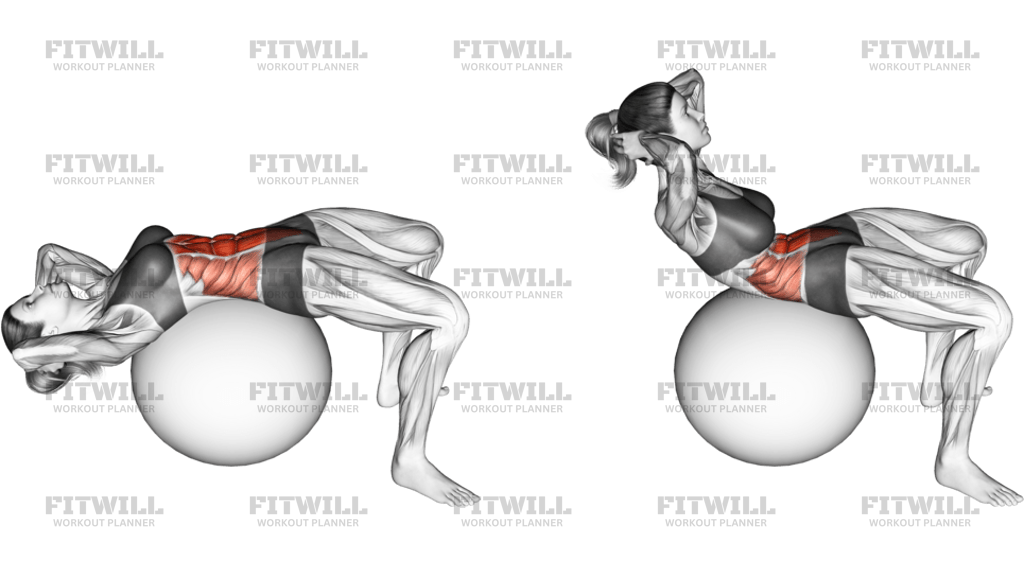
Crunch On Stability Ball is a bodyweight core exercise built around one simple idea: let the ball support your upper back, then curl your ribcage toward your pelvis without turning the rep into a neck pull or hip drive. The unstable surface increases the demand on the abs to organize the trunk, so the exercise is useful for people who want a more controlled crunch than they get from the floor. It also gives a larger stretch position than a standard crunch, which is one reason it can feel more challenging even without added load.
This movement mainly trains the rectus abdominis, with the deeper core muscles and hip stabilizers helping keep the torso centered on the ball. Because the body is partially supported, the exercise can teach cleaner spinal flexion and better control of the ribs and pelvis than fast, short-range crunching on the floor. Crunch On Stability Ball is especially useful in accessory work, warmups, or core-focused sessions where the goal is tension and precision rather than speed.
The setup matters more here than on many ab exercises. If the ball sits too high under the back, the neck and hips tend to dominate; if it sits too low, the rep can feel unstable and rushed. Start with your feet flat on the floor, knees bent, and the ball supporting the upper to mid-back so your torso can open slightly over it. Keep the chin gently tucked and the elbows wide, then let the spine extend only as far as you can still control the return.
Each rep should start from a long, supported position and finish with the ribs closing toward the front of the pelvis. Exhale as you curl up, lift the shoulder blades off the ball, and think about bringing the sternum toward the navel rather than throwing the chest forward. Lower slowly until the abs are lengthened again, but stop before the low back loses control or the ball shifts under you. A smooth tempo is more valuable than a big range.
Crunch On Stability Ball works well for beginners, but only if the ball size and foot position make the setup stable. It is also useful for intermediate lifters who want a core exercise that is easy to load with a light plate or med ball later on. Keep the movement strict, stop the set when the neck starts helping, and use the exercise to train the abs to shorten and control the trunk through a clean, repeatable arc.
[ Workout Log & Planner ]
Put your next workout in Fitwill
Keep your plan and training log ready when you are.


Instructions
- Sit on the stability ball and walk your feet forward until the ball supports your upper to mid-back, with your feet flat and about hip-width apart.
- Place your hands lightly behind your head or at your temples, and keep your elbows open so you do not tug on your neck.
- Let your torso lean back over the ball until your abs are lengthened, but keep your feet planted and your hips steady.
- Exhale and curl your ribs toward your pelvis, lifting your shoulder blades off the ball without driving your hips forward.
- Keep your chin slightly tucked as you rise so the neck stays long and relaxed.
- Pause briefly at the top when your abs are fully shortened and your lower ribs have closed in front.
- Lower yourself slowly back over the ball until the torso is stretched again, maintaining control instead of dropping into the bottom.
- Reset your feet if the ball rolls, then repeat for the planned number of reps and step off carefully at the end.
Tips & Tricks
- Keep the ball under your upper to mid-back, not your neck, or the rep quickly turns into a head-and-neck movement.
- Think about bringing your sternum toward your navel rather than reaching your elbows toward your knees.
- If your hip flexors take over, widen your stance slightly and reduce how far you lean back over the ball.
- Use a slower lowering phase so the ball stays stable and the abs keep tension through the full arc.
- Do not let your low back collapse off the ball at the bottom; stay supported and move from the ribs.
- Hands behind the head are only a cradle, not a pull, so keep the fingertips light and the elbows open.
- A smaller crunch is better than a bigger one if your lower ribs flare or your chin juts forward.
- If the ball feels slippery, place your feet a little farther forward so your shins stay closer to vertical.
Frequently Asked Questions
What does Crunch On Stability Ball work most?
It mainly targets the rectus abdominis, with the deeper core muscles and hip stabilizers helping you stay balanced on the ball.
How is Crunch On Stability Ball different from a floor crunch?
The ball gives you more range of motion and adds an element of balance, so the abs have to control both the curl and the return more carefully.
Where should the stability ball sit for Crunch On Stability Ball?
It should sit under your upper to mid-back so your torso can open over it while your feet stay firmly planted on the floor.
Should I pull on my head during Crunch On Stability Ball?
No. Keep your hands light and let the abs lift the ribcage; pulling on the head usually shortens the neck and reduces the crunch.
Is Crunch On Stability Ball good for beginners?
Yes, as long as the ball size and foot position make the setup stable. Beginners should keep the range small and the tempo slow.
Why do my hips or hip flexors feel busy in this exercise?
That usually means the ball is too low or the lean-back position is too aggressive. Bring the ball slightly higher on the back and shorten the range.
How high should I come up on Crunch On Stability Ball?
Only high enough to lift the shoulder blades off the ball and fully shorten the abs. You do not need to sit all the way upright.
Can I add weight to Crunch On Stability Ball?
Yes, but only after you can keep the ball stable and the neck quiet. A small plate or medicine ball held at the chest is usually enough.