Hip Circle With Hula Hoop
Hip Circle With Hula Hoop is a standing coordination and core-control drill where the hoop travels around the waist while the pelvis traces a smooth, continuous circle. The goal is not to force a big twist through the spine; it is to keep the hoop moving with small, repeatable hip actions while the trunk stays stacked and relaxed. That makes the exercise useful for warm-ups, conditioning circuits, and anyone who wants a light but focused core challenge.
This movement mainly asks the waist, hips, and deep core to work together. The obliques, transverse abdominis, glutes, and hip stabilizers help keep the hoop level and prevent the torso from wobbling side to side. Because the task is rhythmic rather than heavy, clean mechanics matter more than speed. A smooth circle usually feels better than a jerky twist.
Set the hoop around the midsection, stand with feet about hip-width apart, and soften the knees so the pelvis can move freely. Keep the ribs over the pelvis, avoid arching the lower back, and lightly brace before you start the first spin. If the hoop sits too high or too low, it will change the feel immediately, so adjust the placement until it rotates around the waist without pinching the ribs or catching the hips.
Once the hoop is moving, guide it with controlled circles from the waist and hips instead of throwing the chest forward or swinging the shoulders. The movement should look subtle from the outside: enough shift to keep the hoop alive, but not so much that the torso drifts or the feet scramble. Breathe steadily, keep the neck loose, and if the hoop starts to fall, reset and start again rather than chasing it with bigger, sloppy circles.
Hip Circle With Hula Hoop fits well as a low-impact cardio option, a playful warm-up, or a coordination drill between heavier strength sets. It can be beginner-friendly with a larger hoop and a slower pace, but it still rewards patience and body awareness. If your lower back takes over or the hoop keeps riding up toward the ribs, reduce the tempo, use a bigger hoop, and return to a smaller, more controlled waist circle.
[ Workout Log & Planner ]
Put your next workout in Fitwill
Keep your plan and training log ready when you are.


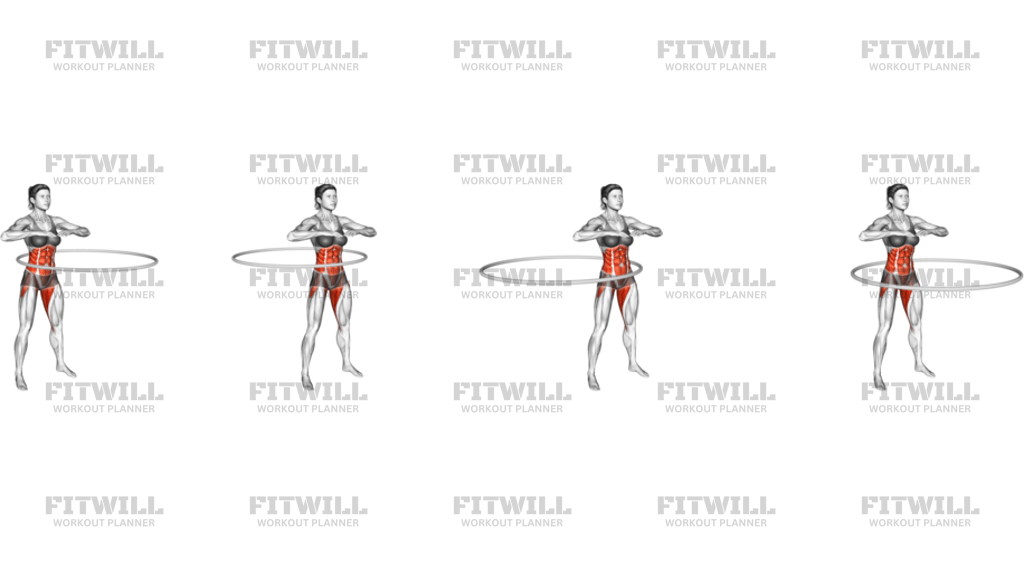
Instructions
- Stand in a clear space and place the hoop around your waist with your feet about hip-width apart.
- Soften your knees, stack your ribs over your pelvis, and hold your arms lightly in front of your chest for balance.
- Give the hoop one controlled push so it begins spinning around your waist.
- Trace small circles with your hips and waist to keep the hoop level instead of twisting hard through your spine.
- Keep your weight centered over midfoot and let your knees absorb the rhythm of the motion.
- Breathe in a steady pattern and keep your shoulders, jaw, and neck relaxed while the hoop moves.
- If the hoop starts to slide, slow the motion, re-center your posture, and restart the circle before it drops.
- Continue for the planned time or repetitions, then slow the hoop and catch it safely before stepping out.
Tips & Tricks
- A larger hoop is easier to control; a smaller hoop needs faster, more precise circles.
- If the hoop climbs toward your ribs, you are usually leaning back or over-twisting the chest.
- If it drops toward your hips, your waist circle is too small or too slow for the hoop size.
- Keep the movement below the ribcage; the spine should stay tall instead of folding or side-bending.
- A slight knee bend makes it easier to keep the hoop moving without bouncing.
- Try each direction separately; one side often feels smoother than the other.
- Use the lightest, smoothest pace that keeps the hoop alive for the full interval.
- Stop the set if you start chasing the hoop with your shoulders or taking big steps.
Frequently Asked Questions
What muscles does Hip Circle With Hula Hoop work?
It works the waist, deep core, obliques, and hip stabilizers, with the glutes helping control the pelvic circle.
How do I keep the hoop from falling?
Keep the hoop level with small, steady waist circles and a soft knee bend. If it drops, reset and restart rather than chasing it with your shoulders.
Should my feet stay planted during Hip Circle With Hula Hoop?
Mostly yes. Small weight shifts are fine, but if you are stepping around a lot, the hoop is probably too fast or the torso is overworking.
Is Hip Circle With Hula Hoop a good beginner exercise?
Yes, especially with a larger hoop and a slower rhythm. It is easier to learn when you keep the movement small and stay upright.
Do I need to twist my torso a lot?
No. The hoop should move from a controlled waist and hip circle, not from big chest rotation or an exaggerated lower-back arch.
Can I switch directions during the set?
Yes. Many people find one direction smoother than the other, so it makes sense to train both sides separately.
Is this more of a cardio drill or a core drill?
It can be both. Use a longer, steady interval for cardio or a shorter, more controlled set if you want to emphasize waist and hip control.
What size hoop should I use?
A larger hoop is usually easier because it moves more slowly and gives you more time to keep the circle going. Smaller hoops demand tighter, faster control.