Barbell Overhead Carry
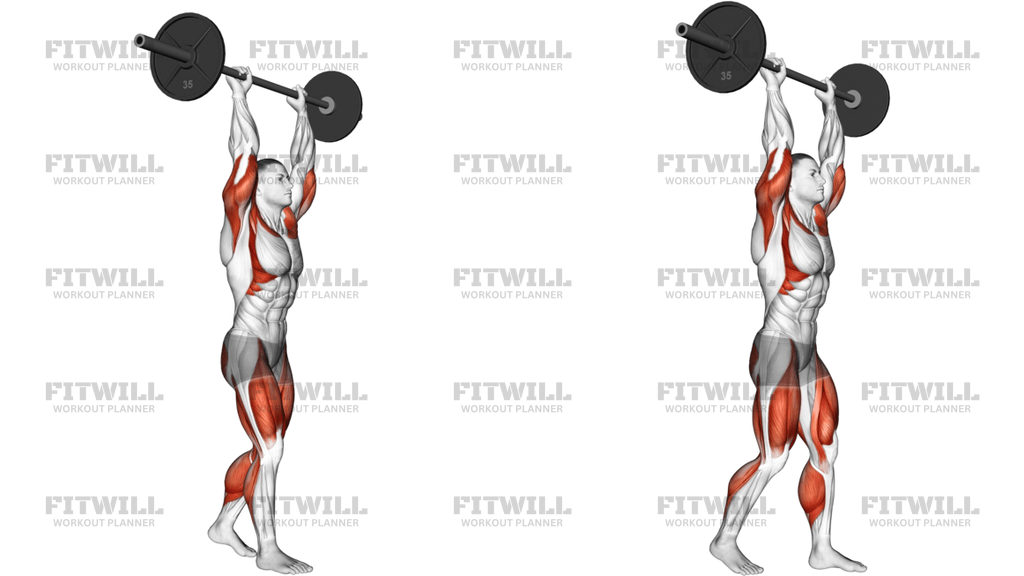
Barbell Overhead Carry is a loaded carry performed with the barbell fixed overhead while you walk under control. It challenges shoulder stability, trunk stiffness, grip, and whole-body coordination because every step has to keep the bar stacked over the midfoot. The exercise looks simple, but the quality of each rep depends on how well you control the press-out position, rib cage, and walking pattern.
The setup matters more here than in many barbell drills. If the bar starts slightly behind the head, with the elbows locked and the wrists stacked over the shoulders, the carry feels steady. If the ribs flare or the lower back arches, the bar drifts forward and the shoulders have to chase the weight. A clean start from a rack or a controlled clean to overhead lets you organize the body before the walk begins.
As you move, the goal is not distance or speed. Take short, deliberate steps and keep the torso tall while the bar stays directly above the shoulder line. The shoulders should stay active without turning the movement into a shrugging contest, and the neck should stay relaxed so you can breathe and maintain position. The carry becomes much harder when you overstride, twist, or let one side of the body collapse.
This exercise is useful for overhead strength, core control, and athletic bracing. It also exposes weak links quickly, especially in the shoulders, midsection, and upper back, so light to moderate loads are often more productive than heavy ones. Use it as an accessory lift, a warm-up carry, or a conditioning drill when you want a demanding overhead pattern without repeated pressing.
Treat every turn and stop with the same control as the walk itself. If the elbows bend, the bar drifts forward, or the trunk starts leaning, the set is already too heavy or too long. A well-executed overhead carry should finish with the bar still stable overhead and the body able to lower it under control, not by dumping the weight or losing position.
Fitwill
Log Workouts, Track Progress & Build Strength.
Achieve more with Fitwill: explore over 9600 exercises with images and videos, access built-in and custom workouts, perfect for both gym and home sessions, and see real results.
Start your journey. Download today!




Instructions
- Set the bar in a rack at about shoulder height, step under it, and take a grip just outside shoulder width.
- Rack the bar across the upper chest and front delts, then brace and press it overhead to full elbow lockout.
- Stack wrists over elbows and shoulders, keep the ribs down, and set the feet about hip-width apart.
- Check that the bar sits slightly behind the head and directly over the midfoot before you move.
- Walk forward with short, even steps while keeping the torso tall and the bar path vertical.
- Keep the glutes lightly on and avoid leaning back, twisting, or letting one shoulder drift lower than the other.
- Breathe in under control as you walk and use a steady exhale to keep the brace without softening the lockout.
- Stop, stabilize, and lower the bar to the shoulders or rack it once the planned distance or time is complete.
Tips & Tricks
- Choose a load you can keep overhead without any elbow bend or wrist collapse during the full walk.
- If the low back arches, lower the ribs first and squeeze the glutes before you take the first step.
- Keep your steps short so the bar stays stacked instead of drifting in front of the face.
- Think about pushing the bar upward into the ceiling rather than shrugging it hard toward the ears.
- Use a slightly wider grip if your shoulders feel pinched or the bar is hard to balance overhead.
- Keep the feet on a straight path and avoid crossing them; crossing steps usually create unwanted trunk rotation.
- Turn around with small, controlled steps instead of pivoting fast under fatigue.
- End the set as soon as the bar starts to wobble, the elbows soften, or the breathing turns into a loss of posture.
Frequently Asked Questions
What muscles does a Barbell Overhead Carry work?
It strongly challenges the shoulders, triceps, upper back, core, grip, and the legs that keep you walking steadily under the bar.
Is this mainly a carry or a press?
It is primarily a carry. The press is just the way to get the bar into the locked-out overhead position before you walk.
How far should I walk with the bar overhead?
Short, controlled distances work best. If the bar starts drifting or the torso changes shape, the set is already long enough.
Can beginners do the overhead carry?
Yes, if they can press the bar overhead pain-free and hold a stable lockout with very light weight and short walks.
What is the biggest form mistake?
Letting the ribs flare and the lower back arch so the bar moves in front of the head instead of staying stacked over the midfoot.
Should my elbows stay locked?
Yes. A slight elbow bend turns the carry into a less stable hold and usually means the load is too heavy for clean overhead position.
Can I substitute dumbbells or kettlebells?
Yes, those are common alternatives if you want the same overhead carry pattern with a simpler setup or less shoulder demand.
What should I do if my shoulders feel cramped overhead?
Widen the grip slightly, reduce the load, and make sure the bar is just behind the head rather than pressing forward into the face.