Hands Reversed Clasped Circular Toe Touch
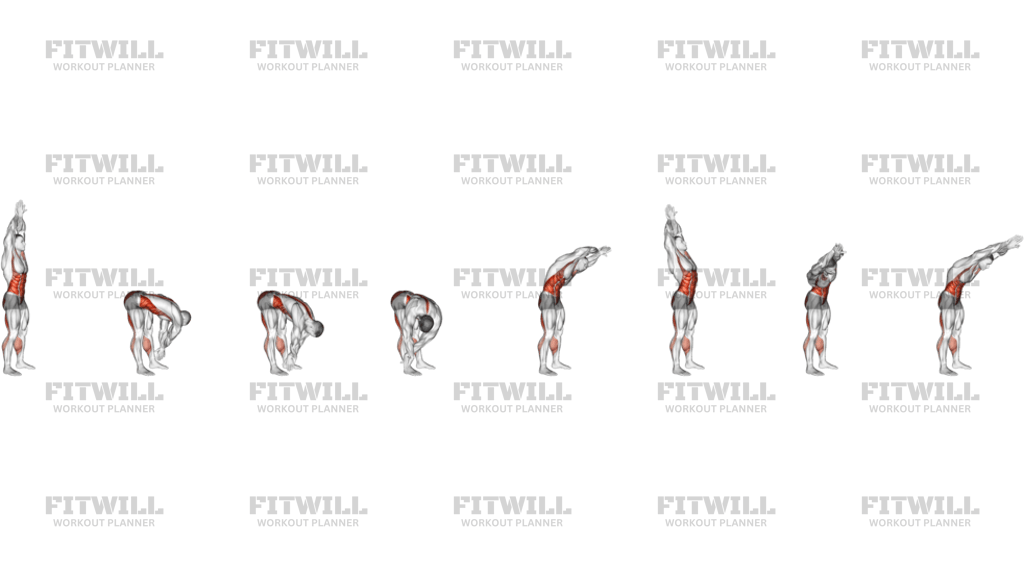
Hands Reversed Clasped Circular Toe Touch is a bodyweight mobility drill that combines a tall overhead reach with a controlled forward fold and circular toe-touch path. The reverse clasp changes the shoulder position, while the circular reach adds a little more control demand through the hips, trunk, and upper back. It is less about speed and more about tracing a smooth pattern that stays organized from the first rep to the last.
The movement mainly challenges the abs and deep core to control the fold, with the obliques and hip flexors assisting as the torso changes angle. The hips and glutes help guide the hinge and keep the descent smooth, while the shoulders and lats stay active to hold the clasped arms in position. In anatomy terms, the focus sits on the rectus abdominis, with support from the external obliques, iliopsoas, and transversus abdominis.
The setup matters because the reverse clasp and overhead reach set the line for the entire rep. Stand tall, keep the feet grounded, and let the ribs stay stacked over the pelvis before you begin the fold. From there, the torso should travel under control rather than collapsing, and the hands should follow a smooth circular path instead of dropping straight down and snapping back up.
When done well, Hands Reversed Clasped Circular Toe Touch works well as a warm-up drill, a mobility reset between harder lifts, or a light core-focused accessory in a circuit. It can help prepare the posterior chain and trunk for squats, deadlifts, lunges, or athletic work that needs cleaner hip movement and better position control. Because the pattern includes a deep forward fold, the rep should stay pain-free and never be forced through the low back.
The best version of this exercise looks calm and deliberate. Keep the neck long, the knees soft, and the breathing steady so the fold stays controlled instead of jerky. If the clasp or the toe touch starts to pull your shoulders forward, shorten the range and keep the circle smaller. The goal is a repeatable mobility pattern that feels smooth, controlled, and easy to repeat without losing posture.
Fitwill
Log Workouts, Track Progress & Build Strength.
Achieve more with Fitwill: explore over 9600 exercises with images and videos, access built-in and custom workouts, perfect for both gym and home sessions, and see real results.
Start your journey. Download today!




Instructions
- Stand tall with your feet about hip-width apart and clasp your hands in a reverse grip so your palms face away from you.
- Press your arms overhead, keep your ribs stacked over your pelvis, and soften your knees just enough to protect the lower back.
- Take a breath in, then hinge at the hips and start folding forward while keeping the clasped arms long.
- Let your torso travel down in a smooth arc until your hands reach toward your shins, ankles, or toes without forcing the range.
- Trace a small circular path with your clasped hands around the outside of your legs as you settle into the toe touch.
- Keep your neck relaxed and your weight centered over both feet so the fold stays balanced instead of tipping forward.
- Reverse the circle and roll back up through the spine and hips until you are standing tall again with the arms overhead.
- Exhale as you fold and inhale as you rise, then repeat for the planned number of reps with the same controlled rhythm.
Tips & Tricks
- Keep a slight bend in the knees so the forward fold comes from the hips instead of a hard pull through the low back.
- Make the circle smaller if your shoulders lose the reverse clasp or your upper back starts to round aggressively.
- Think about sending the hips back first, then letting the torso follow, rather than reaching straight down with the hands.
- Touch your shins or ankles if the toes are too far away; forcing the floor usually turns the rep into a back stretch instead of a controlled drill.
- Keep the clasped hands active overhead on the way up so the shoulders do not collapse forward at the top.
- Move slowly enough that you can feel the trunk control the descent and the return instead of using momentum.
- Keep your heels planted if the forward fold makes you rock onto the balls of your feet.
- Use this as a warm-up before lower-body training, not as a max-range hamstring test.
- If you feel pinching in the low back, shorten the range and reduce how far you circle around the toes.
Frequently Asked Questions
What muscles does Hands Reversed Clasped Circular Toe Touch work?
It mainly challenges the abs and deep core, with help from the obliques, hip flexors, and the muscles around the hips and shoulders that control the fold.
Is Hands Reversed Clasped Circular Toe Touch a stretch or an exercise?
It is mostly a mobility drill with a light core-control element. The goal is a smooth forward fold and return, not a strength max.
Why do my hands stay clasped in a reverse grip?
The reverse clasp keeps the shoulders opened up overhead and makes the circular path more demanding. If the clasp feels strained, shorten the reach rather than forcing it.
Should my knees stay straight during Hands Reversed Clasped Circular Toe Touch?
A soft bend is better for most people. Locking the knees tends to pull the movement into the low back and makes the fold less controlled.
How low should I reach in the toe touch?
Reach as low as you can while keeping the spine organized and the movement smooth. Shins or ankles are fine if the toes are not available without rounding hard.
Can beginners do Hands Reversed Clasped Circular Toe Touch?
Yes. Beginners should keep the circle small, bend the knees slightly, and use a shorter range until the fold feels stable and repeatable.
What is the most common mistake with this movement?
People usually rush the fold and turn it into a sloppy toe reach. The better version is a controlled arc down and up with steady breathing.
When should I use Hands Reversed Clasped Circular Toe Touch?
It fits well in a warm-up, a mobility sequence, or light accessory work before lower-body training. It is not meant to be loaded heavily.
Should I feel this more in my hamstrings or core?
You should feel both, but the torso control from the abs and deep core should be obvious throughout the rep. If the hamstrings dominate and the low back tugs, shorten the range.