Hands Clasped Circular Toe Touch
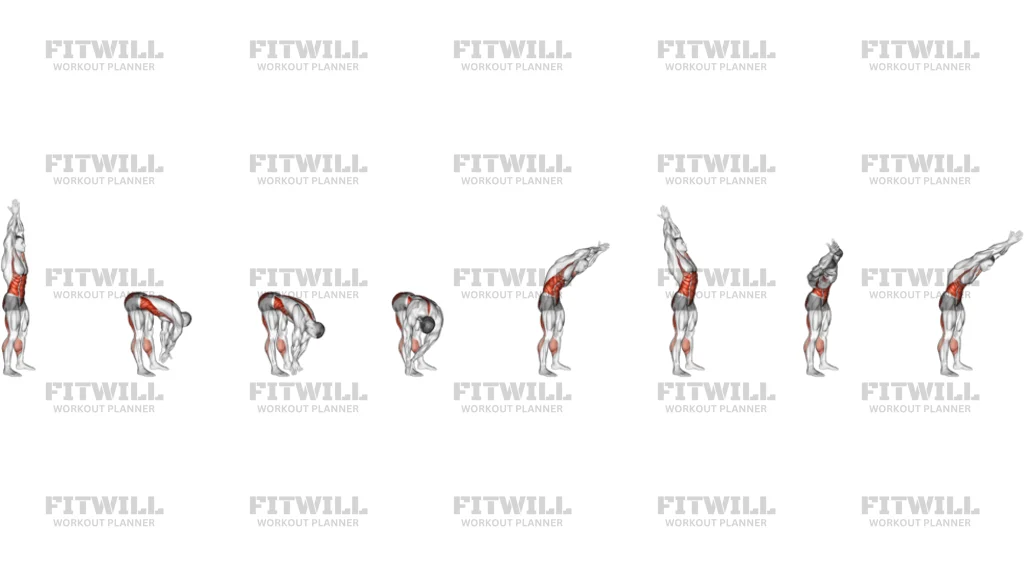
Hands Clasped Circular Toe Touch is a standing bodyweight mobility drill that traces a smooth arc from overhead to the floor and back again. The clasped hands keep the reach long, while the circular path asks the hips, hamstrings, obliques, and deep abdominal muscles to coordinate instead of simply dropping straight down. It is a useful warm-up movement when you want to wake up the posterior chain, open the backs of the legs, and prepare the trunk for hinging or rotation.
The exercise works best when the setup is deliberate. Stand tall with your feet about hip- to shoulder-width apart, clasp your hands overhead, and keep your elbows straight or nearly straight so the arms stay connected to the torso. The first part of the rep is not a dead hang toward the floor; it is a controlled fold from the hips with a soft knee bend and a long spine. That setup keeps the movement clean and prevents the lower back from taking over the entire range.
Each repetition should feel like a continuous circle rather than a quick bounce. Fold toward one foot, travel through the middle, and continue the arc toward the other side before returning upright. The body should stay balanced over the feet, with the weight centered through the mid-foot and heel instead of shifting onto the toes. Breathing matters here: exhale as you fold, keep the trunk organized while you pass through the bottom of the arc, and inhale as you rise back to standing.
Use Hands Clasped Circular Toe Touch as a dynamic warm-up, a mobility reset between harder sets, or a low-intensity core and hamstring drill. It is not meant to be forced into a maximal hamstring stretch. Instead, the goal is repeatable control, a smooth range of motion, and a clear end position on every rep. If the lower back feels pinched or the motion becomes jerky, shorten the circle and keep the knees a little softer until the movement feels fluid again.
Fitwill
Log Workouts, Track Progress & Build Strength.
Achieve more with Fitwill: explore over 9600 exercises with images and videos, access built-in and custom workouts, perfect for both gym and home sessions, and see real results.
Start your journey. Download today!




Instructions
- Stand tall with your feet hip- to shoulder-width apart and clasp your hands overhead.
- Keep your arms long, your ribs stacked over your pelvis, and your knees softly bent.
- Brace lightly, then hinge at the hips to begin the circle toward one foot.
- Reach down under control, letting the torso fold while the spine stays long and the neck relaxed.
- Sweep the reach through the center of your body and continue the arc toward the other side.
- Keep your weight centered through the mid-foot and heel instead of rocking onto your toes.
- Reverse the arc and rise back to standing without bouncing or yanking the arms.
- Exhale as you fold, inhale as you return upright, and reset tall before the next rep.
Tips & Tricks
- Start with a small circle; you can widen the range after the hamstrings and hips warm up.
- Think about folding from the hips first, not collapsing the chest straight toward the floor.
- Keep the clasped hands active overhead so the shoulders stay organized instead of drifting forward.
- A slight knee bend is fine and usually helps protect the lower back on the way down.
- If your fingertips cannot reach the toes without rounding hard, touch the shins or ankles instead.
- Move slowly enough that you can feel the transition from one side of the circle to the other.
- Stop the rep before the low back starts doing the work the hips should be doing.
- Use this as a preparation drill, not a max-stretch contest at the bottom of the rep.
Frequently Asked Questions
What does Hands Clasped Circular Toe Touch work?
It emphasizes the hamstrings, hips, obliques, and rectus abdominis while also training balance and trunk control.
Is this more of a stretch or a strengthening exercise?
It is mainly a dynamic mobility drill with a light active-core demand rather than a strength lift.
How should my feet be positioned?
A hip-width or slightly wider stance usually works best because it gives room for the circular fold without losing balance.
Do my knees have to stay straight?
No. A soft bend is usually better than locking the knees, especially if your hamstrings are tight.
Where should I feel the movement most?
You should feel a stretch and controlled load through the backs of the legs, hips, and side body, not a sharp pull in the low back.
What is the most common mistake with this drill?
Rushing the circle and swinging through the bottom usually turns it into momentum instead of controlled mobility.
Can beginners do this exercise safely?
Yes, as long as they keep the range small, bend the knees slightly, and avoid forcing the hands to the floor.
When is the best time to use it?
It fits well in a warm-up, between lower-body sets, or before exercises that need hip hinging and trunk control.