Standing Alternate Arms Circling _shoulders
Standing Alternate Arms Circling _shoulders is a bodyweight shoulder mobility drill built around slow, alternating arm circles while you stay tall and quiet through the torso. It is less about loading the muscles and more about creating clean, repeatable motion through the shoulders, upper back, and trunk. That makes it useful before pressing, overhead work, throwing, or any session where the shoulders need to move smoothly without feeling jammed up.
The exercise works best when the body stays stacked and the circle comes from the shoulder joint instead of the lower back or rib cage. Stand with your feet set under you, knees soft, and your pelvis and ribs aligned so the arms can move freely. When the posture is organized first, the arms can sweep through a bigger arc without the neck tightening or the shoulders shrugging upward.
Each repetition should feel like one arm is drawing a controlled circle while the other arm resets and then takes over. Keep the motion smooth, with the hand traveling forward, overhead, and back down in a way that feels natural for the shoulder. The goal is to keep the circle clean, not to force a huge range or speed through the movement, because fast circles usually turn into swinging.
This drill is especially useful as part of a warm-up for bench press, overhead pressing, pull work, or general shoulder preparation. It can also work as a light recovery drill between harder sets when you want to keep the shoulders moving without fatigue. If the front of the shoulder pinches or the neck starts working harder than the shoulder, shorten the circle and slow the pace until the motion feels smooth again.
Because this is a bodyweight coordination and mobility pattern, the main quality marker is control. Breathing should stay easy, the chest should stay relaxed, and the neck should remain long rather than tense. When the repetition looks tidy and feels effortless, you are getting the most out of the exercise; when it looks rushed or jerky, the circle is too large or the tempo is too fast.
[ Workout Log & Planner ]
Put your next workout in Fitwill
Keep your plan and training log ready when you are.


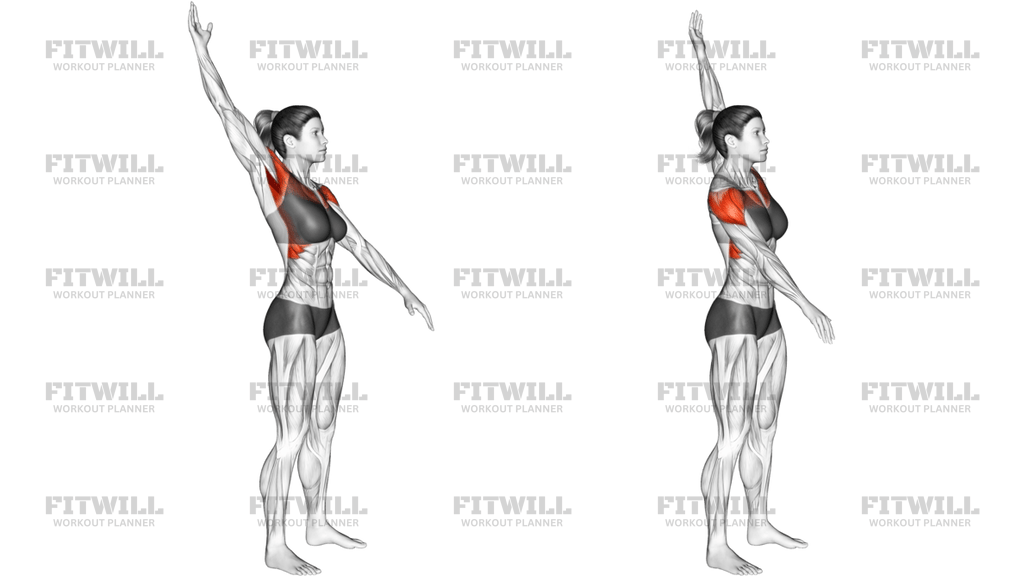
Instructions
- Stand tall with your feet about hip-width apart, arms relaxed by your sides, and your chin level.
- Soften your knees and stack your ribs over your pelvis so your torso stays quiet while your arms move.
- Let one arm begin a smooth circle by sweeping forward and up while the opposite arm stays relaxed and lower.
- Reach the moving arm overhead without leaning to the side or shrugging the shoulder toward your ear.
- Continue the arc behind and down so the shoulder makes a smooth, controlled circle instead of a jerky swing.
- As the first arm finishes, start the other arm through the same path so the circles alternate side to side.
- Keep the circles small at first, then widen them only if the shoulders stay smooth and pain-free.
- Breathe steadily through the drill and keep the neck long, stopping if the front of the shoulder pinches.
- Finish with both arms at your sides and reset before the next repetition or set.
Tips & Tricks
- Keep the circles slow enough that your ribs and pelvis stay stacked instead of twisting.
- A smaller arc is better if the shoulder feels pinched near the top of the circle.
- Let the hands stay relaxed; gripping hard often makes the neck and upper traps take over.
- If one shoulder is stiffer, give that side a shorter circle instead of forcing both sides to match.
- Do not swing the arm from the low back or rib cage; the shoulder should be doing the work.
- A soft elbow is fine if it helps the circle stay smooth, especially during the overhead portion.
- Use this as preparation before pressing or pulling, not as a fatigue-heavy conditioning drill.
- If the motion gets jerky, slow down before you make the circle larger.
Frequently Asked Questions
What does Standing Alternate Arms Circling _shoulders work?
It mainly trains the shoulders and the muscles that control the shoulder blade, with the upper back and core helping keep the torso steady.
Is Standing Alternate Arms Circling _shoulders a good warm-up?
Yes. It fits well before bench press, overhead press, rows, or any session where you want the shoulders moving smoothly before heavier work.
Should my arm circle be big or small?
Start small and only make it bigger if the shoulder stays smooth and pain-free. A controlled arc is more useful than a dramatic one.
Why do I feel this in my neck?
Usually the shoulder is shrugging or the motion is too fast. Drop the circle size, keep the ribs down, and let the arm move without lifting the shoulder toward the ear.
Can beginners do Standing Alternate Arms Circling _shoulders?
Yes. It is beginner-friendly because it is bodyweight and low impact, as long as the circles stay slow and controlled.
What should I do if one shoulder feels tighter than the other?
Use a smaller circle on the tighter side and keep the pace slow. Do not force both arms to match if one side is clearly restricted.
Do I need weights for this exercise?
No. This version is a bodyweight mobility drill, and adding load usually makes it harder to keep the shoulder path clean.
What is the most common mistake with Standing Alternate Arms Circling _shoulders?
Rushing the circles and turning them into swings. Keep the torso still and make each arm trace a smooth path instead.