Barbell Curl
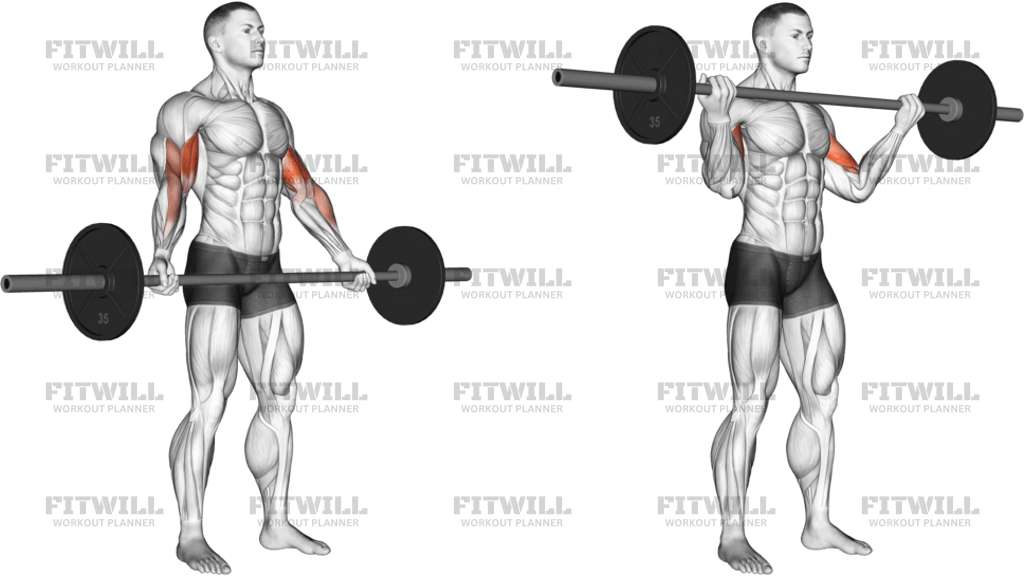
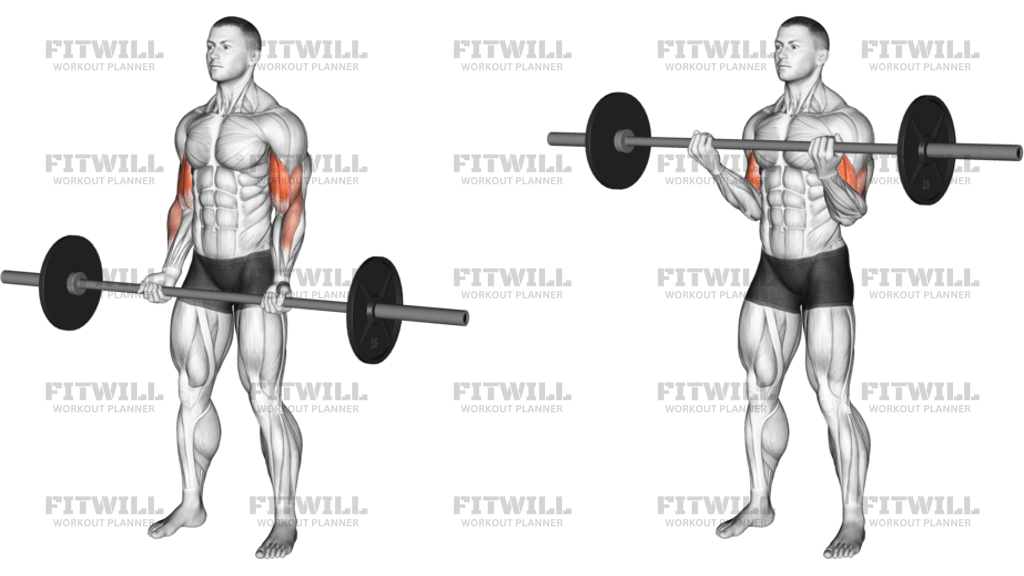
Barbell Curl is a strict standing arm exercise built around elbow flexion against a straight bar. In the image, the lifter stands tall with an underhand grip, the bar starting at thigh level and rising in a close, controlled path toward the upper torso. That simple setup makes it easy to see what the movement is really training: the biceps do most of the work, while the brachialis, brachioradialis, and forearm flexors help stabilize the forearm and control the bar.
Because the load is balanced across both hands, Barbell Curl is useful when you want to keep tension consistent and compare left-right effort without the extra stability demands of separate dumbbells. The exercise is most effective when the torso stays quiet and the elbows remain close to the sides. Once the shoulders start swinging forward or the lower back starts helping the bar rise, the movement stops being a curl and becomes a full-body heave.
The setup matters just as much as the lift. A shoulder-width underhand grip usually gives the cleanest line of pull, with the wrists stacked over the forearms and the rib cage kept down. From there, the bar should travel close to the body, the elbows should bend without drifting wildly forward, and the rep should finish when the forearms are nearly vertical and the biceps are fully shortened without shrugging the shoulders.
A good repetition is smooth on the way up and even more controlled on the way down. Lower the bar until the arms are fully extended or just short of lockout if your elbows prefer it, then reset before the next curl. Breathing should stay simple: brace before the pull, exhale through the hard part of the lift, and inhale on the descent. If you need to lean back, kick the hips, or bend the wrists hard to finish reps, the load is too heavy for strict work.
Use Barbell Curl as accessory work after compound lifts, in an arm-focused session, or anywhere you want direct biceps loading with a clear technique standard. It is a straightforward exercise for beginners to learn, but it rewards precision more than load. Keep the motion honest, keep the bar path close, and treat each repetition as a controlled elbow bend rather than a momentum-driven swing.
[ Workout Log & Planner ]
Put your next workout in Fitwill
Keep your plan and training log ready when you are.


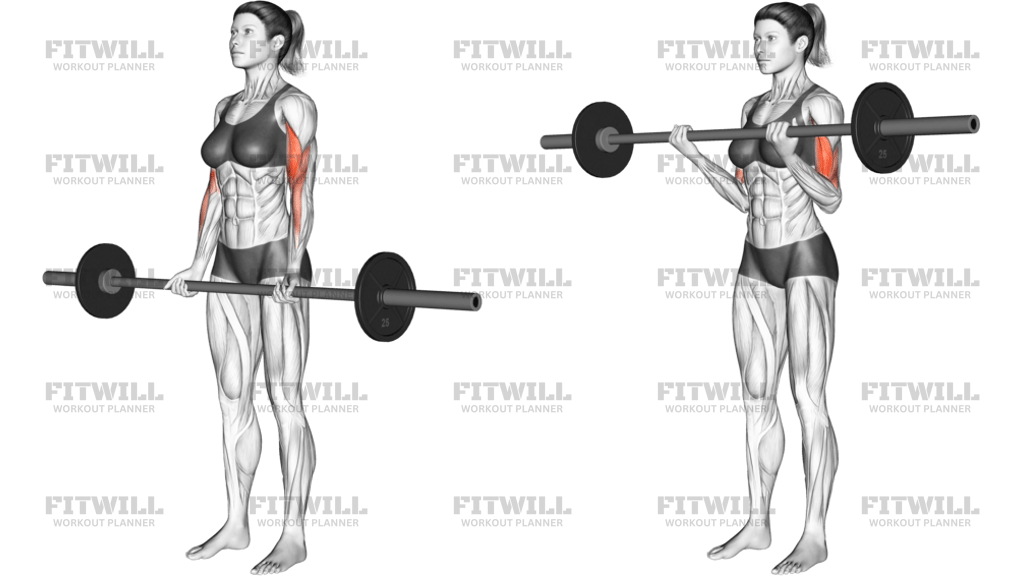
Instructions
- Stand tall with your feet about hip-width apart and hold the bar at thigh level with an underhand grip roughly shoulder-width apart.
- Stack your wrists over your forearms, let your arms hang straight, and keep the bar close to the front of your thighs before the first rep.
- Brace your torso, keep your chest lifted without leaning back, and pin your upper arms near your sides.
- Curl the bar by bending only at the elbows, letting the bar travel upward close to your body.
- Keep your elbows from drifting far forward and avoid shrugging your shoulders as the bar rises.
- Finish the rep when the bar reaches upper-chest height and your forearms are nearly vertical.
- Squeeze the biceps briefly at the top without bouncing or tipping the torso backward.
- Lower the bar slowly until your arms are straight again, then reset your stance and breathing before the next rep.
Tips & Tricks
- Choose a load that lets you keep the torso still from the first rep to the last; if you have to rock backward, it is too heavy.
- Keep your wrists neutral instead of letting them bend back as the bar climbs, especially near the top of the curl.
- A shoulder-width grip usually keeps the forearms in a strong line; a much wider grip tends to shorten the range and stress the wrists more.
- Think about pulling the bar toward your lower chest rather than just lifting it straight up with the hands.
- Lower the bar for about two to three seconds so the biceps stay loaded through the descent.
- If your elbows feel irritated, stop the lowering phase just short of a fully locked elbow and keep tension in the arms.
- Keep the neck relaxed and the chin neutral; looking up or forward hard often turns into upper-body compensation.
- End the set when the bar starts moving because of shoulder swing instead of elbow flexion.
Frequently Asked Questions
What muscles does Barbell Curl train most?
The biceps are the primary target, with the brachialis, brachioradialis, and forearm flexors helping to move and stabilize the bar.
What grip should I use on the barbell?
A shoulder-width underhand grip is the standard starting point. It usually gives a strong wrist position and a clean curling path.
How high should the bar come up?
Bring it to about upper-chest height or until your forearms are nearly vertical. Higher usually means the shoulders are taking over.
Should my elbows stay glued to my sides?
Keep them close to your torso and let them move only a little if needed. Big forward drift usually means you are turning the curl into a body swing.
Why do my wrists feel uncomfortable during this lift?
The most common reason is letting the wrists bend backward under load. Keep the knuckles stacked over the forearms and reduce the load if that still feels rough.
Is Barbell Curl better than dumbbell curls?
It is not better, just different. The barbell makes it easier to load both arms evenly, while dumbbells allow each arm to move more independently.
Can beginners do this exercise safely?
Yes. Start with a light bar and strict tempo so you can learn the elbow path before chasing heavier loads.
What is a good substitute if I do not have a barbell?
Dumbbell curls, EZ-bar curls, and cable curls are the closest options and all keep the same basic elbow-flexion pattern.