Dumbbell Zottman Curl
Dumbbell Zottman Curl is a standing dumbbell arm exercise that combines a regular curl on the way up with a pronated lowering phase on the way down. The palms-up ascent loads the biceps hard, while the palms-down descent asks the forearms and brachioradialis to control the weight as it comes back to the start. That change in hand position is what makes the movement distinct from a standard dumbbell curl.
The exercise is useful when you want direct arm work without needing a machine or barbell. It trains the biceps, brachialis, brachioradialis, and forearm flexors together, so it can be a strong accessory choice for lifters who want thicker upper arms and better grip-oriented control. Because the lowering phase is more demanding than it looks, the best results come from a load you can rotate and lower smoothly, not from chasing heavy weight.
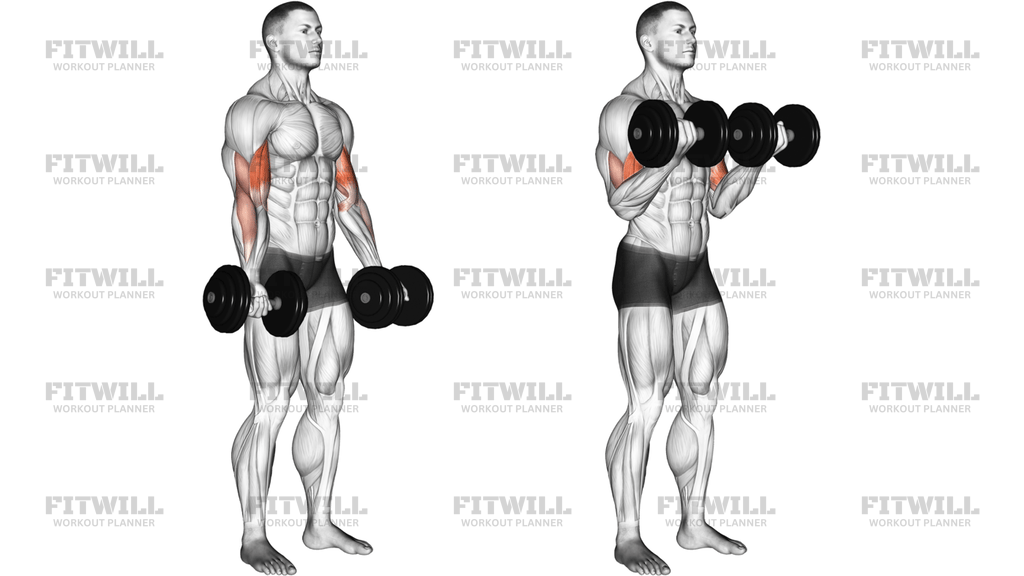
Set up by standing tall with a dumbbell in each hand at your sides, palms facing your thighs, feet about hip-width apart, and ribs stacked over your pelvis. Keep your shoulders down, wrists straight, and elbows close to your torso before the first rep starts. From there, curl the dumbbells up by bending the elbows and begin turning the palms up as the weights rise, letting the forearms rotate naturally instead of forcing the wrist.
At the top, the dumbbells should be near shoulder height with the biceps fully shortened and the upper arms still quiet. Pause briefly, then rotate the palms back down before lowering under control. The descent should feel deliberate and slightly slower than the lift, with the elbows staying close and the torso staying upright so the shoulders do not take over.
Dumbbell Zottman Curl is especially useful as a finishing movement for arm sessions, or as a forearm-focused variation when regular curls stop feeling challenging enough. Keep the motion crisp, the wrist position honest, and the rep quality consistent from side to side. If the rotation, grip, or lowering phase starts to break down, the set is too heavy or too long for the current level of control.
[ Workout Log & Planner ]
Put your next workout in Fitwill
Keep your plan and training log ready when you are.


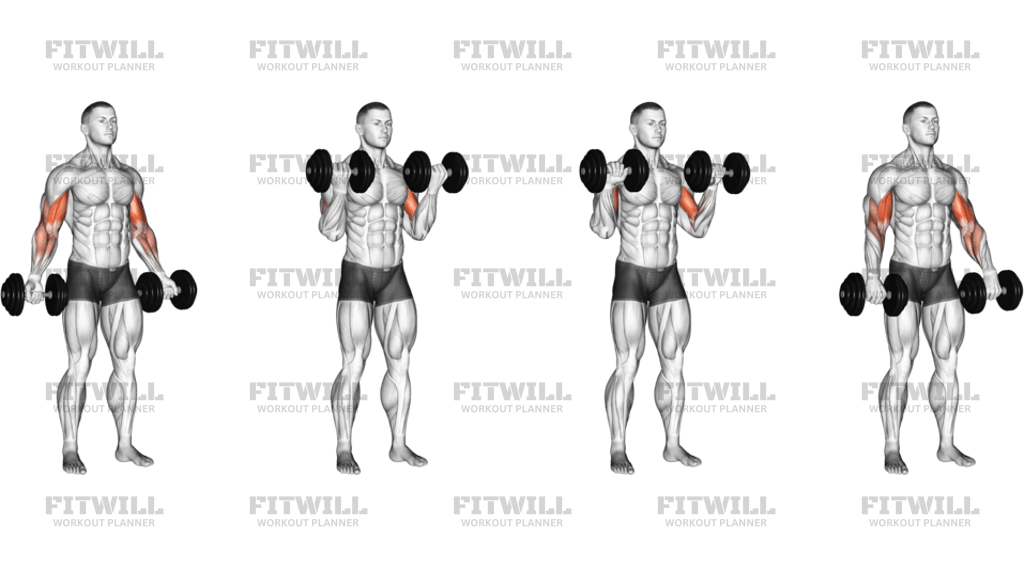
Instructions
- Stand with a dumbbell in each hand at your sides, palms facing your thighs, feet about hip-width apart.
- Stack your ribs over your pelvis, keep your chest tall, and let your shoulders stay down instead of rolling forward.
- Set your elbows close to your ribs and keep your wrists straight before the first rep begins.
- Curl the dumbbells up by bending the elbows and let the palms turn up as the weights rise.
- Keep the upper arms still so the hands travel toward the front of your shoulders instead of swinging forward.
- Pause for a brief squeeze at the top with the palms up and the dumbbells near shoulder height.
- Rotate the palms down before you start the descent so the forearms take the load on the way back down.
- Lower the dumbbells slowly until the elbows are almost straight, then reset the shoulders and repeat for the next rep or set the weights down under control.
Tips & Tricks
- Use lighter dumbbells than you would for a standard curl, because the palms-down lowering phase is the part that usually exposes weak control first.
- Keep the wrists stacked over the forearms; if the dumbbells start to bend your wrists back, the load is too heavy.
- Rotate the palms gradually near the top instead of snapping the wrists over in one fast motion.
- Let the elbows stay close to your sides, because drifting them forward turns the rep into a front-shoulder swing.
- Take at least two seconds on the lowering phase so the brachioradialis and forearms actually have to resist the weight.
- If your torso rocks backward, stand with your back lightly against a wall to keep the curl strict.
- One-arm reps can help if both forearms cramp too early or if one side loses the palm rotation before the other.
- Stop the set when you can no longer control the turn from palms up to palms down without shrugging.
Frequently Asked Questions
What muscles does Dumbbell Zottman Curl work?
Dumbbell Zottman Curl mainly works the biceps, brachialis, brachioradialis, and forearm flexors. The standing position also asks the upper back and core to keep the torso from swinging.
Is Dumbbell Zottman Curl beginner-friendly?
Yes, as long as the dumbbells are light enough to rotate cleanly. Beginners should keep the elbows pinned near the ribs and focus on smooth lowering before trying to load it heavily.
Why do I rotate the dumbbells to palms down on the way down?
That rotation shifts more work to the forearms and brachioradialis during the eccentric phase. It is the part of Dumbbell Zottman Curl that makes the exercise different from a regular curl.
Should my elbows move during Dumbbell Zottman Curl?
They should stay close to your sides with only a small natural hinge at the elbow. If they drift forward, the shoulders and body swing are taking over.
How heavy should the dumbbells be?
Heavy enough to challenge the curl, but light enough that you can rotate and lower without twisting the wrists or leaning back. Most people need less weight here than on a regular dumbbell curl.
Can I do Dumbbell Zottman Curl one arm at a time?
Yes. Single-arm reps can make it easier to keep the rotation clean and notice whether one forearm is fading sooner than the other.
What grip should I use at the bottom?
Start with a neutral grip, palms facing your thighs, then curl up and rotate to palms up as you rise. On the way down, finish with the palms facing down before the dumbbells reach the bottom.
Should Dumbbell Zottman Curl hurt my wrists or elbows?
No. You should feel muscle effort in the arms and forearms, not sharp joint pain or pinching; if the rotation bothers the wrists or elbows, reduce the load or shorten the range.
How is Dumbbell Zottman Curl different from a regular dumbbell curl?
A regular curl stays palms up for the whole rep, while Dumbbell Zottman Curl turns the palms down on the lowering phase. That extra rotation makes the forearms work much harder.
What should I do if I cannot control the palm rotation?
Lower the weight and slow the rep down until the hands can turn without jerking. If the rotation still breaks down, use fewer reps or switch to a standard curl for that session.